A will that doesn’t hold up in probate can leave your family facing costly delays, legal battles, and heartbreak. In St. Augustine and Palatka, FL, we see too many estates derailed because wills failed basic validity checks.
At Family, Estate & Mediation Law, we help families avoid these preventable problems. This guide shows you exactly what makes a will legally sound and what can tear it apart.
Why Wills Get Challenged in St. Augustine and Palatka
Testamentary Capacity Remains the Primary Vulnerability
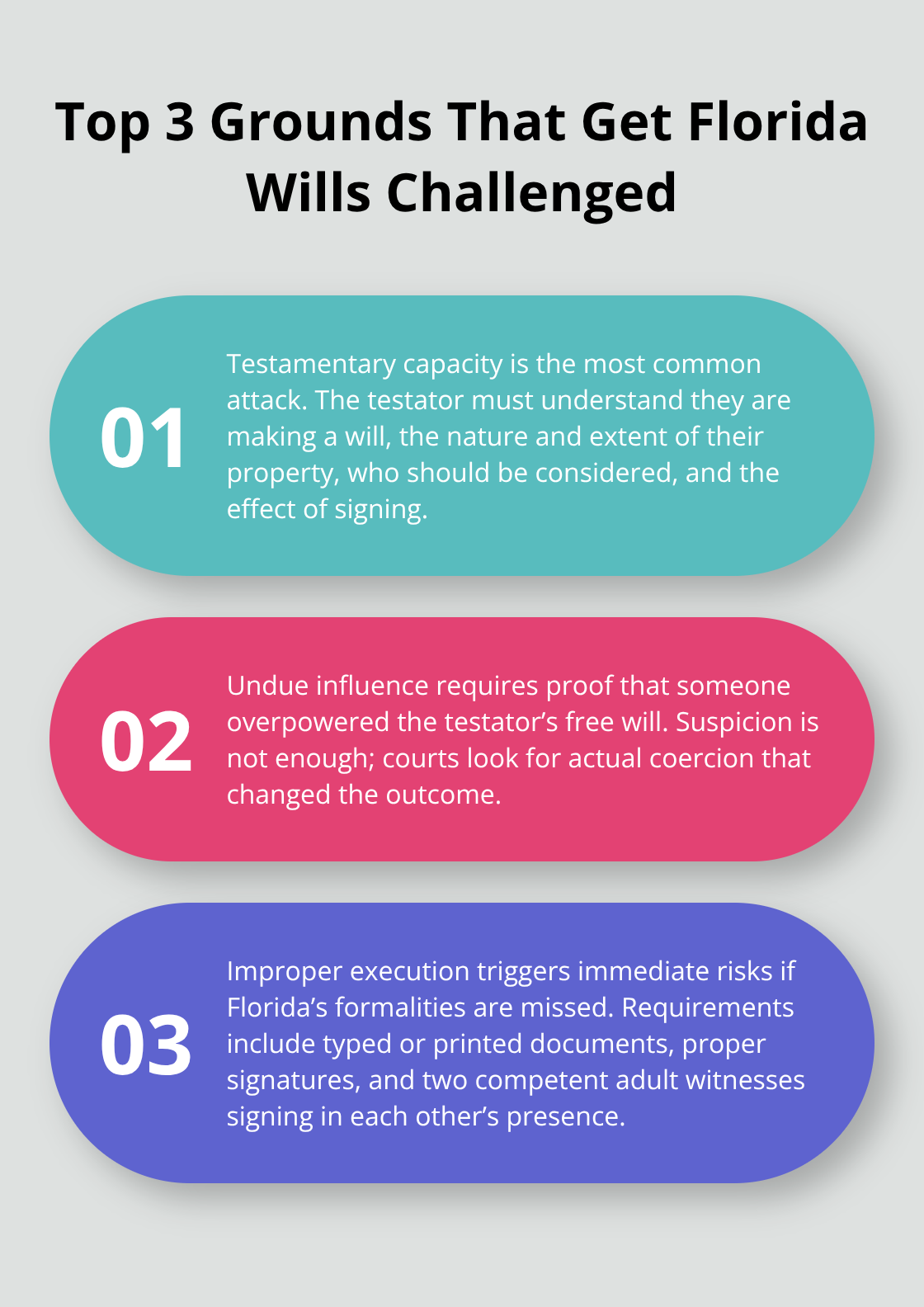
Testamentary capacity stands as the most common ground for challenging a will in Florida. The Banks v Goodfellow test, established in 1869, still governs capacity assessments today. A testator must understand they are making a will, grasp the nature and extent of their property, know who should be considered, and possess sound mind at the time of signing. Capacity is relative to the estate’s complexity. A simple $50,000 estate requires less mental acuity than a $2 million portfolio with multiple properties and business interests.
Medical records become critical evidence in capacity disputes. If your parent showed early signs of dementia or cognitive decline when the will was signed, that creates vulnerability. Courts examine when the will was drafted relative to diagnosis dates. A will signed three months after a dementia diagnosis faces far greater scrutiny than one executed years before symptoms appeared.
Undue Influence and Coercion Present a Higher Burden
Undue influence represents the second major vulnerability, though it is harder to prove than capacity issues. Florida courts require actual coercion or overpowering of the testator’s free will, not merely suspicion. A family member who spent significant time with the deceased before signing, stood to inherit substantially, and isolated the testator from other relatives creates red flags. However, mere influence alone does not invalidate a will. The person challenging it must prove the testator’s free will was genuinely overborne.
Improper Execution Triggers Immediate Invalidation
Improper execution-failing to meet Florida’s formal requirements-presents the third critical risk. Florida demands the will be typed or printed, signed by the testator or someone directed by them in their presence, and witnessed by two competent adults who sign in the testator’s and each other’s presence. Handwritten wills are not recognized in Florida unless they meet strict formalities rarely satisfied.
Self-proving affidavits eliminate many execution disputes by confirming proper signing and witnessing upfront, avoiding costly witness testimony later. These three grounds appear repeatedly in challenged estates across Northeast Florida. Addressing them during drafting prevents years of family conflict and legal expense. Understanding what makes a will vulnerable sets the stage for examining what Florida law actually requires to protect your estate.
What Florida Actually Requires for a Valid Will
Florida’s Core Requirements Are Simple-Execution Details Are Not
Florida’s will requirements are straightforward, but the devil lives in execution details that trip up countless families in St. Augustine and Palatka. The state demands your will be typed or printed, not handwritten. You must sign it at the end, or direct someone else to sign it in your presence if you cannot. Two competent adult witnesses must sign in your presence and in each other’s presence. That is it. No notarization required. No filing needed before your death. Yet we see wills fail validity checks constantly because families skip the self-proving affidavit or use witnesses with conflicts of interest.
Self-Proving Affidavits Eliminate Years of Litigation Risk
A self-proving affidavit is a sworn statement that confirms proper execution and voluntariness upfront, eliminating the need for witnesses to testify later in probate court. Without it, the court may demand witness testimony years after signing, when memories fade and witnesses have moved away. Florida courts have repeatedly upheld self-proving affidavits as the gold standard for avoiding execution disputes. The cost is minimal-typically under $100 when drafted alongside your will-yet it saves thousands in potential litigation.
Precise Language Prevents Court Battles Over Intent
Your language matters just as much as your signature. Vague language like leaving money to my family or giving my belongings to those I love creates ambiguity that leads directly to court battles. Instead, name specific people or organizations and specify exactly what they receive. If you want $50,000 to go to your daughter Sarah and the remainder to your son Michael, write precisely that. If property passes outside your will through named beneficiaries on life insurance, joint ownership, or living trusts, acknowledge those in your will to prevent confusion about what the will actually controls. Courts in Florida examine testamentary intent-your clear, documented desire about who gets what and when. Ambiguous wills shift that burden to judges who must interpret your likely intent based on incomplete evidence.
Neutral Witnesses Protect Against Immediate Challenges
Using neutral witnesses matters far more than most people realize. A neutral witness is someone who stands to gain nothing from your will. If your caregiver, a beneficiary, or a family member in line to inherit signs as a witness, that person’s credibility comes under fire immediately. Some Florida counties see challenges filed solely because a beneficiary witnessed the will, even when the execution was entirely proper. Try finding two witnesses completely unconnected to your estate-a notary public, a bank employee, or a colleague from work. Document the date and location of signing. Keep a brief note about the circumstances. If questions arise years later about your mental state or whether you signed voluntarily, this documentation becomes your strongest defense.
Capacity Documentation Protects Against Future Disputes
Florida law also requires you to be at least 18 years old and of sound mind at the time of signing. Sound mind does not mean perfect memory or youthful energy-it means understanding the nature of your property, knowing who your family members are, and recognizing the effect of the will you are signing. If you have concerns about capacity due to age, medication, or health conditions, schedule the signing with a professional who can document your mental state. An attorney can note observations about your coherence, your understanding of questions, and your ability to articulate your wishes. That documentation becomes invaluable if capacity is later questioned. Moving to Florida or updating an existing will drafted in another state requires formal review. Some out-of-state wills are honored in Florida, but differences in homestead protections, spousal rights, and execution requirements create gaps. An invalid or unclear will triggers Florida intestacy laws, which may exclude intended beneficiaries like unmarried partners or close friends entirely. The cost of addressing these issues upfront is negligible compared to the cost of probate litigation when your will fails validity checks. These execution safeguards form the foundation of a defensible will, yet they address only half the battle-what happens when someone challenges your will despite these protections is where the real complexity emerges.
When a Will Fails Validity Checks in St. Augustine and Palatka
Probate Freezes and Legal Costs Mount Rapidly
When a will fails validity checks, Florida probate courts halt the entire process until validity is resolved. Your estate sits frozen. No assets transfer. No debts get paid. No one receives their inheritance. Meanwhile, legal bills accumulate at alarming rates. Probate attorneys in Florida typically charge $150 to $350 per hour, and validity disputes consume 40 to 60 billable hours before resolution. Court filing fees add another $500 to $2,000 depending on estate size. If your family hires separate counsel to contest the will, those costs multiply dramatically.
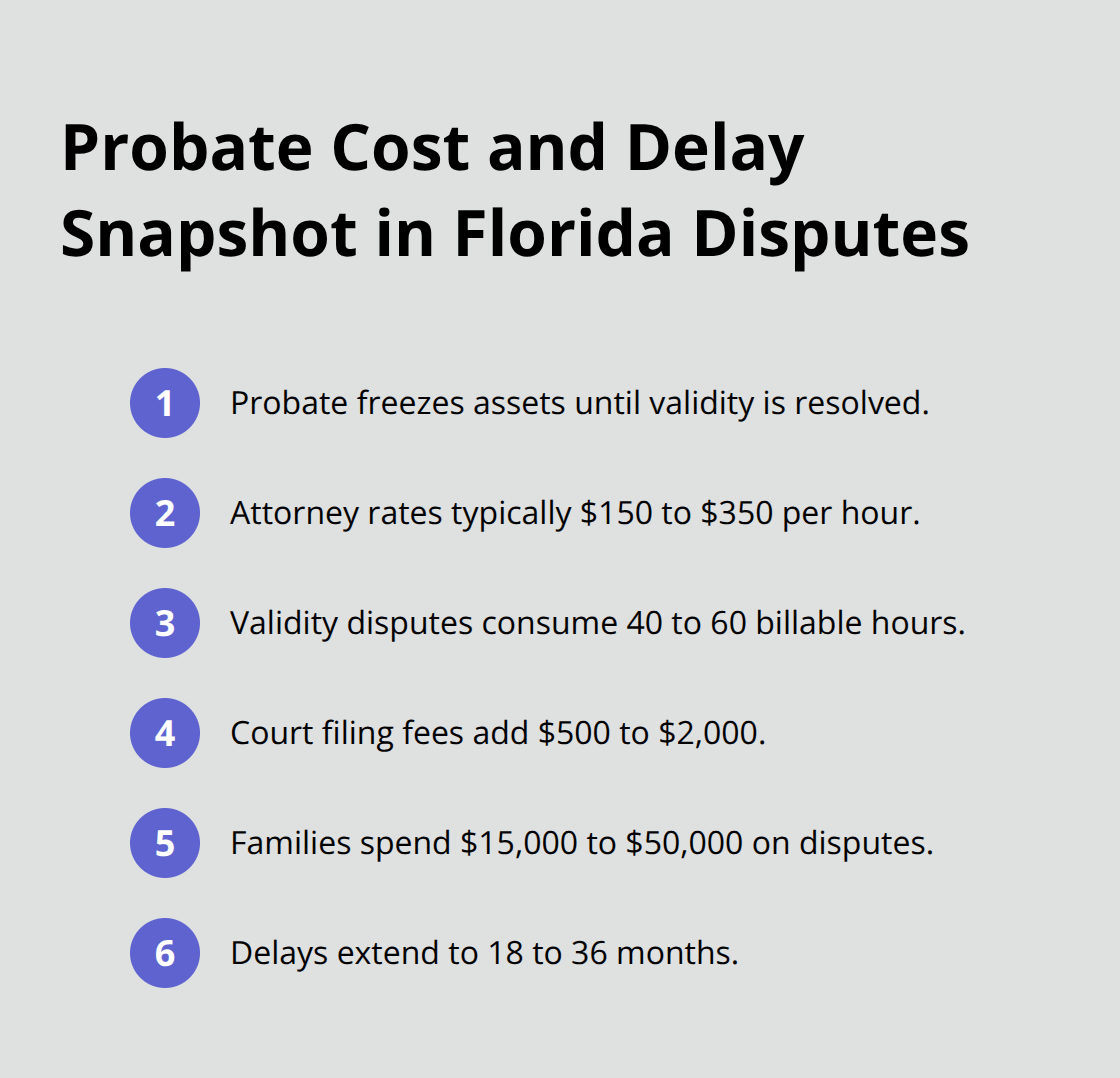
Families spend $15,000 to $50,000 fighting over will validity when the original estate was only worth $200,000. The irony cuts deep: disputes over an invalid will consume resources that should have passed to beneficiaries.
Probate delays stretch from the typical 6 to 12 months to 18 to 36 months when validity is questioned. During this time, your home may sit vacant, rental properties generate no income, and investment accounts remain frozen. Creditors and taxing authorities grow impatient. Beneficiaries who depend on inheritance funds face financial hardship waiting for resolution.
Florida Intestacy Laws Override Your Stated Wishes
When Florida courts determine a will is truly invalid, they don’t create a new one-they apply Florida’s intestacy statutes, which override your stated wishes entirely. If you died married with children, Florida law gives your spouse 50 percent and your children split the remaining 50 percent equally. If you intended to leave everything to your unmarried partner or to charity, that intention vanishes.
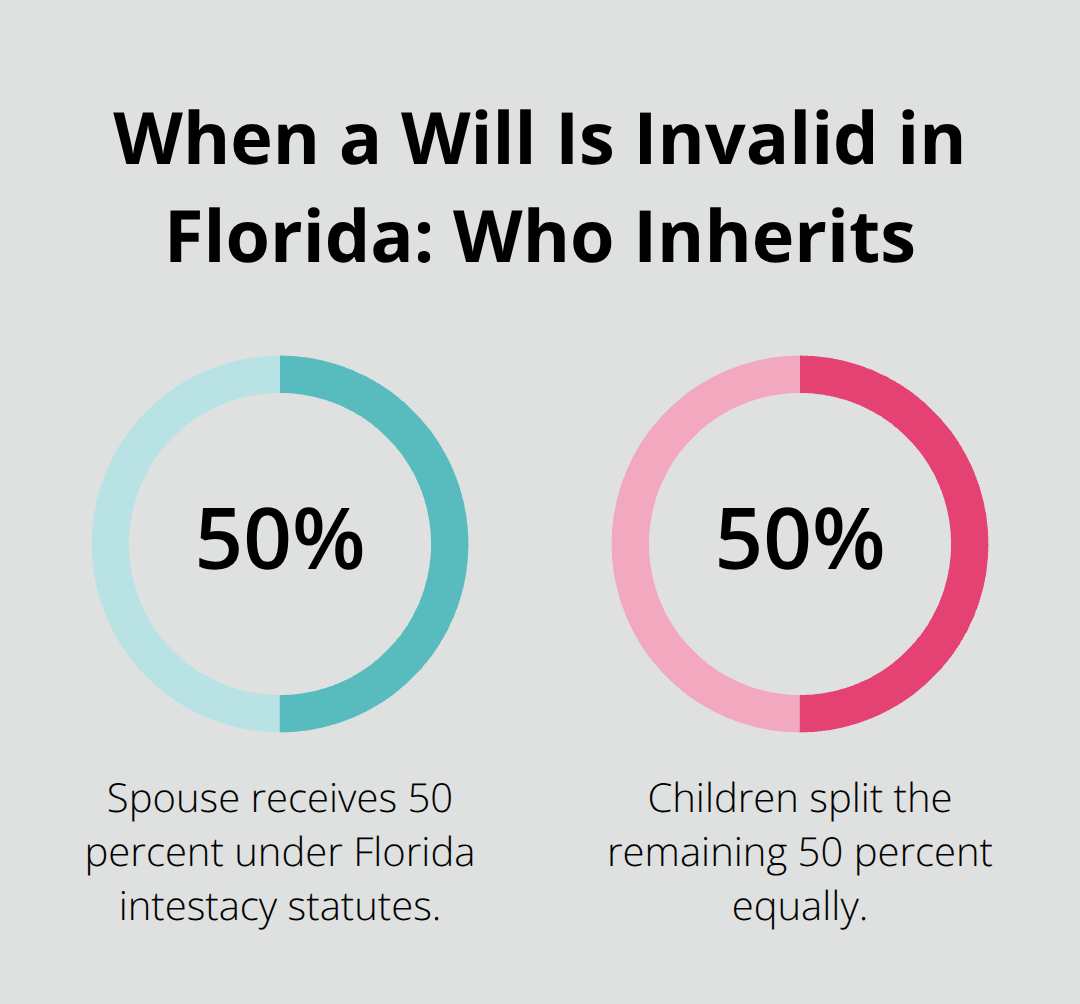
Florida intestacy law recognizes only blood relatives and legal spouses. Close friends, stepchildren, and charitable organizations receive nothing, regardless of your desires.
The distribution order follows rigid priorities: surviving spouse first, then children, then parents, then siblings. This statutory process eliminates your control over who inherits what. The law cares nothing for your personal relationships or charitable commitments-it applies a one-size-fits-all formula that may contradict everything you wanted.
Family Relationships Fracture Under Validity Disputes
An invalid will fractures families in ways that money alone cannot repair. One beneficiary may claim the will was invalid due to undue influence by another beneficiary, triggering accusations and resentment that persist for years. Siblings who felt excluded by your stated wishes suddenly have grounds to fight, knowing intestacy laws might favor them differently. Validity disputes rarely settle quickly or amicably. They generate discovery disputes, depositions, expert witness testimony about your mental state, and courtroom trials. Your family members testify against each other. Medical records get scrutinized publicly. The deceased’s mental competency becomes a matter of court record. These disputes transform private family matters into public legal proceedings where judges and juries examine intimate details of your life and relationships.
Final Thoughts
A will that passes validity checks protects your family from years of conflict and legal expense. The steps outlined in this guide-proper execution, neutral witnesses, clear language, and capacity documentation-form the foundation of a defensible estate plan. We at Family, Estate & Mediation Law understand these risks because we see them play out repeatedly in Northeast Florida estates, and our role is straightforward: help you build a will that withstands scrutiny and reflects your actual wishes with precision.
Taking action now costs far less than defending an invalid will later. We document your capacity, guide you through proper execution, ensure your language is unambiguous, and create the self-proving affidavits that eliminate future disputes. We also review out-of-state wills and update existing plans when life changes demand it.
Schedule a consultation with Family, Estate & Mediation Law to review your current will or draft a new one that holds up in probate. Your will should reflect your values and your choices-not Florida’s default rules or a judge’s interpretation of your unclear intent.