
What happens if something unexpected occurs and you’re unable to care for your children? Preneed guardianship basics give you control over who raises them and how their lives unfold.
At Family, Estate & Mediation Law, we help families in St. Augustine and Palatka, FL establish clear guardianship plans before they’re needed. This guide walks you through what preneed guardianship is, how to set it up, and why it matters for your family’s security.
What Preneed Guardianship Actually Does
Preneed guardianship is a written declaration where you name someone to become your children’s guardian if you die or become incapacitated. Under Florida Statutes 744.3045, this document must be signed in front of at least two witnesses and clearly identify you and your chosen guardian. The court doesn’t automatically appoint your choice-instead, Florida law creates a rebuttable presumption that your designated guardian is entitled to serve, meaning the court will honor your preference unless it finds the guardian unqualified. This distinction matters because it puts your voice in the decision rather than leaving everything to a judge who doesn’t know your family.
Once a court determines you’re incapacitated, your preneed guardian assumes duties immediately and must petition for confirmation within 20 days. The process is straightforward: file the declaration with the clerk of court, and it stays on file until needed. If your first choice can’t serve, an alternate preneed guardian prevents gaps in care and keeps the process moving. Many families in St. Augustine and Palatka, FL skip this step, thinking guardianship only happens after death, but incapacity during your lifetime is equally important to plan for.
How Preneed Guardianship Differs From Powers of Attorney and Healthcare Directives
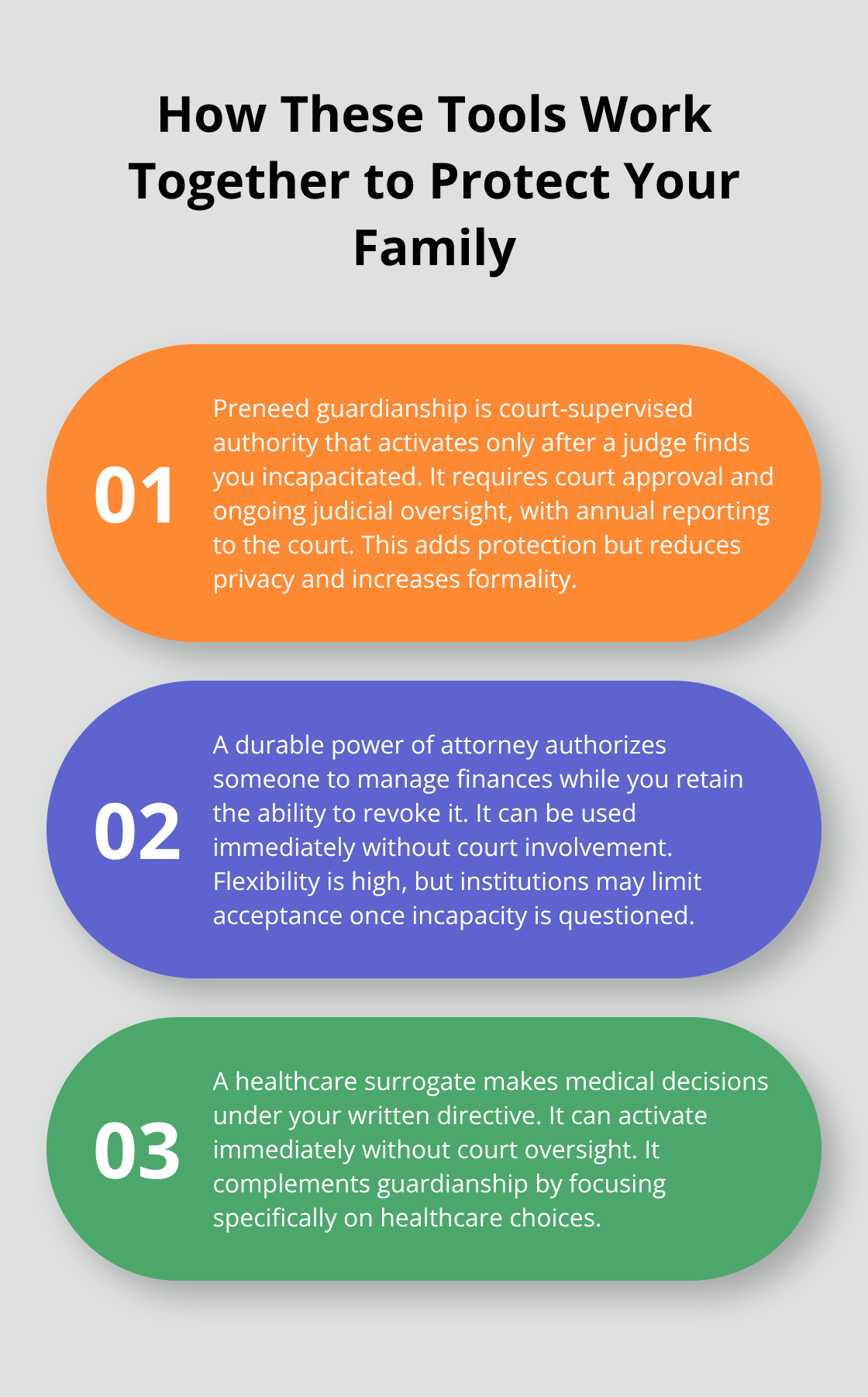
Preneed guardianship is not a power of attorney or healthcare directive-it’s court-supervised authority that activates only after a judge finds you incapacitated. A durable power of attorney lets you appoint someone to manage finances while you’re still able to revoke it, offering flexibility and control. A healthcare surrogate under Florida Statutes Chapter 765 lets you name someone for medical decisions and can activate immediately without court involvement. Preneed guardianship requires court approval and ongoing judicial oversight, meaning the guardian files annual accounts and remains accountable to the court. This extra layer of protection prevents abuse but also means less privacy and more formality.
The three tools work together, not separately-a comprehensive plan uses all three so decisions flow smoothly whether you’re temporarily incapacitated, permanently disabled, or facing end-of-life choices. Many families mistakenly think a power of attorney covers everything, then discover banks and healthcare providers won’t honor it once incapacity is questioned.
Why Families Get Preneed Guardianship Wrong
The biggest misconception is that preneed guardianship only applies to minor children, but it covers adults too. Florida law lets any competent adult name a preneed guardian for personal care, medical decisions, and financial management if incapacity strikes later. Another common mistake is assuming the named guardian automatically takes over-they don’t. The guardian must wait for a court to adjudicate incapacity, then file for confirmation within 20 days. Families also believe that a will is enough for guardianship, but wills don’t address living incapacity and don’t bind the court.
Some people think preneed guardianship is optional paperwork with no real effect, then face chaotic situations where family members fight, banks freeze accounts, and no one has authority to make decisions. The reality is that without a preneed designation, the court appoints a guardian through a full hearing process-expensive, time-consuming, and based on what the judge thinks is best, not what you wanted. Families in Northeast Florida who wait until crisis hits often spend thousands more and lose control over the outcome.
Moving Forward With Your Guardianship Plan
Understanding these distinctions and common pitfalls positions you to make informed decisions about your family’s protection. The next section walks you through the specific steps to establish preneed guardianship in St. Augustine and Palatka, FL, including what documents you’ll need and how the court process actually works.
How to Establish Preneed Guardianship in St. Augustine and Palatka, FL
Filing Your Preneed Guardianship Declaration
The process of establishing preneed guardianship in Florida starts with a written declaration that meets strict statutory requirements under Florida Statutes 744.3045. You must identify yourself clearly, name your chosen guardian, and sign the document in front of at least two witnesses at the same time. The declaration must be specific enough that a court can immediately recognize who you are and who you’ve designated. Vague language like “someone trustworthy” won’t work-use full legal names and include the guardian’s current address and relationship to you. If you name an alternate guardian, follow the same identification process for them.
File the original declaration with the clerk of court in your county (Duval, St. Johns, Putnam, Flagler, or Clay County depending on where you live). The clerk maintains it in the guardianship file, and it becomes immediately available if incapacity proceedings are later filed. This filing step takes one business day and costs between 50 and 150 dollars depending on your county’s filing fees.
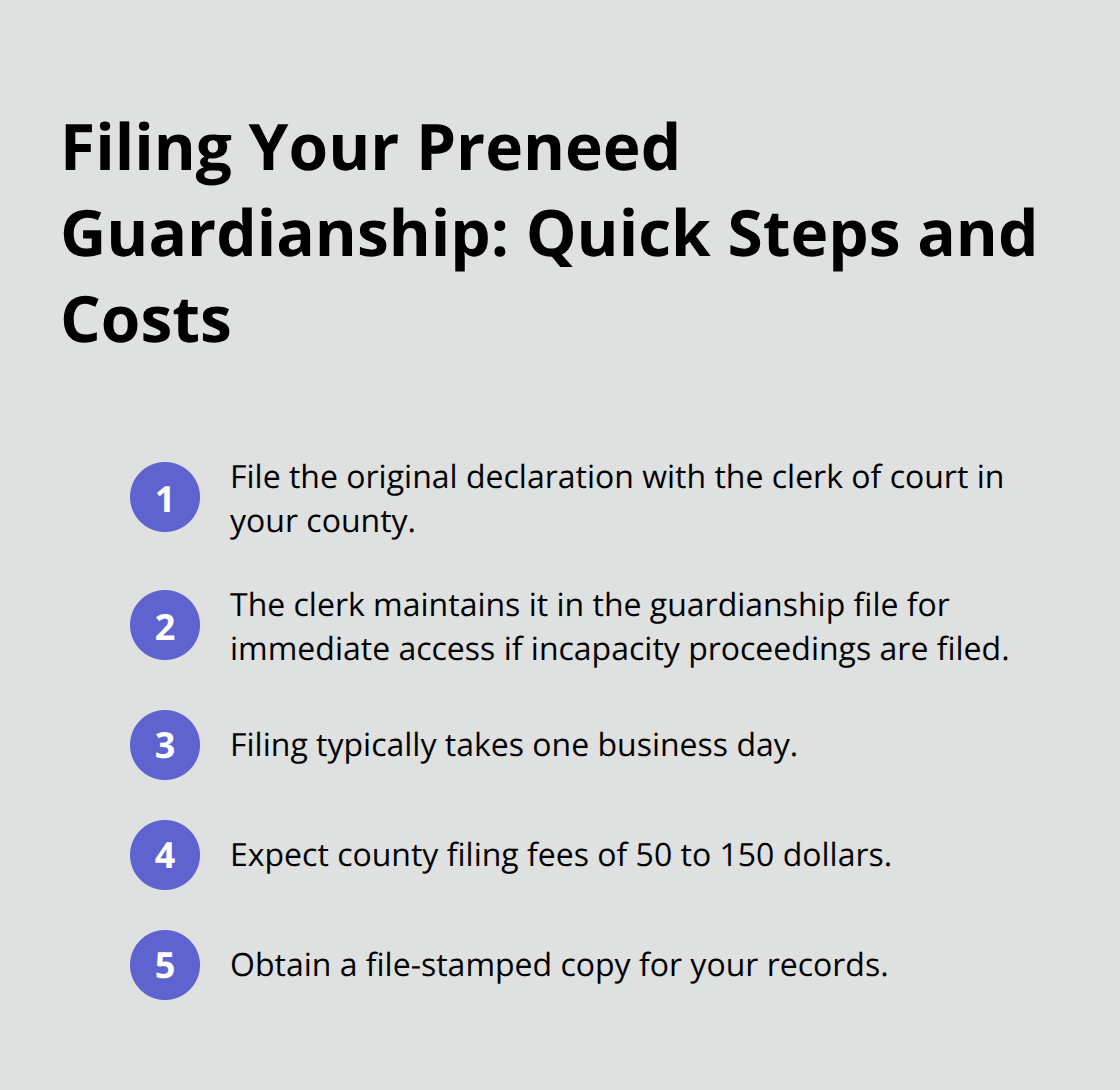
Many families keep only a personal copy at home, which creates a serious problem: if incapacity occurs and your family cannot locate the declaration quickly, the court appoints a guardian without knowing your preference. Once the declaration is filed, you receive a file-stamped copy that confirms it’s part of the court record.
Documentation the Court Requires
Florida courts expect clear evidence of your capacity and intent at the time you signed. Two witnesses must be present who are not related to you and not named as guardian or alternate-ideally people like a notary, coworker, or trusted community member who can testify they watched you sign voluntarily and understood what you were doing. Many families mistakenly believe a notary’s seal replaces witnesses, but Florida law specifically requires two attesting witnesses, not notarization. While notarization isn’t legally required, it creates an additional layer of evidence that you were competent and acting freely.
The guardian you name should provide written consent before you file, confirming they’re willing and able to serve. If they later refuse, your alternate guardian steps in with the same legal presumption. Keep copies of the signed declaration in multiple locations-one filed with the court, one with your designated guardian, one with your attorney, and one in your home safe or secure storage. This redundancy matters because if your family faces a crisis and cannot quickly produce the document, the court may not know it exists. The complete documentation package typically takes two to three hours to prepare, gather signatures, and arrange filing.
Timeline from Declaration to Court Confirmation
Once a court determines you’re incapacitated through a separate legal proceeding, your preneed guardian has exactly 20 days to petition the court for confirmation of appointment under Florida Statutes 744.3045(7). The court then reviews the guardian’s qualifications against the standards in Florida Statutes 744.309 and 744.312, which examine factors like the guardian’s financial responsibility, criminal history, and ability to manage personal or financial decisions. This confirmation process typically takes 10 to 30 days depending on court scheduling and whether the guardian’s qualifications are challenged.
Once confirmed, the guardian must file an oath and any required bond, then receives letters of guardianship that serve as proof of authority. The entire process from incapacity adjudication to letters issued usually runs 30 to 60 days-much faster than a contested guardianship where no preneed designation exists. Contested guardianships without a preneed declaration can stretch 90 to 180 days because the court holds hearings, reviews evidence, and decides without guidance from you.
Understanding the Costs Involved
Filing the preneed declaration runs 500 to 1,500 dollars when handled through an attorney, covering document preparation, witness coordination, and court filing. If incapacity later occurs and you have no preneed designation, a full guardianship action costs 2,000 to 5,000 dollars or more depending on whether family members dispute the appointment. The preneed declaration essentially front-loads a small expense to avoid a much larger one if crisis strikes. Families in St. Augustine and Palatka, FL who establish this protection now gain significant financial and emotional advantages when unexpected circumstances arise.
The next section addresses the most important decision in this process: selecting the right person to serve as your guardian and how to structure your plan for your family’s specific needs.
Who Should You Name as Guardian for Your Children
Selecting a guardian ranks as the most consequential decision in preneed guardianship planning, yet many parents rush through it based on gut feeling rather than realistic assessment. The person you name will make daily decisions about your children’s education, healthcare, discipline, and upbringing if you die or become incapacitated. Florida courts evaluate guardian qualifications under Florida Statutes 744.309 and 744.312, examining financial responsibility, criminal history, and ability to manage the role. Before naming anyone, sit down with them and discuss what guardianship actually means: managing your children’s inheritance, making medical decisions without you present, potentially relocating them, and handling their emotional trauma from losing you. Many people accept the role out of family obligation, then struggle or resent the burden when it activates. Your chosen guardian must demonstrate genuine willingness, not just politeness. Ask directly whether they can commit financially, emotionally, and logistically. If they hesitate or change the subject, that’s your answer to move to someone else.
Evaluating Your Guardian’s Capacity and Stability
Consider the guardian’s age and health alongside your children’s ages. A 75-year-old grandparent might be wonderful now but face serious challenges in ten years when your children are teenagers. Think about geographic stability-will this person remain in Northeast Florida or might they relocate, uprooting your children? Financial stability matters tremendously because guardians must manage your children’s property and inheritance without court approval for routine expenses, though significant decisions require court authorization. A guardian struggling with their own finances often faces temptation or poor judgment with your children’s money. Religious and cultural values deserve careful attention too, since your guardian will shape your children’s daily environment and worldview. If family values differ significantly between your choice and your actual beliefs, your children may feel disconnected from their identity.
Name an alternate guardian with the same care you give the primary choice, because that person steps in immediately if your first choice dies, refuses, or becomes incapacitated themselves. Many parents name an alternate without discussing it with them, creating shock and resentment when the role activates. Include details in your preneed declaration about your children’s special needs, medical conditions, educational preferences, and any religious or cultural practices you want maintained. This guidance helps your guardian honor your wishes and gives the court context for confirming their appointment.
Medical Decisions and Special Needs Planning
Your preneed guardian handles healthcare decisions for minor children unless you pair this role with a healthcare surrogate designation under Florida Statutes Chapter 765. The two roles differ significantly: a guardian makes decisions within court supervision and must report to the court, while a healthcare surrogate activates immediately based on your written directive and acts independently without court involvement. For children with chronic conditions like diabetes, asthma, or developmental disabilities, naming a guardian who understands these needs prevents dangerous gaps in treatment. A guardian unfamiliar with your child’s condition might miss warning signs or fail to maintain necessary medications or therapies. If your child receives specialized educational services through an Individual Education Plan, your guardian must advocate within school systems and understand educational law. Special education disputes sometimes require legal action, and a guardian uncomfortable with confrontation may accept inadequate services rather than fighting for your child’s rights.
Developmental disabilities require additional planning beyond standard guardianship. Florida Statute 393.12 offers guardian advocacy as an alternative to full guardianship for adults with developmental disabilities, providing supported decision-making rather than complete control. If your child has intellectual disabilities, consider whether full guardianship or a more limited arrangement better serves them long-term. Discuss this distinction with an attorney because the choice affects your child’s independence and autonomy significantly. For children with severe medical conditions, document your treatment preferences clearly in your preneed declaration or separate medical directive. If your child requires specific medications, dietary restrictions, or therapy schedules, write these down explicitly so your guardian executes your wishes, not their own judgment. Medical decisions include organ donation preferences, life support choices, and consent for surgery or experimental treatments-conversations you should have with your guardian before they’re needed so they understand your values and can act accordingly.
Updating Your Plan as Life Evolves
Preneed guardianship designations remain effective indefinitely unless you revoke or amend them, but your life rarely stays static for decades. Marriage, divorce, new children, moves, health changes, and shifts in family relationships all warrant reviewing your guardianship plan. If your designated guardian moves out of state, becomes estranged from you, develops substance abuse issues, or faces financial crisis, that person no longer fits the role. Many parents name a sibling as guardian, then years later realize that sibling’s own family situation makes them unable to parent additional children.
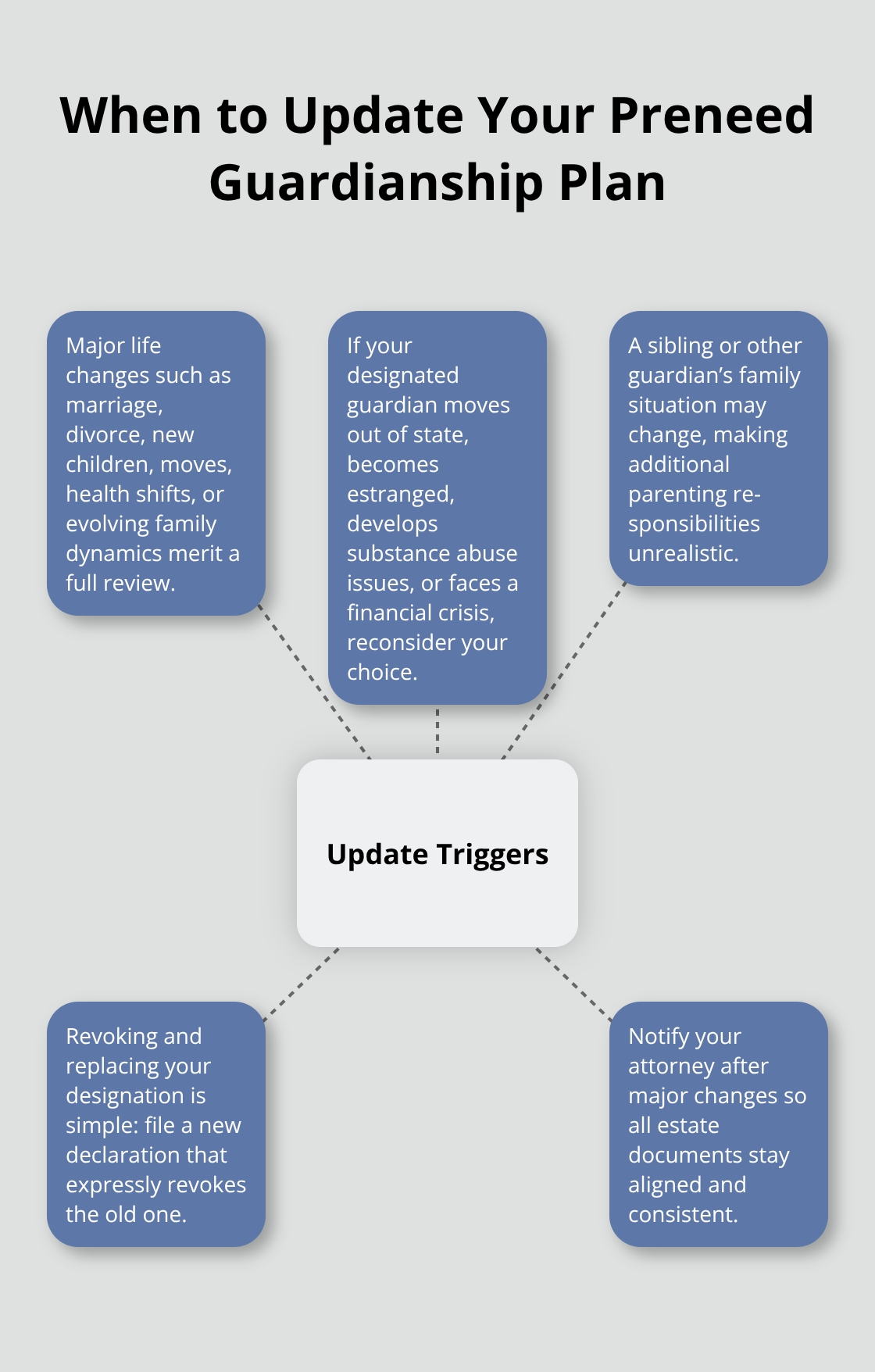
Revoking your original designation and naming someone new takes minimal effort but requires deliberate action-inaction means your outdated choice stays in effect. You can amend your preneed declaration at any time without court permission, simply by filing a new declaration that revokes the previous one and names a new guardian. Keep your attorney updated when major life changes occur so your guardian designation stays aligned with your actual preferences and circumstances.
Review your preneed guardianship plan every three to five years or whenever significant family changes occur. If you had one child when you created the plan and now have three, consider whether your chosen guardian can reasonably parent all of them. If your children’s needs have changed-one now has a serious illness, another excels in a specific school-document how your guardian should accommodate these evolving circumstances. Coordinate updates across your entire estate plan so your will, trust, power of attorney, healthcare directive, and preneed guardianship designation all reflect the same intentions and name compatible decision-makers. Inconsistencies between documents create confusion and sometimes litigation if your incapacity or death triggers multiple conflicting instructions.
Final Thoughts
Preneed guardianship basics protect your family by placing your voice in decisions rather than leaving everything to a judge who doesn’t know you. Families in St. Augustine and Palatka, FL who establish this protection now gain control over who raises their children and makes critical decisions if incapacity strikes. Without a preneed declaration, the court appoints a guardian based on what a judge thinks is best, not what you want.
We at Family, Estate & Mediation Law transform preneed guardianship from a vague idea into a concrete plan that actually protects your family. Our team ensures your declaration meets Florida’s strict statutory requirements, coordinates this document with your will, trust, power of attorney, and healthcare directive so everything works together seamlessly, and files everything correctly with the court. Mistakes in wording or procedure can render a declaration ineffective, leaving your family in the same vulnerable position as if you’d done nothing.
Contact Family, Estate & Mediation Law to discuss your family’s guardianship needs and schedule a consultation to review your current situation. With over 50 years of combined experience serving Northeast Florida, we help families establish clear protection plans before they’re needed. The time you invest now gives your family security and peace of mind that transcends any other planning step.