Most people put off estate planning because they don’t know where to start. The basic estate documents Florida residents need-wills, trusts, and powers of attorney-form the foundation of any solid plan.
At Family, Estate & Mediation Law, we help clients in St. Augustine and Palatka gather the right paperwork and understand Florida’s specific requirements. Starting now protects your family and saves money later.
The Three Documents Every Florida Estate Plan Must Have
Wills: The Foundation Document
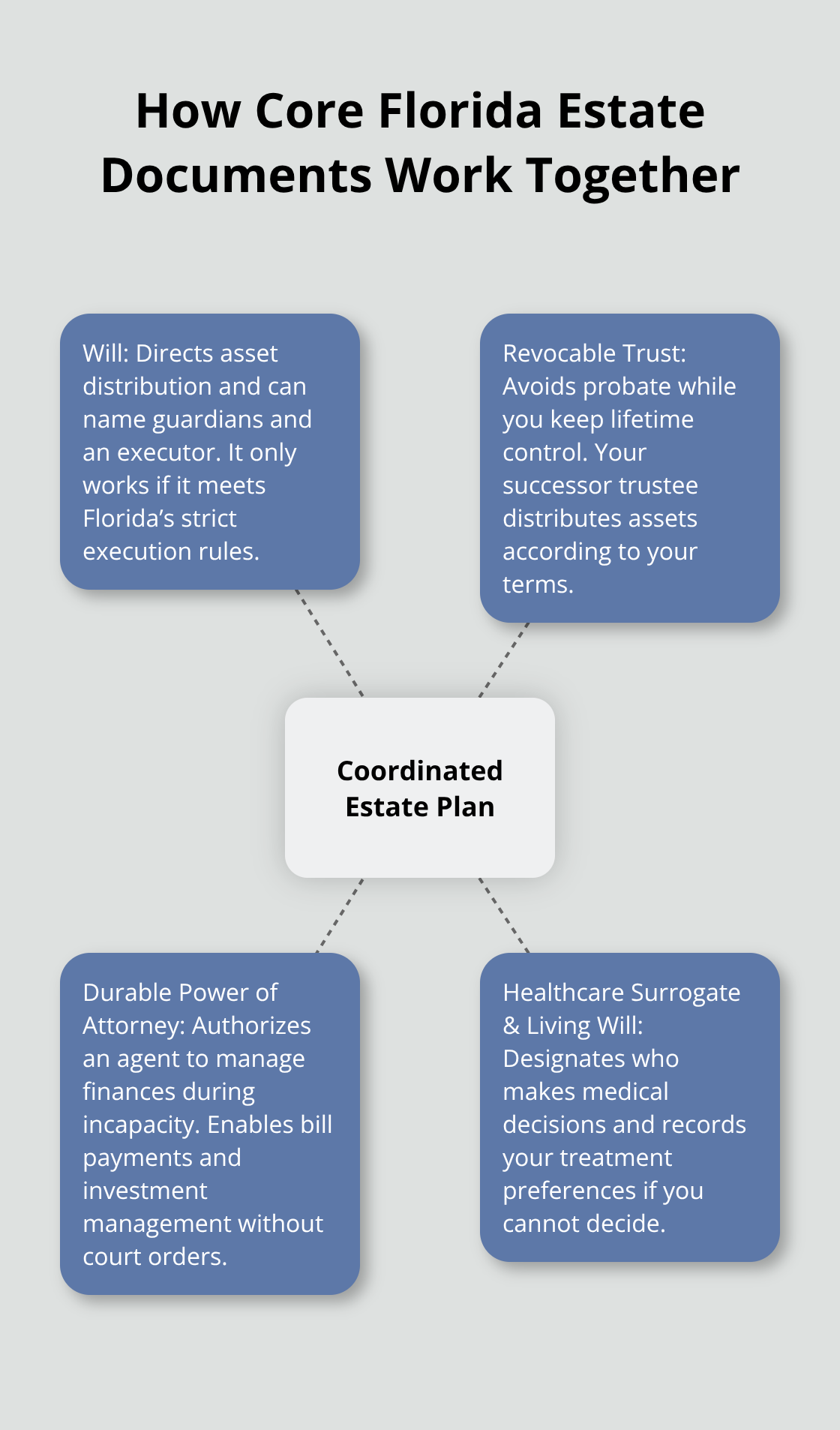
A will tells the court how you want your assets distributed after death, but Florida law is strict about execution. The will must be in writing, signed by you, and witnessed by at least two people who sign in your presence and in each other’s presence. Florida does not recognize handwritten wills without proper witnesses or oral declarations, so DIY forms from the internet often fail probate scrutiny. The testator must be at least 18 years old and of sound mind. Notarization is optional under Florida Statutes 732.502, but a notarized will speeds up probate admission and costs only $10 to $25 extra. Without a valid will, Florida intestacy laws decide who inherits, which rarely matches what families actually want.
A will alone does not avoid probate-it simply tells the probate court what to do with your assets while the court supervises the process, which takes 6 to 12 months in Florida and costs 3% to 7% of the estate in legal fees and court costs.
Revocable Living Trusts: Control Without Probate
A revocable living trust transfers your assets into a trust during your lifetime, and those assets pass to beneficiaries outside probate when you die. The trust must be in writing and signed, but no witnesses are required. You remain the trustee during your life, so you keep full control and can buy, sell, or gift assets as you wish. Florida Statutes 736.0801 allows you to amend or revoke the trust at any time.
Powers of Attorney and Healthcare Documents
A durable power of attorney names someone to manage your financial affairs if you become unable to do so, and Florida law gives agents immediate authority without a court order. You can specify exactly which financial powers your agent has, from paying bills to managing investments. A healthcare surrogate and living will work together to handle medical decisions. The healthcare surrogate makes treatment choices if you cannot, while the living will documents your preferences about life-sustaining care. Florida Statutes 765.401 requires both documents to be signed with two witnesses or notarized.
How These Documents Work Together
These three documents form a coordinated set that addresses different aspects of your estate and incapacity planning. The will and trust handle asset distribution, the power of attorney manages finances during incapacity, and the healthcare surrogate and living will handle medical decisions. Gaps between these documents create confusion and conflict when your family needs them most.
The next step involves gathering the specific records and information your attorney will need to draft these documents properly.
What Records Do You Need Before Your First Meeting
Organize Your Personal and Financial Information
Gathering the right documents before meeting with an attorney saves time and money. Most people underestimate how many records they actually own, and showing up unprepared means your attorney spends billable hours hunting for information instead of drafting your estate plan. Start by collecting your personal identification, including your driver’s license, passport, and Social Security card.
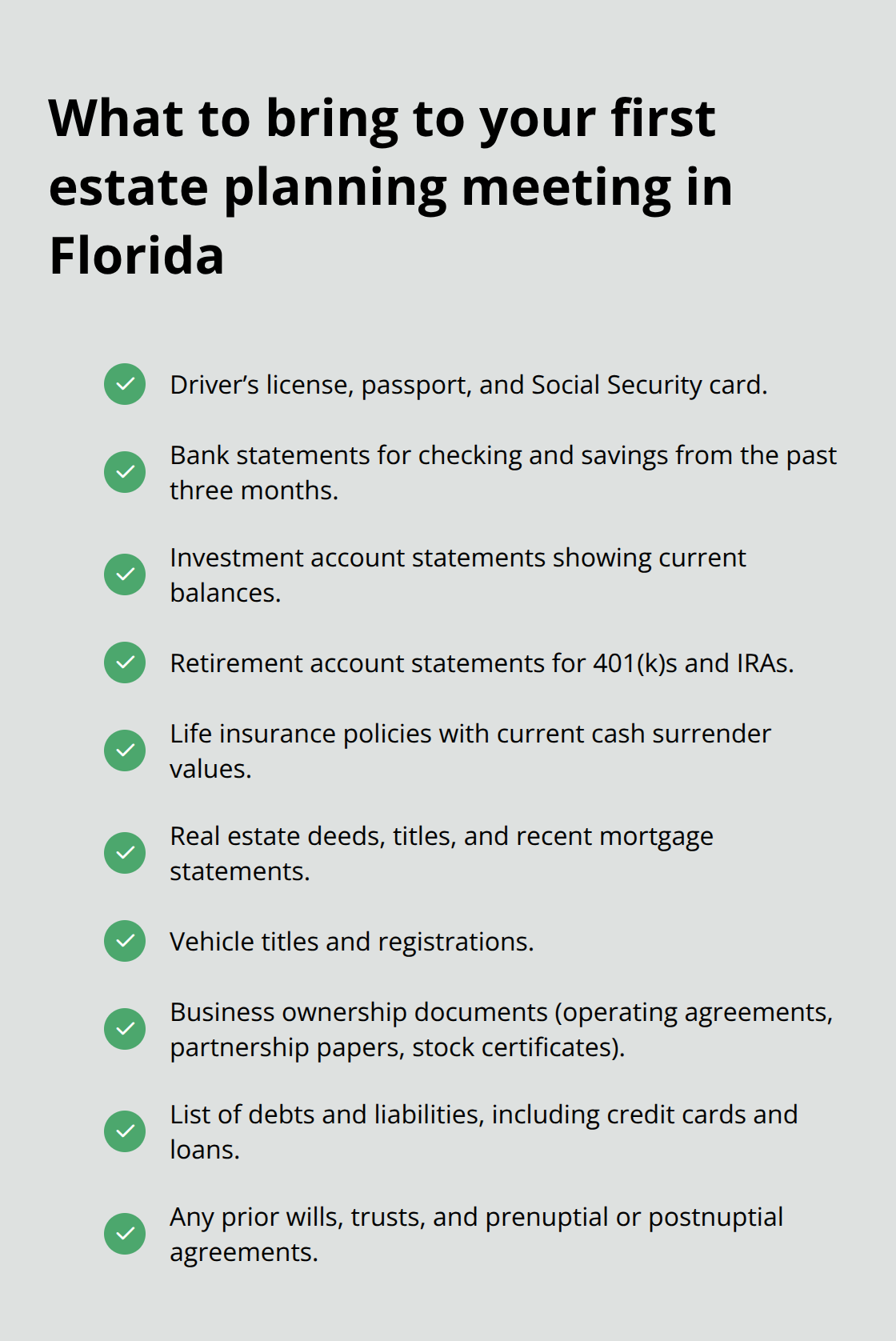
Next, pull together a complete list of your financial accounts: bank statements from the past three months for checking and savings accounts, investment account statements showing current balances, retirement account statements from 401(k)s and IRAs, and any life insurance policies with their current cash surrender values.
Document Your Real Estate and Tangible Assets
For real estate, locate the original deed or title document for any property you own in Florida or out of state. Property owned in multiple states creates probate exposure in each state unless your trust or other planning documents specifically address it. Gather mortgage statements and any outstanding loan documents tied to real estate. If you own a vehicle, bring the title and registration. For business interests, collect any operating agreements, partnership documents, or stock certificates.
Review Existing Beneficiary Designations and Liabilities
Review your existing beneficiary designations on life insurance, retirement accounts, and any pay-on-death bank accounts. Outdated beneficiary designations frequently contradict your current wishes and override what a will or trust specifies, creating unintended consequences that cost families thousands in litigation. Don’t overlook documents that show your liabilities and debts-bring credit card statements, mortgage statements, and any promissory notes or personal loans you’ve made to family members.
Update Plans After Major Life Changes
If you’ve already drafted a will or trust with another attorney, bring those documents so your new attorney understands what’s already in place and what needs updating. Many Floridians fail to update estate plans after major life events: the CDC reports that about 60% of American adults lack a will, and among those who do have one, most haven’t updated it in over five years. Life changes like marriage, divorce, the birth of children or grandchildren, significant changes in asset value, or the death of a named executor or trustee all require updates. Bring any prenuptial or postnuptial agreements if they exist. If you have minor children or grandchildren, list their names, ages, and any special needs or circumstances.
Prepare a Summary for Your Attorney Meeting
Create a simple one-page summary listing all your assets and their approximate values, all your debts, and the names of people you want to serve as executor, trustee, healthcare surrogate, and agent under power of attorney. This level of preparation means your attorney focuses on strategy and compliance with Florida law rather than administrative details. You’ll also leave your meeting with a clear timeline and cost estimate for completing your plan. With these records in hand, you’re ready to address the specific requirements Florida law imposes on your estate documents.
How Florida Probate and Tax Rules Shape Your Estate Plan
Florida Probate Timelines and Costs
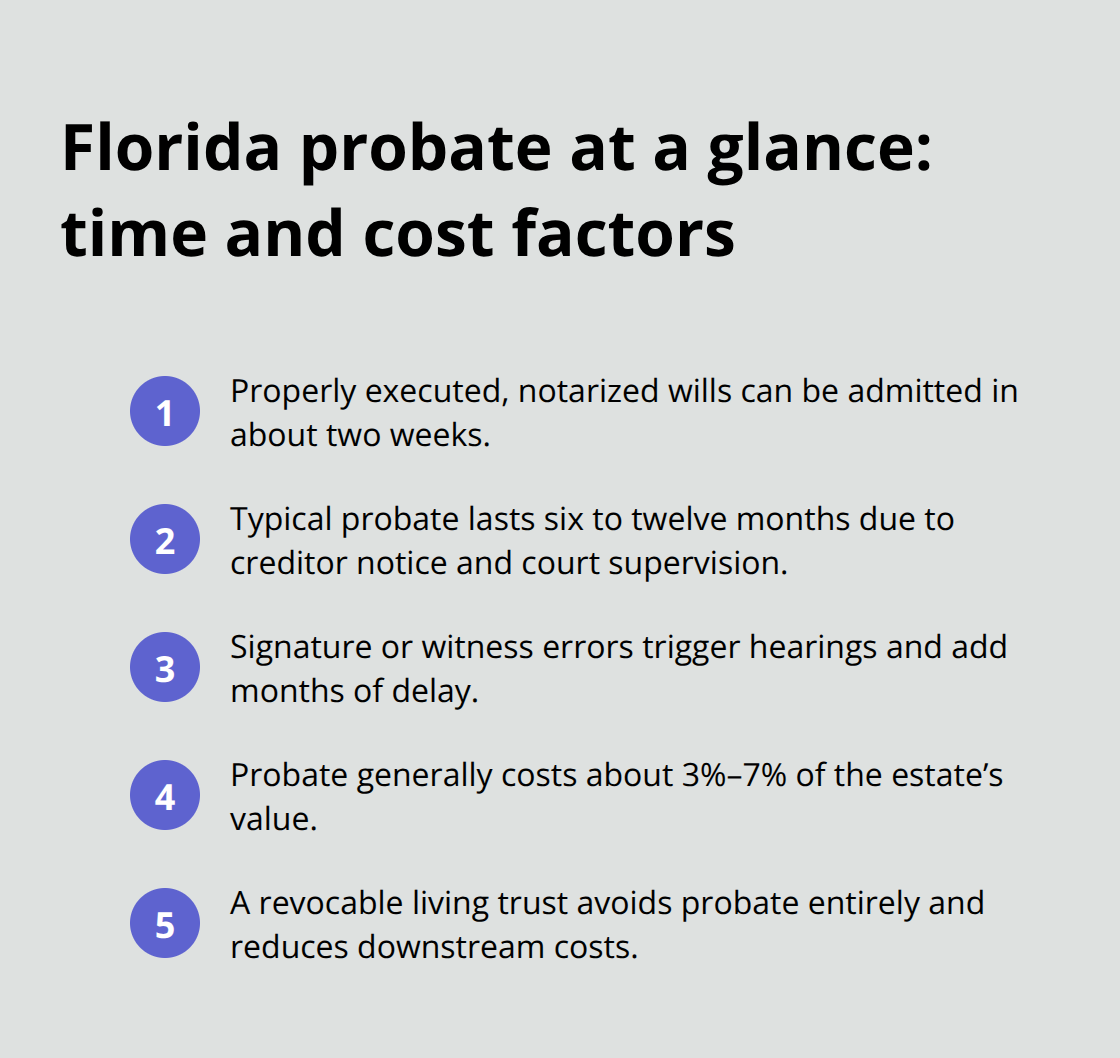
Florida probate moves faster than most states when your documents meet execution requirements. A properly executed and notarized will can be admitted to probate in as little as two weeks under Florida Statutes 732.901. The full probate process typically takes six to twelve months because the court must notify creditors, allow them time to file claims, and supervise asset distribution. If your will lacks proper witnesses, has signature errors, or skips notarization, probate admission stalls while the court holds a hearing to determine validity-adding months and thousands in attorney fees. Probate in Florida costs between three and seven percent of your estate value, so a $500,000 estate costs $15,000 to $35,000 in court fees and legal fees combined. A revocable living trust eliminates probate entirely and costs significantly less upfront than fixing probate mistakes later.
Probate Alternatives for Specific Assets
Florida recognizes pay-on-death designations for bank accounts and transfer-on-death registrations for vehicles, which bypass probate for those specific assets without requiring a full trust structure. These tools work well for straightforward situations but lack the flexibility and control that a trust provides for multiple beneficiaries or complex family situations. Ladybird deeds, also called enhanced life estate deeds under Florida Statutes 689.2 and 732.4015, allow real estate to pass automatically at death while you retain control during life and receive a step-up in basis at death.
Federal Estate Tax and the Step-Up in Basis
Florida has no state income tax and no state estate tax, which gives residents a major advantage over residents in states like New York or California. The federal estate tax still applies if your estate exceeds $13.61 million in 2024 (this threshold changes annually, so verify the current year’s limit). Most Florida families fall well below this threshold, but married couples should know that each spouse has a separate exemption, so coordinated planning can shelter $27.22 million from federal estate tax. Property owned as tenants by the entirety-a form of ownership available only to married couples in Florida-passes automatically to the surviving spouse outside probate and receives a full step-up in basis at death. This step-up means heirs inherit the property at its current market value rather than the deceased owner’s original purchase price, which eliminates capital gains taxes on appreciation during the deceased owner’s lifetime.
Special Needs Planning and Asset Limits
For disabled beneficiaries, Florida asset thresholds matter significantly. Supplemental Security Income (SSI) limits assets to $2,000 for a single person and $3,000 for a married person. A properly structured Special Needs Trust allows disabled individuals to receive funds without jeopardizing these government benefits, a planning technique that federal law explicitly permits under 42 U.S.C. Section 1396p(d)(4)(A). Without this structure, a direct inheritance can disqualify someone from benefits for years.
Final Thoughts
Procrastination costs families money and creates unnecessary conflict when estate documents are missing or outdated. Without basic estate documents Florida residents need, state law decides who inherits your assets, who manages your finances if you become incapacitated, and who makes medical decisions on your behalf. These default rules rarely match what families actually want.
The financial benefit is immediate and measurable. Probate costs between three and seven percent of your estate value, so a $500,000 estate costs $15,000 to $35,000 in combined court and legal fees. A revocable living trust eliminates probate entirely and costs far less than fixing mistakes after death, while your successor trustee distributes assets within weeks instead of the six to twelve months probate requires.
We at Family, Estate & Mediation Law help clients in St. Augustine and Palatka create coordinated estate plans that address Florida’s specific requirements and your family’s unique situation. Contact us for a free consultation to discuss your estate planning needs and get started today.