
A power of attorney is one of the most overlooked documents in estate planning, yet it gives someone you trust the legal authority to act on your behalf when you cannot. Without one in place, your family may face costly court proceedings to manage your finances or healthcare decisions.
At Family, Estate & Mediation Law, we help Florida residents appoint power of attorney agents who can step in immediately during emergencies or incapacity. This guide walks you through selecting the right person, understanding their duties, and completing the legal requirements in Florida.
What Is a Power of Attorney in Florida
A power of attorney is a legal document that grants another person, called your agent, the authority to make financial and healthcare decisions on your behalf. In Florida, this document takes effect the moment you sign it in front of two witnesses and a notary-not when you become incapacitated. That immediate effectiveness matters because it lets your agent handle time-sensitive transactions like paying bills, managing investments, or accessing bank accounts without waiting for a court order. Under Florida Statutes Chapter 709, a durable power of attorney remains valid even if you later become incapacitated, which is why you should make your POA durable. Without one, your family must petition the court for guardianship, a process that costs thousands of dollars, takes months, and exposes your financial affairs to public scrutiny.
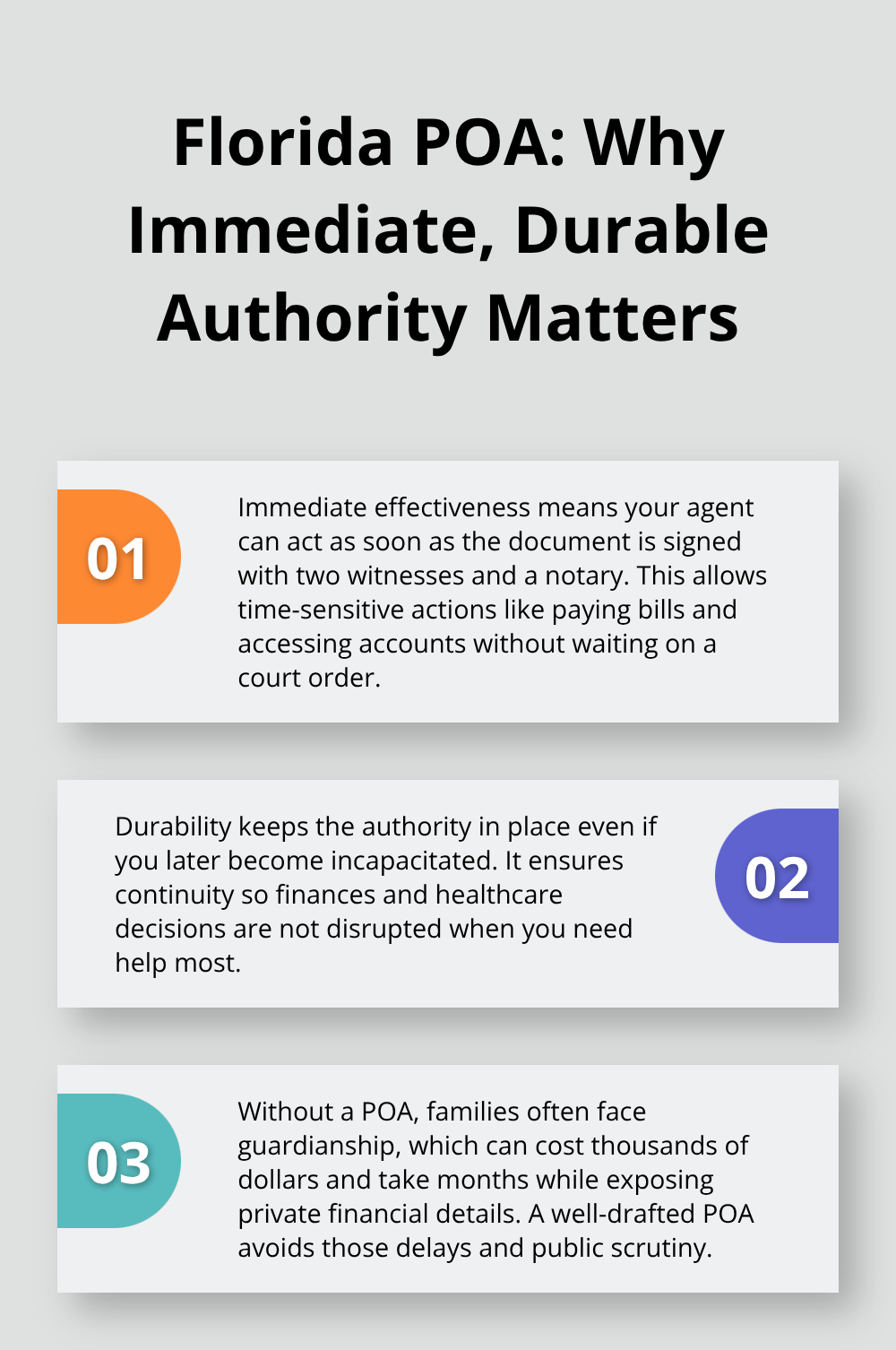
The Florida Bar reports that guardianship proceedings average between $3,000 and $5,000 in attorney fees alone, not counting court costs and the ongoing expenses of annual accountings and compliance.
Durable versus Non-Durable Powers of Attorney
A durable power of attorney includes explicit language stating that the power is not terminated by your subsequent incapacity. Florida law requires this language to be clear and intentional; vague wording will not protect your agent’s authority after you become unable to make decisions yourself. A non-durable power of attorney automatically terminates if you become incapacitated, which defeats the purpose of long-term planning. Since October 1, 2011, Florida law eliminated springing powers-documents that would activate only upon incapacity-so your POA takes effect immediately upon signing. This change means you control when and how your agent uses the document, and you can revoke it at any time while competent.
Types of Authority Your Agent Can Exercise
General powers of attorney grant broad financial authority over banking, investments, real estate, and business matters, while limited powers restrict your agent to specific tasks (like selling a particular property or managing one investment account). Medical powers of attorney handle healthcare decisions separately from financial matters, allowing you to designate different agents for each role or keep them unified. Your agent’s authority is limited to what the document explicitly grants. Broad language like “power to do all acts” does not automatically authorize gifting, creating trusts, changing beneficiary designations, or modifying survivorship rights on property.
What Banks Require from Your POA
If you anticipate needing your agent to handle Medicaid planning, asset protection through trusts, or charitable giving, the POA must enumerate those powers specifically. Banks and financial institutions in Florida can lawfully refuse a POA that lacks clear authority for the transaction at hand, and they have four business days to accept or reject it under Florida Statutes 709.2120. If a bank refuses your valid POA without justification, you can seek a written legal opinion from an attorney or petition the court for relief, but prevention through proper drafting is far more efficient. Third parties rely on the document as written, so incomplete or outdated forms create unnecessary friction when you need immediate access to accounts or decision-making authority.
Now that you understand what a power of attorney is and how it functions in Florida, the next critical step is selecting the right person to serve as your agent and ensuring they understand the responsibilities that come with the role.
How to Designate Your Agent
Selecting your power of attorney agent ranks among the most consequential decisions you will make in estate planning, yet most people rush through it or default to whoever comes to mind first. Your agent will access your bank accounts, manage investments, potentially sell your home, and make healthcare decisions when you cannot. This person holds fiduciary duties under Florida Statutes Chapter 709, meaning they must act in your best interests, avoid conflicts of interest, keep detailed records of all transactions, and preserve your estate plan. The wrong choice can result in financial loss, family conflict, or your agent’s inability to act when time matters most.
Evaluating Trustworthiness and Competence
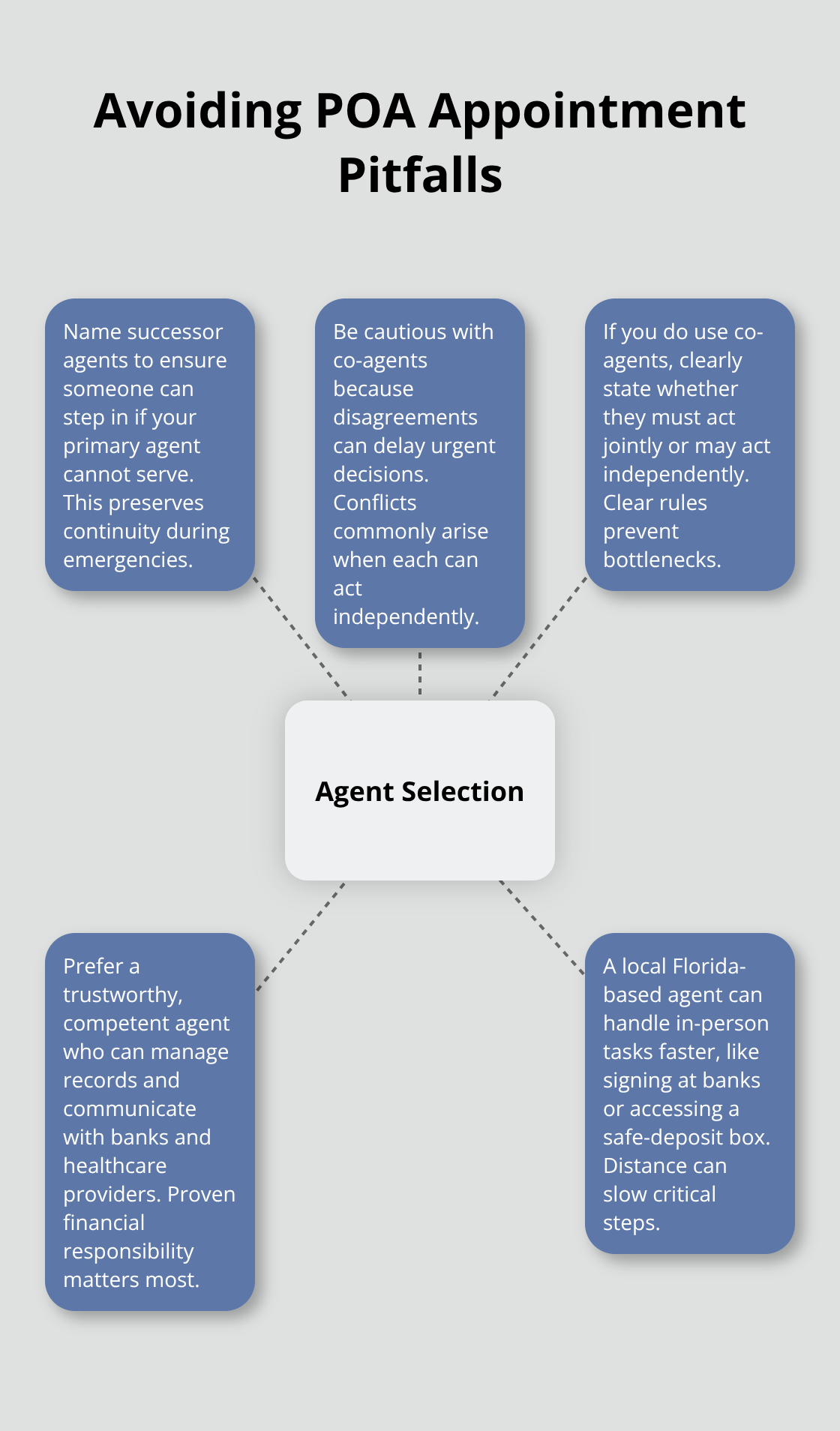
Evaluate trustworthiness above all else-someone who has demonstrated financial responsibility over years, not just good intentions. Your agent must also possess practical competence: comfort with banking systems, ability to understand financial documents, willingness to organize records, and capacity to communicate with institutions like banks and healthcare providers. Age matters; Florida law requires agents to be at least 18 years old and mentally competent. Residency in Florida is not mandatory, but a local agent can handle in-person tasks more efficiently, such as signing documents at banks or visiting safe-deposit boxes. If your chosen agent lives out of state, ensure they are willing to travel or coordinate with professionals who can act on their behalf.
Avoiding Common Appointment Mistakes
Many people appoint spouses or adult children, but this creates risk if that person dies, becomes incapacitated, or develops strained relationships. Florida law permits you to name successor agents who automatically step in if your primary agent cannot serve, so always designate backups. Co-agents sound appealing but often create conflicts; two agents acting independently may disagree on transactions or create delays when quick decisions are essential. If you do appoint co-agents, the POA document must specify whether they act independently or require mutual agreement.
Understanding Fiduciary Duties and Responsibilities
Your agent’s specific duties depend on the powers you grant, but fiduciary obligations apply regardless. They must act loyally, meaning they cannot use your assets for personal benefit or favor themselves over your interests. They must cooperate with healthcare decision-makers if medical powers are involved, keep receipts and disbursements organized, and inventory any safe-deposit box they access. Florida law holds agents liable if they breach these duties through dishonesty, improper motive, or abuse of the fiduciary relationship, so discuss these responsibilities directly before naming someone.
Having the Conversation with Your Chosen Agent
Many agents decline appointment because they do not understand what is expected. Have a candid conversation explaining that they will manage your finances if you become incapacitated, handle time-sensitive transactions during emergencies, and potentially coordinate with banks and healthcare providers. Show them the actual POA document so they understand the scope of authority. Ask whether they are comfortable with the responsibility, willing to maintain records, and able to act in your best interests even if family members disagree with their decisions. If they hesitate or express doubt, that hesitation is valuable information. A reluctant agent may refuse to act when needed, leaving your family without decision-making authority.
If your agent is a professional, such as a financial advisor or CPA, clarify whether they expect compensation for their services. Florida Statutes 709.2112 permits reasonable compensation for qualified agents unless the POA specifies otherwise, but many family members serve without pay. Finally, store the executed POA in an accessible location and provide copies to relevant banks, healthcare providers, and your agent so they can act promptly without delays caused by document searches or requests for originals. Once you have selected your agent and they understand their role, you must complete the legal requirements that make your power of attorney valid and enforceable in Florida.
Making Your Power of Attorney Legally Valid in Florida
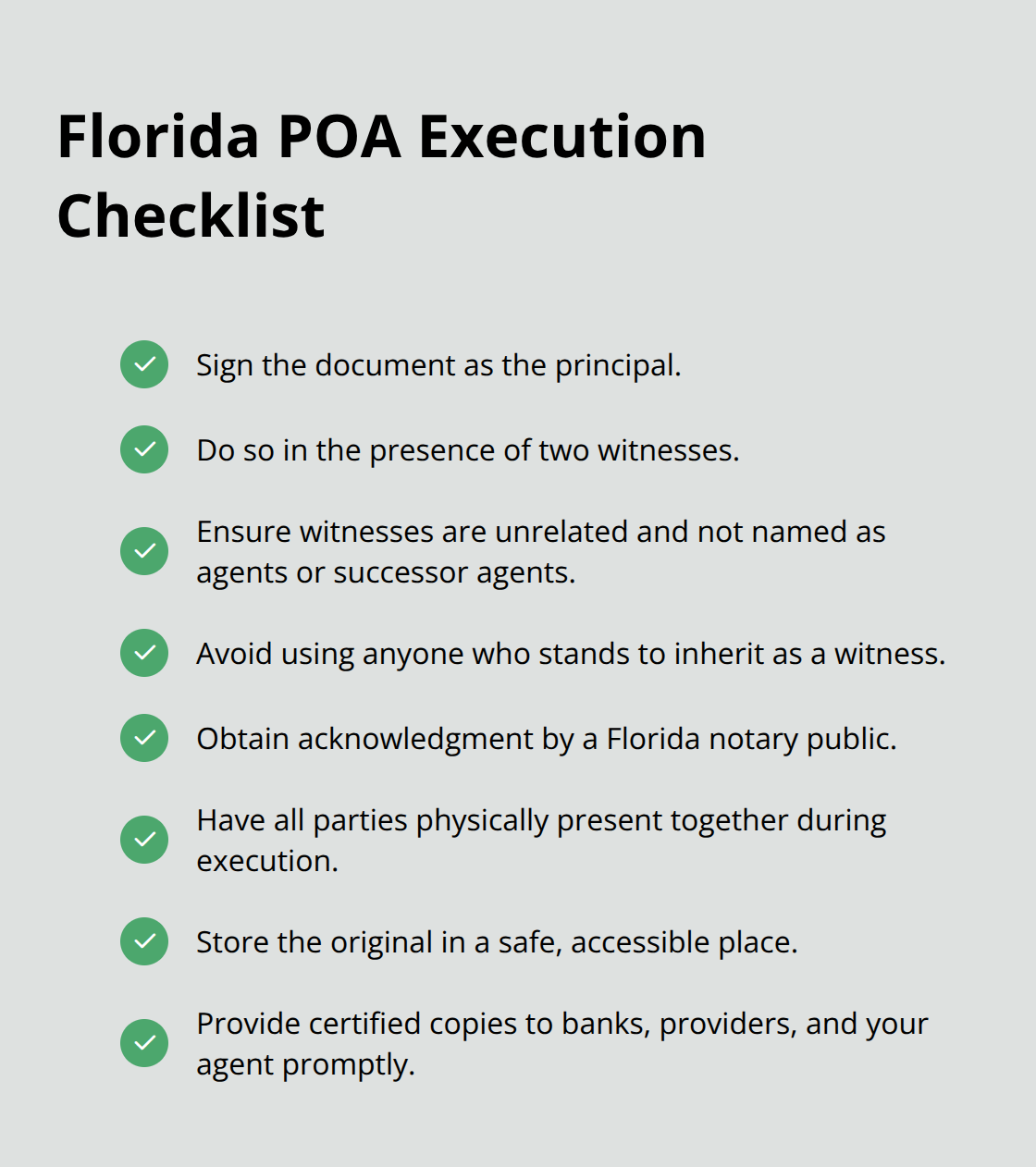
Florida law imposes specific requirements that your power of attorney must meet to be enforceable with banks, healthcare providers, and third parties. The document must be signed by you, the principal, in the presence of two witnesses who are unrelated to you and not named as your agent or successor agent. Neither witness can be someone who stands to inherit from your estate, as this creates a conflict of interest that courts scrutinize closely. After both witnesses sign, a Florida notary public must acknowledge your signature, which means the notary verifies your identity and confirms you signed willingly. This three-part requirement-your signature, two witnesses, and notary acknowledgment-takes approximately 30 minutes to complete. The Florida Bar emphasizes that all parties should be physically present together during execution to prevent challenges later.
If you execute a power of attorney in another state, Florida will recognize it if it complies with that state’s law at the time of execution, but third parties may request a written legal opinion or certified English translation if the document raises questions about validity or language.
Execution Requirements That Banks Will Accept
Your original power of attorney must be stored in a safe but accessible location, such as a home safe or safe-deposit box at your bank. Do not lock it away where your agent cannot find it during an emergency. Provide certified copies to your primary bank, investment firms, healthcare providers, and your agent immediately after execution so they can review the document and accept it before a crisis occurs. Banks have four business days under Florida Statutes 709.2120 to accept or reject a power of attorney, and they frequently request an affidavit from your agent confirming your domicile, that no revocation has occurred, and that you remain competent. This affidavit speeds up acceptance significantly.
Recording Requirements for Real Property Transactions
For real property transactions, the original power of attorney may need to be recorded with the county clerk in the county where the property is located, though recording requirements vary by transaction type. Recording protects your agent’s authority and creates a public record that third parties can verify without requesting additional documentation. The recording process typically costs between $50 and $150 depending on the county, and your agent can handle this task on your behalf once the document is executed.
Updating Outdated or Out-of-State Documents
If your power of attorney predates October 1, 2011, or was drafted using an out-of-state form, update it now to comply with current Florida law and eliminate ambiguities that banks cite when refusing to honor outdated documents. Florida eliminated springing powers (documents that activate only upon incapacity) in 2011, so older POAs may not function as intended. Out-of-state forms often lack the specific language Florida banks require for banking and investment authority, creating delays when your agent needs immediate access to accounts. A current, Florida-compliant document prevents institutional resistance and allows your agent to act without unnecessary friction. Consider estate planning guidance to ensure all your documents work together effectively.
Final Thoughts
Creating a power of attorney in Florida protects your family from costly court proceedings and ensures someone you trust can act immediately when you cannot. The process requires three essential steps: selecting a trustworthy agent who understands their fiduciary duties, executing the document with two witnesses and a notary, and distributing copies to banks and healthcare providers before a crisis occurs. Your agent’s authority depends entirely on what you grant in writing, so enumeration matters more than broad language.
Start now while you are competent and healthy. Review whether your current POA complies with Florida law or needs updating. Identify your agent, have a direct conversation about their willingness to serve, and name successor agents to ensure continuity.
We at Family, Estate & Mediation Law help Northeast Florida residents appoint power of attorney agents and draft documents that banks accept without delay. Contact our offices in St. Augustine and Palatka to schedule a consultation and protect your interests today.