
A hospice directive Florida allows you to document your end-of-life care preferences before a medical crisis forces difficult decisions on your family. This legal document gives you control over pain management, comfort care, and when to stop aggressive treatment.
We at Family, Estate & Mediation Law understand that planning for the end of life is uncomfortable, but it’s one of the most loving things you can do for those closest to you. Without a clear directive, your family may face confusion, conflict, and costly medical decisions that don’t reflect your values.
What Counts as a Valid Hospice Directive in Florida
A hospice directive in Florida is fundamentally a written expression of your medical preferences for end-of-life care, rooted in Florida Statute Chapter 765. Under Florida law, this directive becomes legally binding when you’re terminally ill, have an end-stage condition, or are in a persistent vegetative state and can no longer communicate your wishes. The directive serves as your voice when you cannot speak, instructing physicians and hospice teams on whether to continue aggressive treatments, withdraw life support, or focus solely on comfort and pain management.
Legal Requirements for a Valid Directive
Florida Statute 765.302 requires that your living will-the most common form of hospice directive-be signed by you and witnessed by two individuals, with at least one witness having no blood relation to you and not being your spouse. The document does not need notarization to be valid, though many people add this layer for extra protection. What matters most is that your directive clearly reflects your values and medical wishes, because vague language creates exactly the kind of family conflict and medical uncertainty that planning ahead is supposed to prevent.
How Hospice Directives Differ from Other End-of-Life Documents
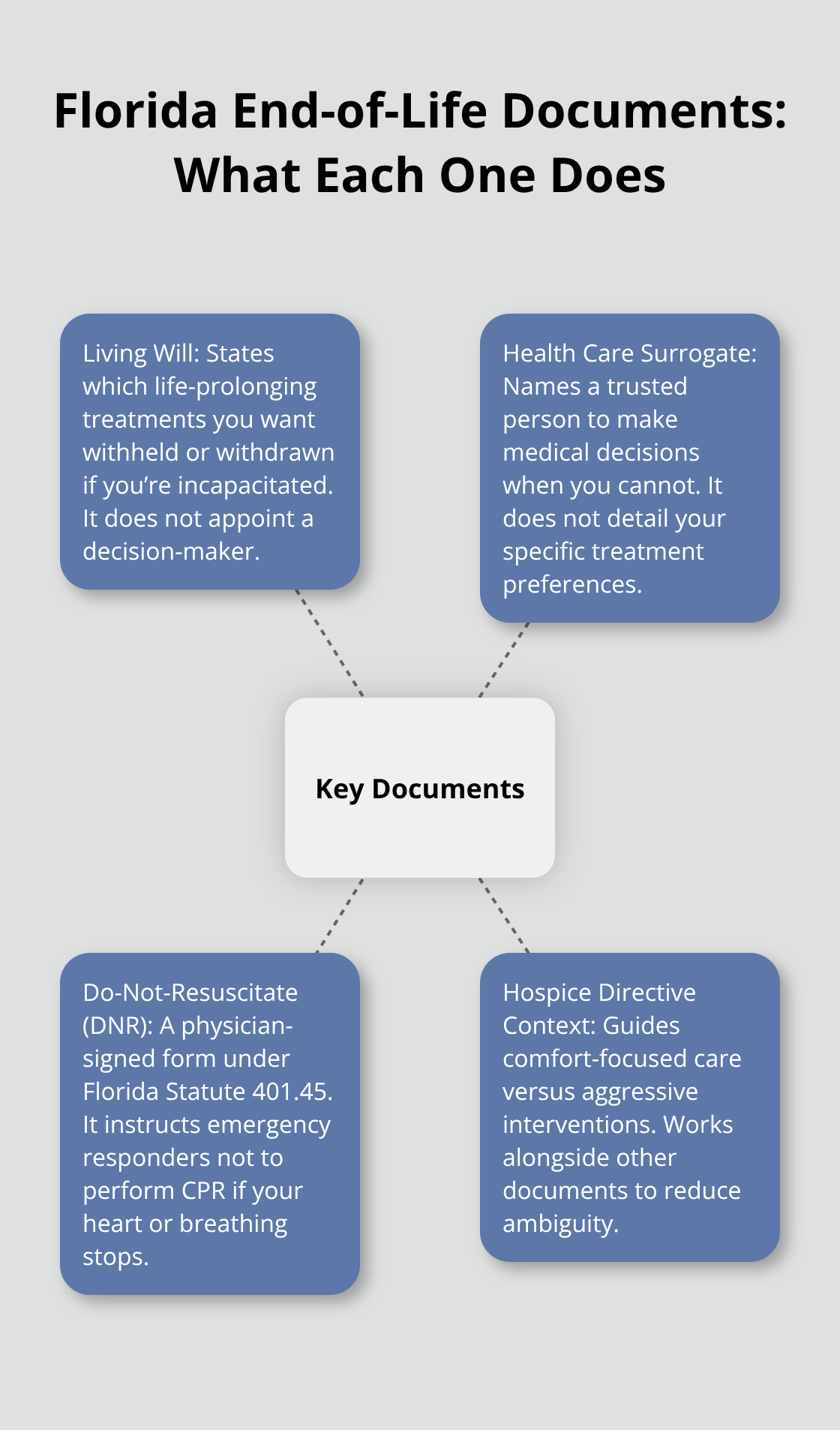
A hospice directive is not the same as a health care power of attorney or a do-not-resuscitate order, though all three serve related purposes. A living will specifically addresses what medical treatments you want withheld or withdrawn if you become incapacitated; it does not designate someone to make decisions on your behalf. A health care surrogate designation, by contrast, names a trusted person to make medical decisions when you cannot, but it does not spell out your specific treatment preferences. A do-not-resuscitate order, governed by Florida Statute 401.45, is a physician-signed form that instructs emergency responders not to perform CPR if your heart stops or you stop breathing.
Why Multiple Documents Matter
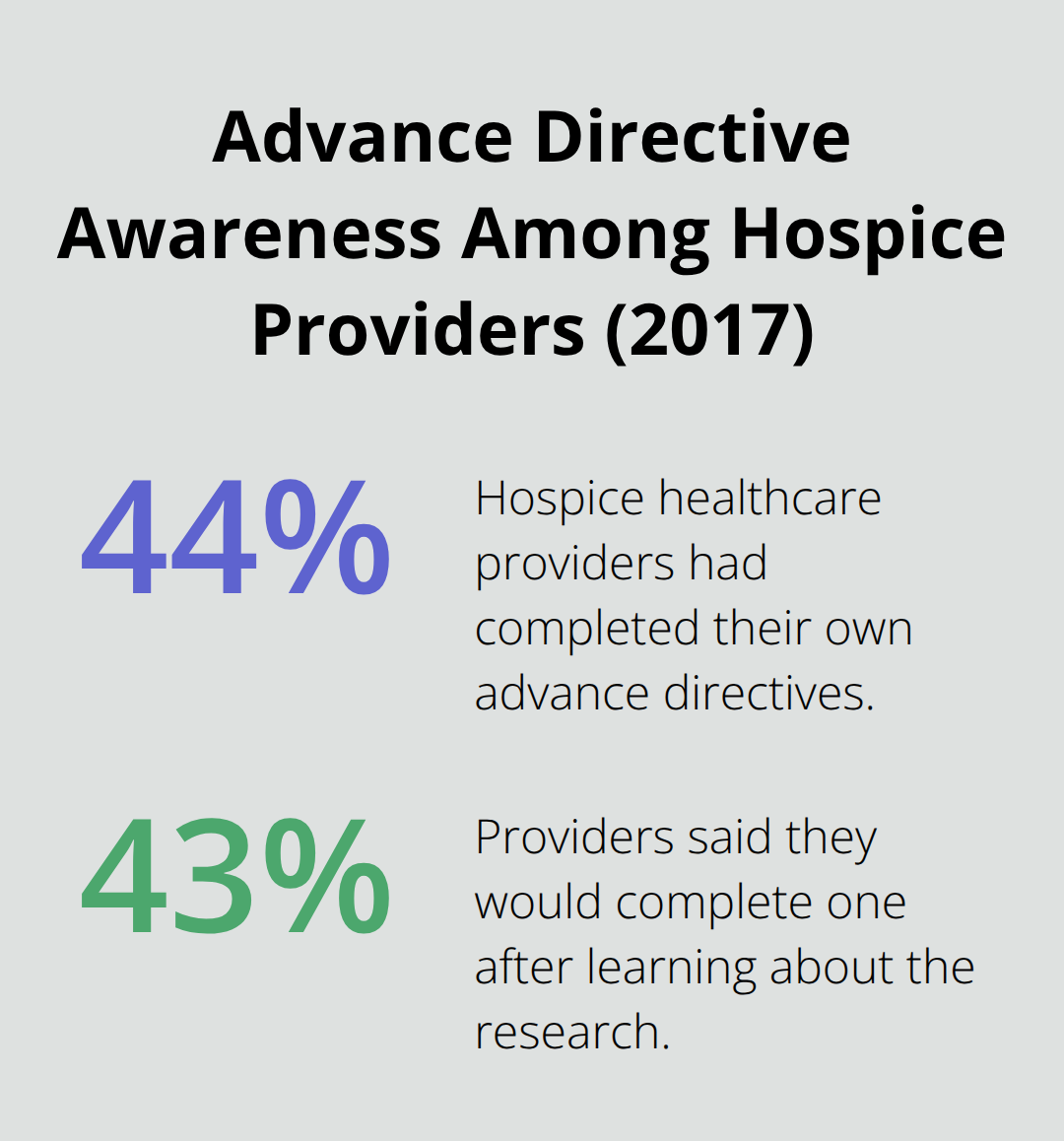
Research published in the American Journal of Medicine in 2017 revealed that only 44 percent of hospice healthcare providers had completed their own advance directives, citing procrastination and fear of mortality as primary barriers. This gap matters because it reveals how easily families and care teams can misunderstand each other without clear, written directives. Using multiple documents together-a living will plus a health care surrogate designation-ensures your wishes are documented from every angle and reduces ambiguity across all care settings. This layered approach protects you and your family when medical decisions become urgent and emotions run high.
Why Your Wishes Get Ignored Without a Directive
The Legal Default When You Have No Directive
Without a written hospice directive, Florida law defaults to a hierarchy of decision-makers who may not know your values or priorities. If you become incapacitated, your spouse makes decisions first, followed by adult children, then parents, then siblings. This legal order assumes family members will agree and act in your best interest, but reality rarely works that way. When hospice staff at your bedside lack a written directive to reference, they follow medical protocols designed for uncertainty, not your preferences. If you want comfort-focused care instead of aggressive interventions, that preference remains unspoken. If your family believes you’d want everything done to extend life, they’ll request it, and physicians will comply because without a directive, they have legal protection to do so.
What Happens When Medical Teams Guess Your Wishes
The result is medical care that contradicts your values, costs your family tens of thousands of dollars in unnecessary treatments, and leaves them traumatized by watching interventions you would have refused. A 2017 study in the American Journal of Medicine found that only 44 percent of hospice healthcare providers had completed their own advance directives, yet 43 percent of those surveyed stated they would complete one after learning about the research. That shift in intention reveals something critical: people understand the stakes once they see the gap between their wishes and what actually happens without documentation.
Medicare data shows that patients with advance directives spend fewer days in intensive care units before death compared to those without directives.
How a Directive Stops Unwanted Medical Interventions
A directive transforms this dynamic immediately. It moves your voice from absent to present, from assumed to documented, from optional to binding. Florida Statute 765.1105 requires healthcare facilities to honor your advance directive or transfer your care within seven days if they have ethical objections. This isn’t theoretical protection; it’s the legal mechanism that stops unwanted CPR, unnecessary feeding tubes, and prolonged intubation when you’ve specified comfort care as your goal. Your documented wishes carry legal weight that family preferences alone cannot match.
The Financial and Emotional Relief a Directive Provides
Hospice care focused on your documented wishes typically costs less than hospital-based end-of-life care because it avoids expensive interventions you didn’t want anyway. More importantly, your family avoids the emotional cost of second-guessing medical decisions made under crisis conditions. They know they’re honoring your actual preferences, not interpreting vague hints or family lore about what you might have wanted. That clarity is invaluable when grief is fresh and decisions are urgent. Families across Northeast Florida who have completed their directives report that the document eliminates the guilt of guessing what a loved one would have wanted.
Taking the Next Step Toward Your End-of-Life Plan
The path forward requires you to move from understanding why a directive matters to actually creating one. Florida law provides clear requirements for what makes a directive valid, and the process itself is straightforward once you know what steps to follow.
Creating Your Hospice Directive Step by Step
Obtain and Complete the Official Florida Form
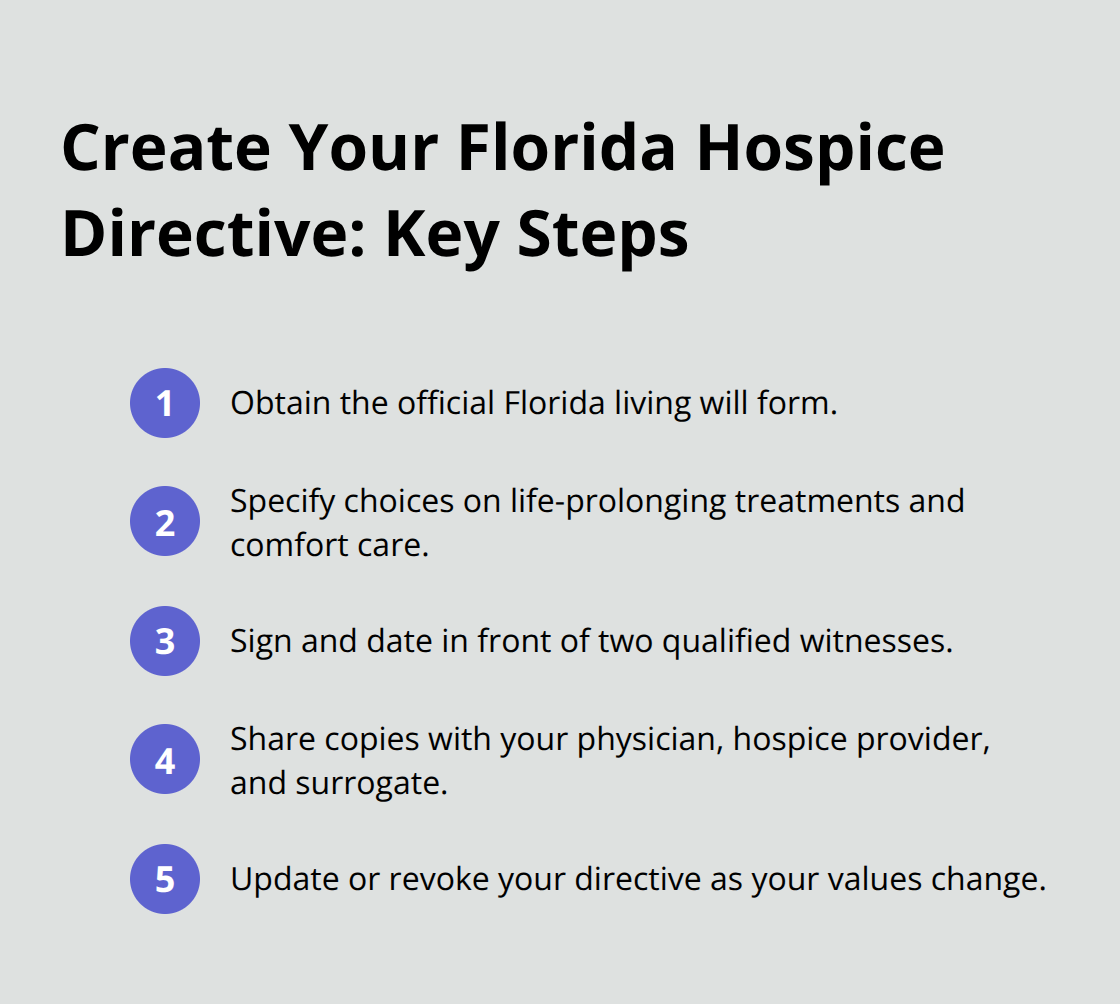
Florida provides official forms for living wills through the Agency for Health Care Administration, and obtaining the correct document is your first practical move. The form itself is straightforward-it asks you to initial boxes indicating whether you want life-prolonging procedures withheld or withdrawn if you develop a terminal condition, end-stage condition, or persistent vegetative state. Specificity matters here. Do not leave sections blank or unmarked; instead, clearly indicate your preferences for artificial nutrition, mechanical ventilation, CPR, and pain management.
Many people mistakenly believe they can write their own directive in plain language, but Florida courts give priority to the statutory form because it meets all legal requirements without ambiguity. Once you’ve completed the form, you must sign and date it in front of two witnesses.
Meet Witness Requirements Correctly
Florida Statute 765.302 requires that at least one witness have no blood relation to you and not be your spouse, your healthcare provider, or an employee of your healthcare facility. This witness requirement exists specifically to prevent coercion or undue influence. If you’re in a nursing home or hospice facility, do not ask staff members to witness-they have conflicts of interest. Instead, invite a trusted friend, your attorney, or a colleague from work.
Notarization is optional in Florida but adds a protective layer; if you choose to have the document notarized, the notary counts as one of your two required witnesses. After execution, give signed copies to your primary care physician, your hospice provider if you’ve already selected one, and your designated health care surrogate. Keep the original in an accessible location-not a safe deposit box where it might be difficult to retrieve during a medical emergency.
Share Your Directive With Your Healthcare Team
Communicating your directive to your healthcare team and family prevents the very misunderstandings that directives are designed to avoid. Schedule a conversation with your physician to discuss your end-of-life preferences before you need hospice care; this discussion clarifies your values and ensures your medical record documents your wishes alongside your legal directive. If you’ve designated a health care surrogate, meet with that person separately to confirm they understand your preferences and feel comfortable carrying out your instructions.
Many families in Northeast Florida have experienced conflict because the surrogate disagreed with the patient’s stated wishes or felt unprepared to enforce them. Avoid that trap with direct, honest conversations.
Use Five Wishes to Address Your Full Picture
Consider using Five Wishes, a tool developed by Aging with Dignity that goes beyond the statutory living will to address your medical, personal, emotional, and spiritual needs. Five Wishes is recognized as valid in Florida and helps frame conversations around comfort, dignity, and what matters most to you as death approaches. Share copies of your directive with your family members, not just your healthcare providers, so everyone knows what to expect.
Florida law does not require your family’s approval of your directive-your wishes control-but transparency prevents shock and resentment when medical decisions align with your documented preferences rather than family hopes.
Update Your Directive When Your Values Change
If you later change your mind about your directive, Florida law allows you to modify or cancel it at any time through a written, signed, and dated amendment, or even through an oral statement witnessed by another person. This flexibility means your directive can evolve as your values or health status change, but only if you actively update it. An attorney in St. Augustine or Palatka can help you integrate your hospice directive with your broader estate plan, ensuring your end-of-life preferences align with your will, trust, and designated surrogates.
Final Thoughts
A hospice directive Florida protects your autonomy and spares your family from guessing what you want when medical decisions become urgent. Write your directive now with specificity about your preferences for pain management and life-prolonging procedures, have two witnesses with no conflicts of interest sign it, and distribute copies to your physician, hospice provider, and designated health care surrogate. If your values shift over time, update your directive in writing and pair it with a health care surrogate designation to address both the medical and emotional dimensions of end-of-life care.
Integrating your hospice directive into your broader estate plan requires coordination with your will, trust, and family dynamics that goes beyond completing a form alone. Our team at Family, Estate & Mediation Law provides practical, client-centered guidance across Northeast Florida that preserves your dignity and protects your family from unnecessary conflict. Contact us in St. Augustine or Palatka to discuss how your hospice directive fits into your overall estate and family plan.