A holographic will Florida residents write by hand can seem like a quick estate planning solution. But Florida law has strict rules about what makes these handwritten wills valid, and many people get them wrong.
We at Family, Estate & Mediation Law help families in St. Augustine and Palatka understand whether a holographic will protects their estate or puts it at risk.
What Qualifies as a Holographic Will Under Florida Law
A holographic will is a document written entirely in your own handwriting and signed by you-nothing more. Florida Statutes Section 732.502 defines it clearly: a will you pen yourself, typically without witnesses. The appeal is obvious. You avoid attorney fees. You maintain privacy. You control every word. But here’s where Florida diverges sharply from other states. Florida does not recognize holographic wills executed within the state, period. Texas, California, Virginia, and North Carolina all accept them. Florida does not. This distinction matters enormously because many people relocate to Florida with valid holographic wills from their home states, assuming those documents remain valid. They do not. Florida law governs what happens to your Florida assets, regardless of where you wrote your will or how legally sound it was elsewhere.
The Foreign Will Exception and What It Actually Means
Florida recognizes one pathway for out-of-state holographic wills through the Foreign Will Exception under Florida Statutes Section 732.502(2). If you created a holographic will in another state where such wills are legal, and you later moved to Florida, that will can potentially be probated in Florida if it complies with the execution laws of the state where you created it or the state where you were domiciled when you signed it. The catch: this exception applies only to assets and only if the original jurisdiction’s law validates the document. Florida courts will examine whether your handwritten will met the requirements of Texas law, California law, or wherever you wrote it. If it did, probate may proceed. If it did not, Florida intestacy rules take over, and your estate distributes according to Florida’s default succession laws, which rarely align with your intentions. Moving to Florida does not preserve a holographic will created in-state. If you wrote a handwritten will after arriving in Florida, it is void. Period.
Why Formal Requirements Exist and What They Protect
Florida requires all valid wills to be in writing, signed by you at the end, and witnessed by at least two attesting witnesses who sign in your presence and in each other’s presence. These are not arbitrary bureaucratic hurdles. They exist because handwritten wills create measurable problems. Ambiguous language leads to probate disputes. Unclear intentions trigger family conflict. Authentication challenges waste thousands in legal fees. Handwritten documents often fail to address Florida’s homestead exemption, which protects your primary residence from creditors and limits spousal rights in specific ways. A handwritten will might inadvertently violate homestead protections or create tax inefficiencies that a properly drafted formal will would avoid. Crossing out words, adding margin notes, or inserting information by hand after you initially sign transforms your will into something courts treat as a holographic amendment-and amendments by hand are invalid in Florida. The original will stands, but your modifications do not. Courts will generally admit the original document and ignore your handwritten changes entirely, leaving your estate distributed contrary to your latest wishes. This is not theoretical. Probate courts in Florida handle these cases regularly, and the outcome is predictable: families fight, costs escalate, and the deceased’s actual intent remains unknown.
What Happens When a Holographic Will Fails
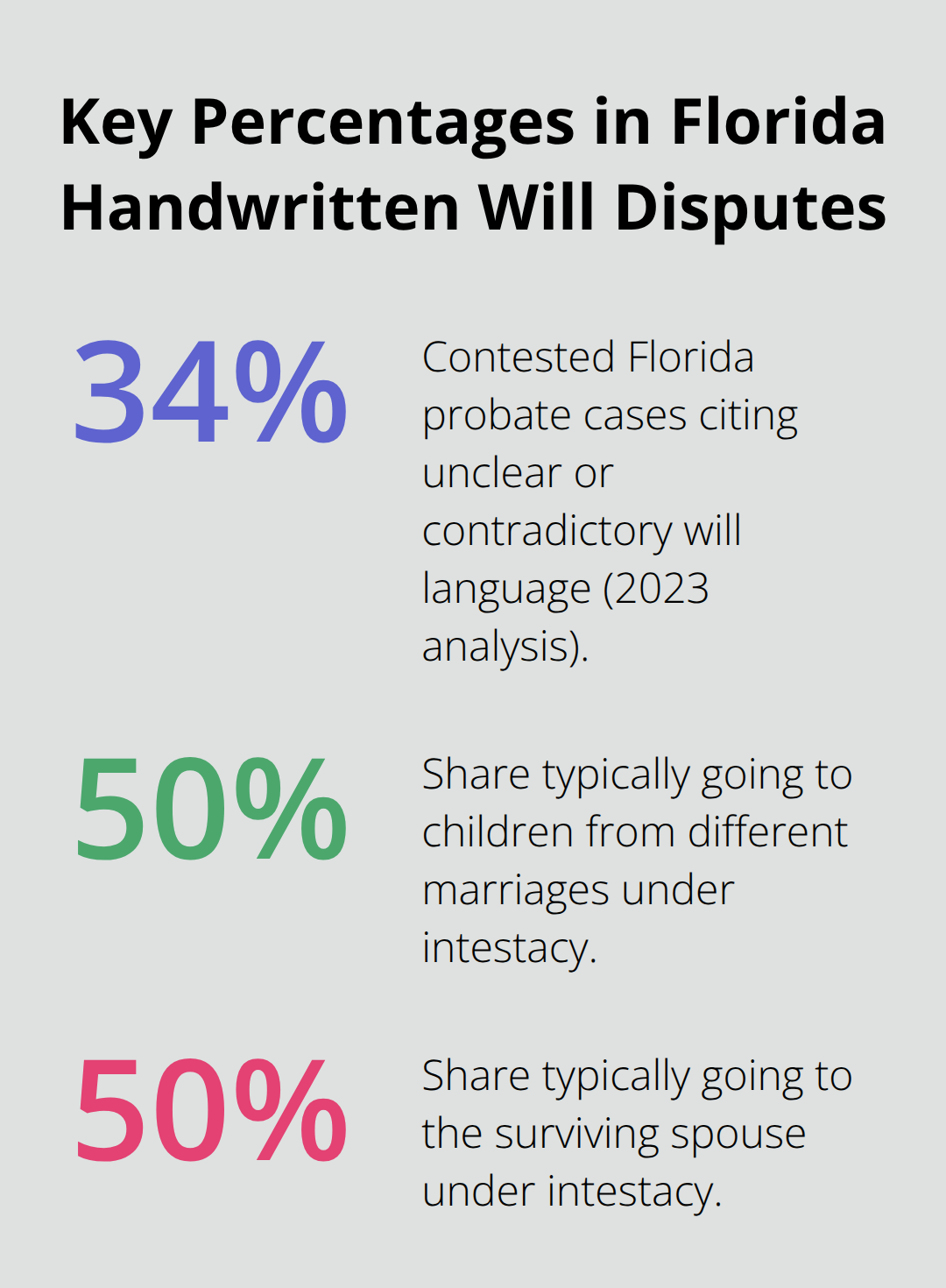
When a holographic will fails to meet Florida’s requirements, your estate does not simply pass to your intended beneficiaries. Instead, Florida intestacy statutes take control. If you have a surviving spouse with no children, that spouse inherits everything. If children exist, distributions depend on your marriage history. Children from different marriages typically receive 50% while the surviving spouse receives 50%. If you have no spouse, your children inherit everything in equal shares. If a child predeceases you, their descendants inherit per stirpes (by representation). Without spouse or children, your parents inherit. If parents are unavailable, siblings or their descendants receive your assets.
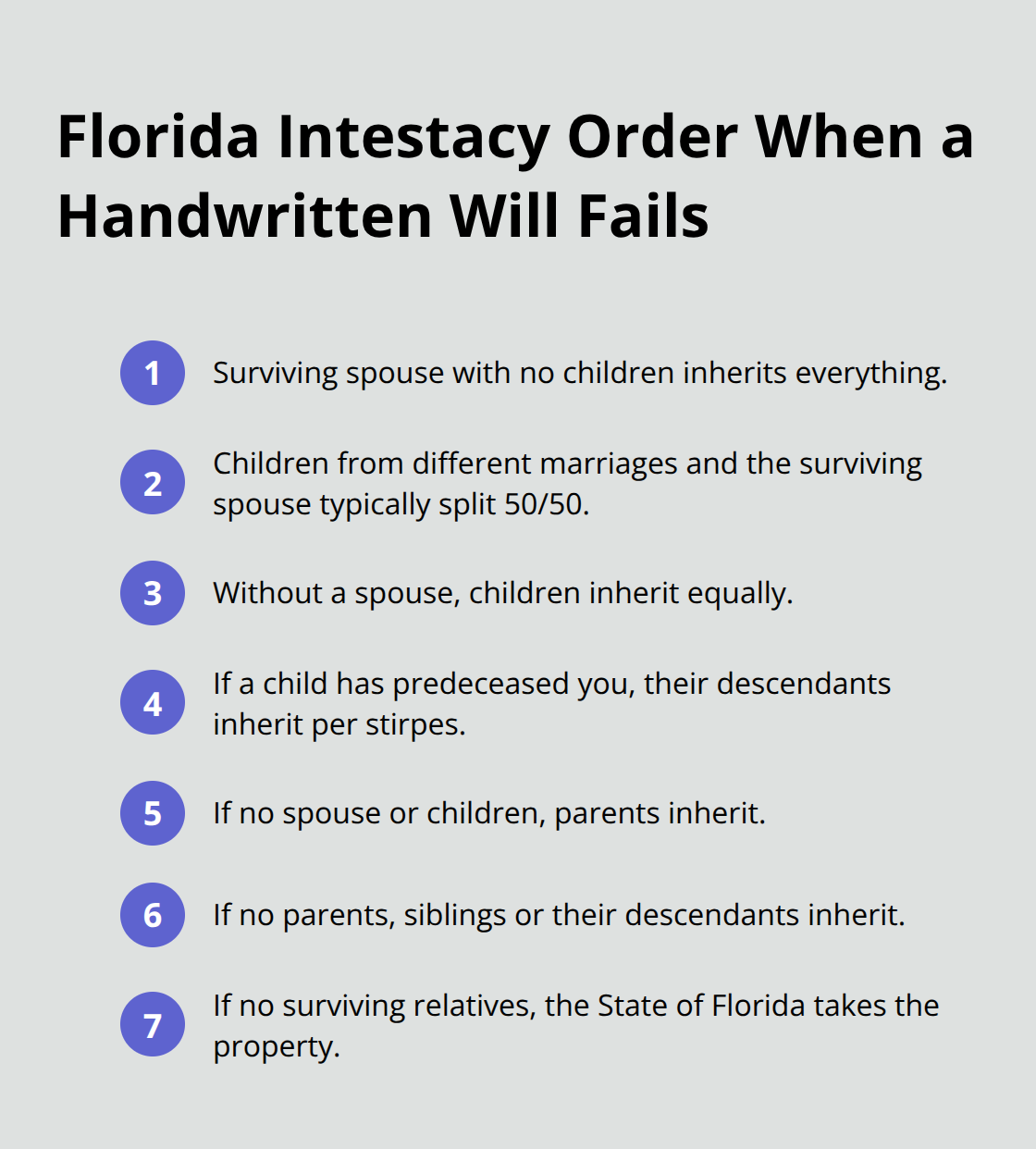
If no surviving relatives exist, the State of Florida takes your property. This default distribution rarely matches what you intended when you wrote that handwritten will. The probate process becomes longer, more expensive, and far more contentious than it would have been with a valid formal will. Your family members may contest the intestacy distribution, leading to litigation that consumes your estate’s value and damages relationships. Understanding these consequences helps explain why Florida’s formal requirements exist-they protect your actual wishes from being lost to default law.
The Real Cost of a Handwritten Will
Why Attorney Fees Pale Against Probate Litigation
You avoid attorney fees when you write a holographic will yourself. This apparent savings vanishes quickly once probate complications emerge. A formal will prepared by an attorney in Florida costs between $300 and $1,000 depending on complexity, while probate litigation over an invalid or ambiguous handwritten will routinely exceeds $5,000 to $15,000 in legal fees alone. The American Bar Association reports that contested probate cases average 18 to 24 months in duration, during which your family cannot access estate assets and relationships deteriorate under the stress of uncertainty. The math is stark: you save a few hundred dollars upfront and spend tens of thousands later.
Three Vulnerabilities That Handwritten Wills Create
A handwritten will exposes your estate to three specific problems. First, authentication challenges arise because courts must verify that you alone wrote the entire document in your own handwriting without assistance or coercion. Handwriting experts cost $1,500 to $3,000 per case, and their conclusions are often challenged by opposing parties.
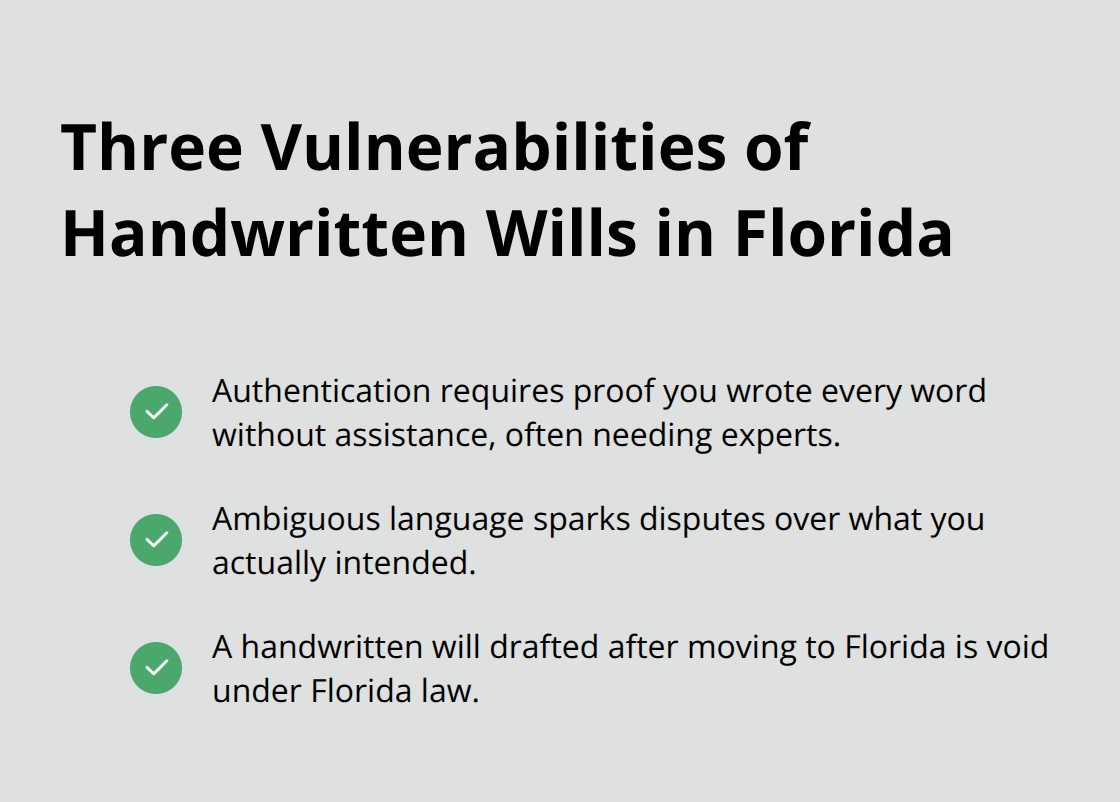
Second, ambiguous language in a handwritten will triggers disputes over your actual intentions. Phrases like “leave my property to my children” or “provide for my family” lack the specificity that formal wills require, forcing courts to interpret vague language and make assumptions about distributions you never explicitly stated. Third, a handwritten will drafted after you moved to Florida is simply void, meaning your estate defaults to Florida intestacy laws that almost certainly contradict your wishes.
When Complexity Makes Handwritten Wills Dangerous
If you have a blended family, multiple properties, minor children, or substantial assets, a handwritten will provides zero protection for these complexities. Florida’s homestead exemption protects your primary residence from creditors and limits spousal rights in specific ways. A handwritten will might inadvertently violate homestead protections or create tax inefficiencies that a properly drafted formal will would avoid. Crossing out words, adding margin notes, or inserting information by hand after you initially sign transforms your will into something courts treat as a holographic amendment-and amendments by hand are invalid in Florida. The original will stands, but your modifications do not. Courts will generally admit the original document and ignore your handwritten changes entirely, leaving your estate distributed contrary to your latest wishes.
The Limited Exception for Out-of-State Holographic Wills
The only scenario where a holographic will makes practical sense is if you created it years ago in a state that recognizes handwritten wills (such as Texas or California) and you can document that the will complied with that state’s execution requirements at the time. Even then, probating an out-of-state holographic will in Florida requires hiring an attorney to prove the original jurisdiction’s law was satisfied, which negates any cost savings. If you have already written a handwritten will in Florida, that document has no legal effect on your Florida assets, and your estate will be distributed according to intestacy law regardless of what your handwritten document says. The practical path forward is clear: replace it with a formal, witnessed will that actually protects your intentions and your family’s future. Understanding these vulnerabilities helps explain why Florida’s formal requirements exist-they protect your actual wishes from being lost to default law.
How Holographic Wills Fail in Florida Courts
Signature and Dating Problems That Courts Reject
Florida probate courts reject handwritten wills for concrete, measurable reasons. The most common failure occurs when a testator signs a handwritten document but fails to include a clear date or signs it ambiguously. Florida Statutes Section 732.502 requires the testator to sign at the end of the will, and courts interpret this requirement strictly. A signature in the margin, at the top of a page, or scattered across multiple pages creates immediate invalidity questions. Handwriting experts hired to authenticate disputed signatures charge $1,500 to $3,000 per case, and their conclusions frequently conflict, forcing judges to make assumptions about intent rather than applying clear legal standards.
Dating matters equally. A handwritten will without a date or with a date written in a different hand than the body text raises red flags about authenticity. Florida courts cannot determine whether you wrote the document before or after another will, whether you had testamentary capacity at the time of execution, or whether someone else added the date later. Without a reliable date, probate becomes a guessing game that costs your estate thousands in litigation fees while your family waits months or years for resolution.
Vague Language and Unclear Intentions
Ambiguous language in handwritten wills creates the second major failure point. Phrases like “leave my assets to my children” or “provide for my loved ones” lack the specificity required by Florida law. Courts must then interpret vague language, guess at distributions you never explicitly stated, and make decisions about property you intended for specific people. A 2023 analysis of contested Florida probate cases found that 34 percent of disputes stemmed from unclear or contradictory language in wills, with average litigation costs exceeding $12,000 per case.
Handwritten amendments compound this problem dramatically. If you cross out words, add margin notes, or insert information by hand after the initial signing, Florida courts treat these changes as holographic amendments, which are invalid under Florida law. The original will stands untouched while your handwritten modifications are discarded entirely, leaving your estate distributed contrary to your latest wishes.
The Two-Witness Requirement That Handwritten Wills Violate
The third failure involves the two-witness requirement. Florida requires at least two attesting witnesses present simultaneously when you sign the will, and both witnesses must sign in your presence and each other’s presence. Many people who write handwritten wills sign them alone, show the document to one person, or have witnesses sign at different times. None of these approaches satisfy Florida law. Without proper witness attestation, your handwritten will has zero legal standing in Florida, regardless of how clearly you wrote it or how carefully you dated it.
Final Thoughts
If you have written a holographic will in Florida or brought one from another state, you need to understand whether that document actually protects your estate. We at Family, Estate & Mediation Law review handwritten wills for Florida residents in St. Augustine and Palatka to identify vulnerabilities before they create probate disasters. Many people discover too late that Florida courts reject their holographic will entirely, leaving their families to navigate intestacy laws that contradict their wishes.
Our review process examines whether your handwritten will meets Florida’s formal requirements, whether it qualifies under the Foreign Will Exception if created out-of-state, and what risks it poses to your estate. If your holographic will is invalid or incomplete, we guide you through transitioning to a formal, witnessed will that actually protects your intentions. For families with blended relationships, multiple properties, or minor children, we develop comprehensive estate plans that address Florida’s homestead exemption, tax efficiency, and guardianship provisions that handwritten documents cannot handle.
Contact Family, Estate & Mediation Law at our St. Augustine or Palatka office to schedule a consultation. We provide practical strategies that preserve your legacy and protect your family’s future. The cost of professional estate planning is minimal compared to the thousands you will spend on probate litigation if your handwritten will fails.