A trust is one of the most effective ways to protect your family’s future and control how your assets are distributed. Many families overlook this tool, choosing wills instead-a decision that often costs them time, money, and privacy during probate.
At Family, Estate & Mediation Law, we guide families through trust creation steps that transform a simple idea into a fully funded, legally sound estate plan. This guide walks you through each phase, from identifying your assets to funding your trust with the accounts and property that matter most.
What Makes a Trust Different From a Will
A trust is a legal arrangement where you transfer ownership of your assets to a separate entity that holds them for the benefit of your chosen beneficiaries. Unlike a will, which only takes effect after your death and must go through probate, a trust operates immediately and keeps your estate completely private. Probate costs families an average of 3 to 7 percent of estate value according to the American Bar Association, and it can take anywhere from six months to several years to complete. A funded trust bypasses this entirely, meaning your beneficiaries receive their inheritance without court involvement, without public disclosure of your assets, and without the delays that plague traditional wills. This is why families increasingly prefer trusts: they work harder during your lifetime and continue working after you’re gone.
The Trust Types That Actually Matter
Revocable living trusts remain the most practical choice for most families because you maintain complete control over your assets while alive and can modify the trust whenever circumstances change. Irrevocable trusts, by contrast, cannot be altered once established, but they offer serious tax advantages and asset protection benefits that make them valuable for high-net-worth individuals or those concerned about creditor claims. Testamentary trusts, which are created within your will and only activate after death, don’t provide the privacy or probate avoidance benefits of living trusts, so they’re rarely the best option for primary estate planning. The right trust structure depends on your specific situation rather than a one-size-fits-all approach.
Why Trusts Win Over Wills for Real Families
Wills require probate validation in court, meaning judges must officially recognize your will’s authenticity before distribution can occur. This public process exposes your entire estate to scrutiny, takes months or years to finalize, and generates substantial legal fees that reduce what your family actually receives. A trust avoids all three problems.
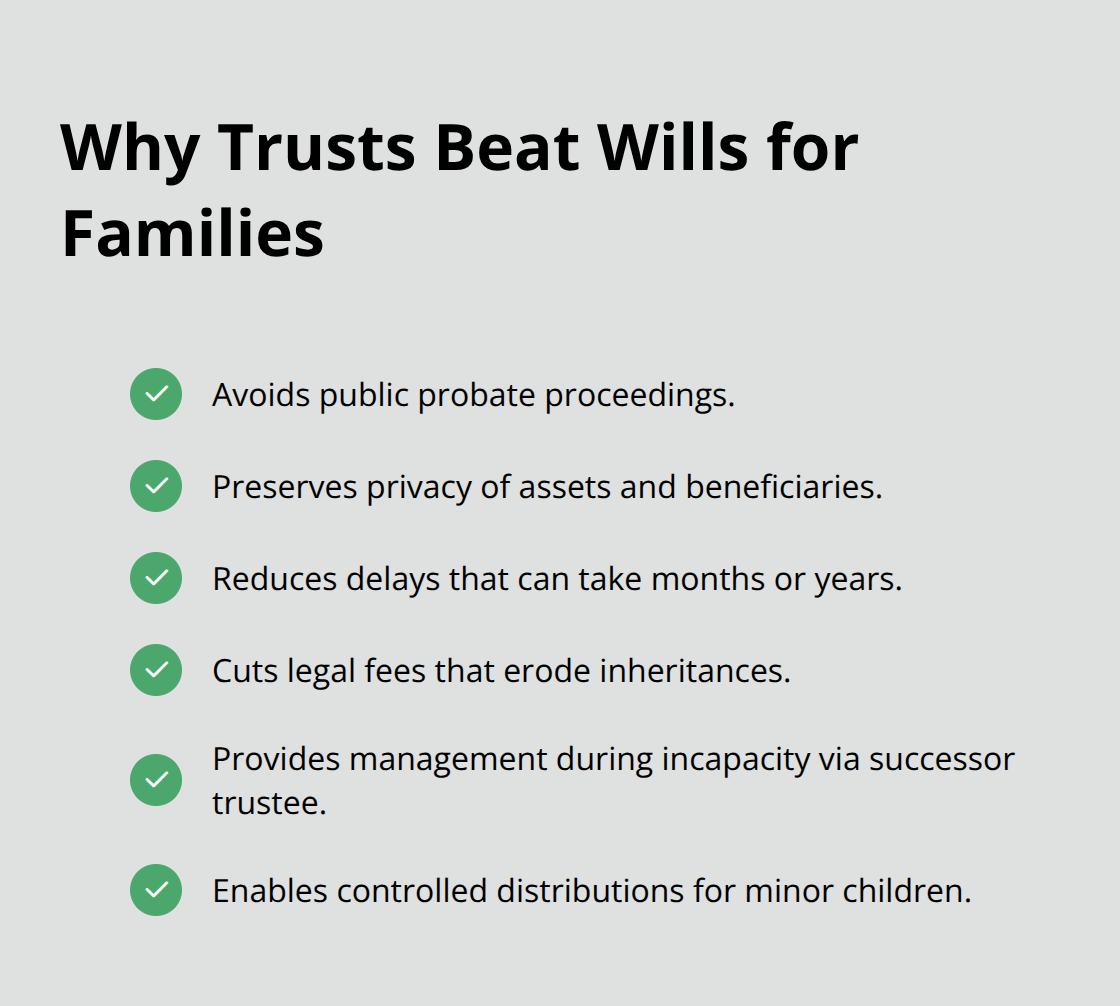
Additionally, if you become incapacitated before death, a will does nothing to manage your affairs, whereas a revocable trust allows your successor trustee to step in immediately and handle finances and property without court intervention. For families with minor children, trusts offer far superior protection because you can specify exactly when and how distributions occur rather than having a court-appointed guardian control everything until children reach age eighteen.
Moving From Understanding to Action
Now that you understand how trusts function and why they outperform wills, the next step involves identifying what you actually own and who you want to benefit from it. This foundation determines everything that follows in your trust creation process.
Building Your Trust From the Ground Up
Creating a trust requires three concrete decisions that determine whether your plan actually protects your family or sits incomplete and ineffective. The first decision involves cataloging everything you own and deciding who inherits what. Most families underestimate their assets significantly. You own more than you think: your primary residence, rental properties, bank accounts, investment portfolios, vehicles, business interests, life insurance policies, retirement accounts, and personal property with sentimental value all factor into your calculation. Create a detailed inventory spreadsheet that lists each asset, its current value, and how it’s currently titled. This spreadsheet becomes your roadmap for the entire trust creation process. Simultaneously, identify your beneficiaries with specificity. Naming someone as a beneficiary means deciding not just who receives assets, but when they receive them and under what conditions. For example, do you want adult children to inherit immediately, or would you prefer distributions at age thirty or forty? Do you want a surviving spouse to receive everything, or should your children from a previous marriage receive a portion? These decisions shape your trust structure and cannot be made casually. Many families make the mistake of assuming their beneficiary wishes are obvious, then discover years later that relatives had completely different expectations about inheritance.
Selecting the Right Trustee Matters More Than Most Realize
Your trustee is the person or institution responsible for managing trust assets after your death and ensuring distributions follow your wishes exactly. This role requires someone who is financially responsible, organized, and able to manage relationships with beneficiaries without playing favorites. Far too many families appoint a family member out of obligation rather than capability, then watch the trust become a source of conflict instead of protection. If you name your eldest son as trustee when he has no financial management experience and your younger daughter is an accountant, you have created a recipe for disaster. Consider whether your chosen trustee can actually handle the responsibilities: reviewing account statements, filing tax returns, making investment decisions, keeping detailed records, and communicating with beneficiaries about distributions. If your family lacks someone with these skills, a professional trustee such as a bank trust department or corporate trustee is the better choice, even though it costs money. Name a successor trustee who takes over if your first choice becomes unable or unwilling to serve. This prevents your estate from stalling due to an unexpected death, illness, or resignation.
Getting Your Trust Document Right From the Start
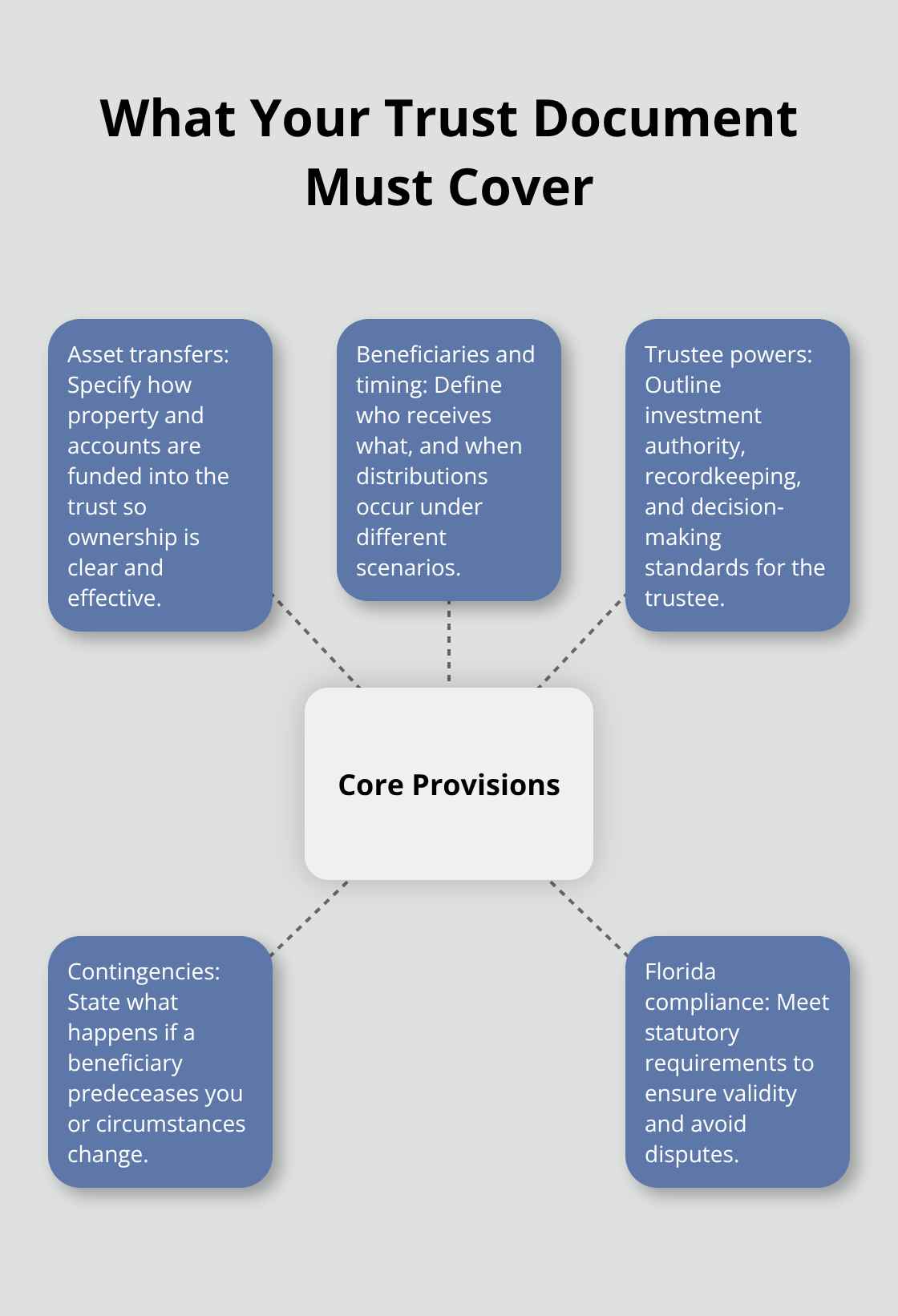
Once you have identified your assets and chosen your trustee, you need a trust document that accurately reflects your wishes and complies with Florida law. This is not a task for online template services or generic documents downloaded from the internet. A poorly drafted trust creates ambiguity about your intentions, exposes your family to disputes, and may not accomplish the tax benefits or asset protection you intended. A trust document must specify how assets transfer into the trust, which beneficiaries receive what, when distributions occur, how the trustee handles investment decisions, what happens if a beneficiary dies before you do, and numerous other technical details. State law requirements vary significantly, and Florida trusts must meet specific statutory standards to be enforceable.
Work with an attorney who understands Florida estate law to ensure your trust document is drafted correctly the first time and includes provisions that address your family’s unique circumstances (rather than generic language that applies to nobody’s actual situation). This foundation of proper documentation sets the stage for the next critical phase: transferring your actual assets into the trust so it functions as intended.
Funding Your Trust: The Step That Makes Everything Work
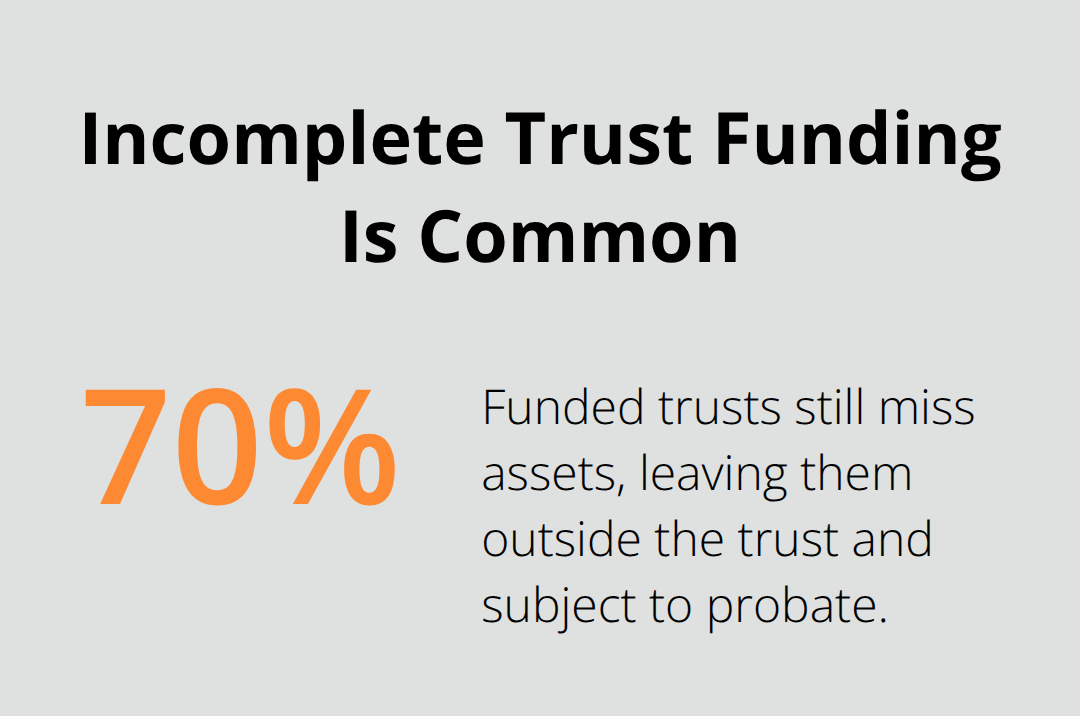
A trust document sitting in a drawer accomplishes nothing. Your trust only protects your family and avoids probate when you transfer your actual assets into it, and this funding process is where most families stumble. Many people create a trust, pay an attorney to draft it properly, then never complete the most critical step: retitling their assets in the trust’s name. According to the American College of Trust and Estate Counsel, approximately 70 percent of funded trusts contain incomplete funding, meaning some assets remain titled in the individual’s name instead of the trust. When that happens, those unfunded assets still go through probate, defeating the entire purpose of creating the trust in the first place.
Your successor trustee cannot access assets that are not in the trust without going to court, which means your family faces exactly the delays and expenses you created the trust to avoid.
How to Transfer Real Estate Into Your Trust
Real estate is typically the largest asset families own, and transferring property into a trust means executing a new deed that names the trust as the owner instead of you personally. In Florida, this deed transfer does not trigger a property reassessment or change your property tax status under the homestead exemption, provided the transfer occurs between you and your revocable living trust. You must file the new deed with the county clerk’s office where the property is located, and you should obtain title insurance for the trust deed to protect against any claims to the property. Many title companies offer this coverage for minimal additional cost when you transfer an existing policy.
Do not attempt this transfer yourself using an online template or generic deed form. A deed must contain specific legal language, accurate property descriptions, and proper notarization to be enforceable. A single error in the property description or deed language can cloud the title and create problems when your trustee later attempts to sell the property or distribute it to beneficiaries. Work with an attorney to prepare the deed correctly, then file it immediately. Some families wait months or years to transfer property into their trust, then discover they have created a gap in their plan. The longer you wait, the greater the risk that you become incapacitated before the transfer occurs, which then requires a court guardianship or conservatorship to complete the funding process.
Retitling Bank and Investment Accounts
Financial institutions require you to retitle accounts in the trust’s name rather than your individual name. This means contacting your bank, investment firm, and brokerage to request new account registrations. Most institutions have a straightforward process: you provide a copy of the trust document, complete a transfer form, and the account is retitled. Some banks or brokerages resist this process or claim they cannot retitle accounts without closing and reopening them, which would trigger capital gains taxes on investment accounts. This is incorrect. Federal law permits direct retitling without triggering tax consequences, and if an institution refuses to cooperate, switch to a financial institution that understands trust funding.
Gather statements from every account you hold: checking, savings, money market, investment accounts, brokerage accounts, certificates of deposit, and any other financial holdings. Create a spreadsheet with account numbers, current balances, and the institution’s contact information for the trust funding department. Call each institution and request the specific forms and procedures for retitling the account into your trust name. This process typically takes two to four weeks per institution. Do not assume that accounts with payable-on-death designations or transfer-on-death designations need retitling. These accounts bypass probate through their own mechanisms and do not need to be in the trust, though consolidating them into the trust provides cleaner management and ensures your successor trustee controls all assets through a single document.
Updating Beneficiary Designations on Insurance and Retirement Accounts
Life insurance policies and retirement accounts like IRAs, 401(k)s, and pension plans have designated beneficiaries, and these designations override your trust document entirely. You cannot simply retitle an IRA into your trust’s name without triggering immediate tax consequences and destroying the account’s tax-deferred growth. Instead, review the beneficiary designations on every insurance policy and retirement account and update them to name your trust as beneficiary if that aligns with your estate plan. This approach allows the death benefit or account balance to pass directly to your trust outside of probate while preserving the account’s tax treatment.
Some families name their trust as beneficiary of a life insurance policy specifically to ensure the proceeds are managed according to trust terms rather than distributed directly to individual beneficiaries who may be minors or financially irresponsible. If you own a life insurance policy, contact your insurance agent and request a beneficiary designation form. Verify the current beneficiary, confirm whether you want the trust to receive the proceeds, and update the form if necessary. The same process applies to retirement accounts: contact the financial institution holding the IRA or 401(k), request the beneficiary designation form, and update it if your plan has changed since you originally opened the account. Many people discover during trust planning that their beneficiary designations are outdated or name ex-spouses, deceased relatives, or people they no longer want to benefit. This funding phase gives you the opportunity to correct those mistakes before it is too late.
Final Thoughts
Creating a trust transforms your estate from a potential source of family conflict and financial waste into a protected legacy that reflects your actual wishes. The trust creation steps we’ve outlined-identifying assets, selecting a trustee, drafting proper documentation, and funding every account-take time and attention, but they eliminate years of probate delays and thousands in unnecessary fees that would otherwise reduce what your family receives. Starting now matters because delays create risk, and every month you postpone funding your trust is a month closer to an unexpected illness or accident that could leave your estate plan incomplete.
The most common mistakes families make are straightforward to avoid: they create a trust document but never fund it, leaving assets scattered across multiple titles and designations that still require probate; they name a trustee based on family obligation rather than actual capability, then watch the trust become a source of resentment instead of protection; or they use generic online templates that miss Florida-specific requirements or fail to address their family’s unique circumstances. Delays in property deed transfers pose particular danger because incapacity can strike before the transfer is complete, forcing your family into a guardianship crisis that the trust was meant to prevent.
Your next step is to gather your financial statements, property deeds, and insurance policies, then contact an attorney who understands Florida estate law and can guide you through proper trust creation and funding. We at Family, Estate & Mediation Law Group help Northeast Florida families build estate plans that actually work and transform your trust from an idea into a fully funded plan that protects everything you’ve built. Schedule a consultation with us to get started.