
A power of attorney in Florida gives someone you trust the legal authority to handle your finances, property, or medical decisions if you become unable to do so yourself. Without one in place, your family may face costly court proceedings to manage your affairs.
At Family, Estate & Mediation Law, we’ve helped countless Florida residents protect their interests by creating clear, legally valid powers of attorney. This guide walks you through what you need to know and how to avoid costly mistakes.
What a Power of Attorney Actually Does in Florida
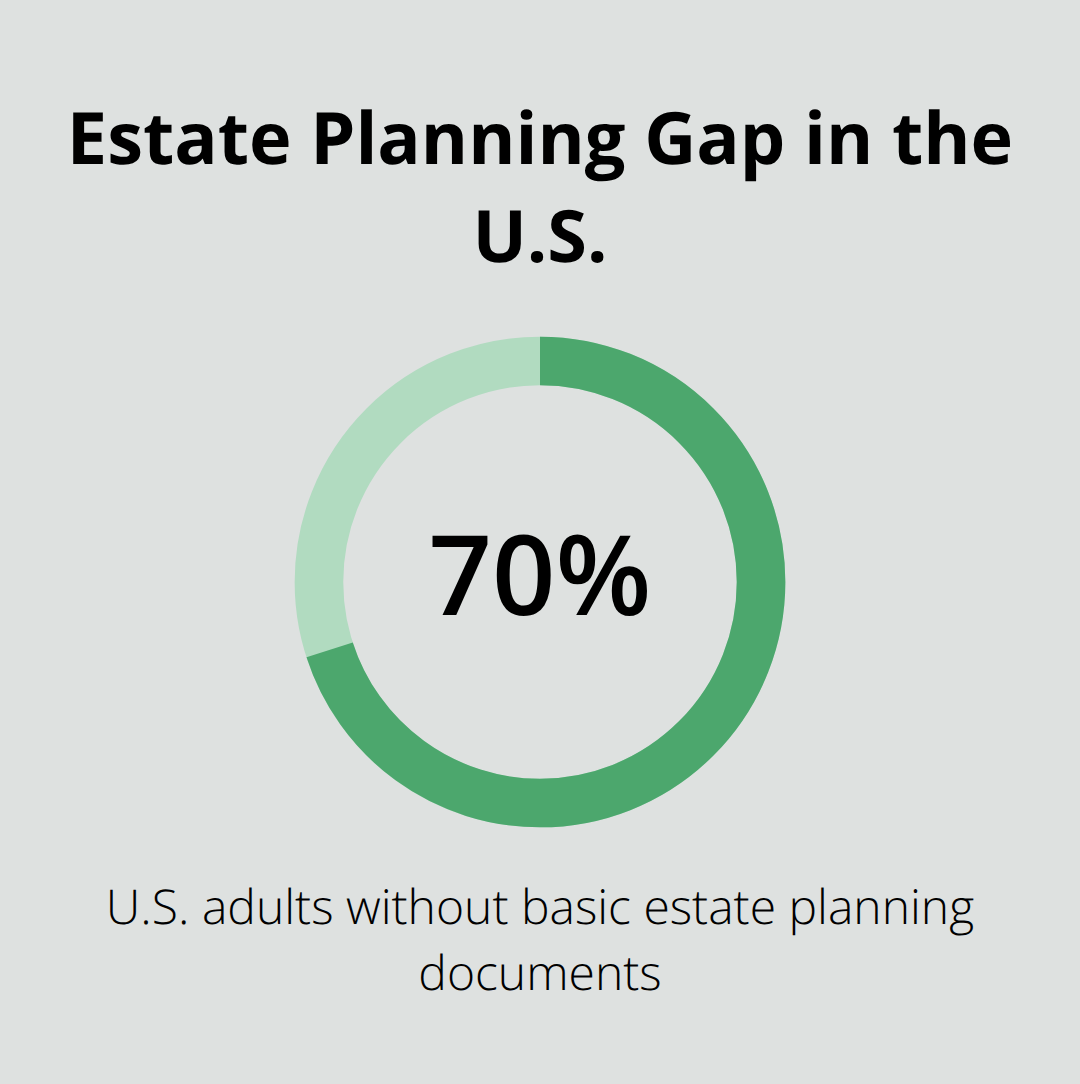
A power of attorney is a legal document that grants someone you select the authority to act on your behalf in specific matters. In Florida, this document becomes invaluable when illness, injury, or cognitive decline prevents you from managing your own affairs. According to the American Bar Association, nearly 70% of American adults lack basic estate planning documents, leaving their families vulnerable to expensive guardianship proceedings if incapacity occurs.
Types of Powers of Attorney in Florida
Florida law recognizes several types of powers of attorney, each serving different purposes depending on your situation. A general power of attorney covers broad financial matters like banking and property management. A limited power of attorney restricts the agent’s authority to specific transactions, such as selling a particular piece of real estate or handling a business sale.
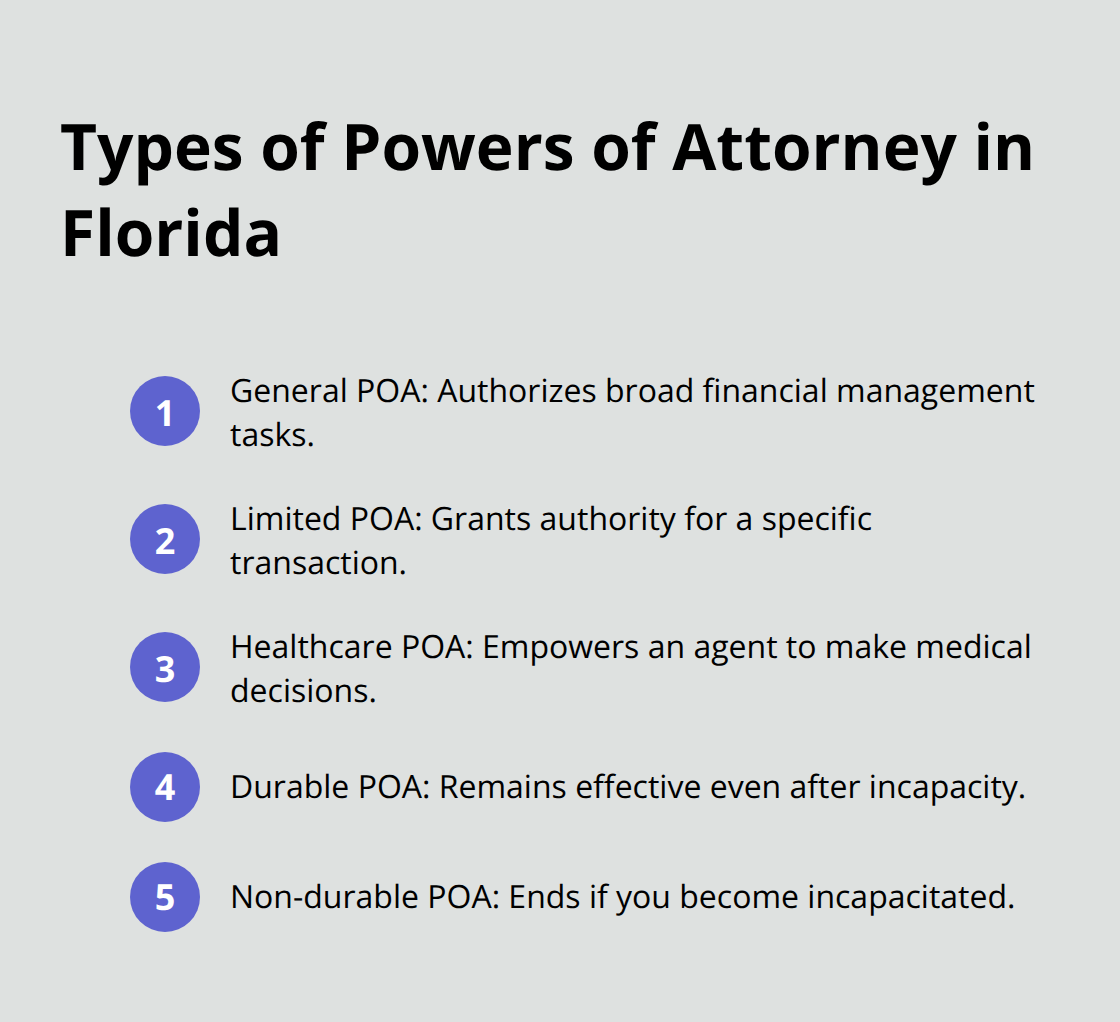
A healthcare power of attorney, also called a healthcare proxy, addresses medical decisions exclusively. Florida Statute 709.2202 specifically defines these requirements, and the distinction between durable and non-durable matters tremendously because a non-durable document leaves your family with no authority to act precisely when they need it most.
Why Durability Changes Everything
The durable designation separates genuinely protective documents from paperwork that fails when you need it. If you create a non-durable power of attorney and then suffer a stroke or develop dementia, that document becomes worthless the moment incapacity sets in. Your family then faces guardianship court proceedings that cost $5,000 to $15,000 in legal fees and require ongoing court supervision of all financial decisions.
Durable powers of attorney continue to function after incapacity occurs. Most Florida residents should prioritize durable powers because the odds of needing them are real. The Alzheimer’s Association reports that one in three seniors dies with some form of dementia, and stroke remains a leading cause of adult disability. Those statistics mean incapacity isn’t theoretical for many families-it’s a genuine risk that affects financial security and family stability.
Moving Forward With Your Protection Strategy
The protection that durable powers of attorney provide far outweighs the minimal additional cost compared to non-durable alternatives. Understanding which type fits your situation sets the foundation for creating a document that actually protects your interests when you need it most. The next step involves learning exactly what makes a power of attorney legally valid in Florida and how to avoid the mistakes that render these documents useless.
When You Need a Power of Attorney
Financial incapacity strikes without warning, and Florida residents face real consequences when they lack the documents to address it. A spouse hospitalized after a car accident cannot pay bills or access joint accounts without a financial power of attorney already in place. Banks will not honor verbal instructions from family members, and without a valid document, your loved ones must petition the court for guardianship-a process that takes months and costs $5,000 to $15,000 in legal fees while your bills accumulate unpaid. The practical reality is that financial powers of attorney should exist before you need them, not after. Florida Statute 709.2202 allows immediate activation of durable financial powers once signed and notarized, meaning your agent can access accounts, pay mortgages, and manage investments the day after your incapacity occurs.
Financial Powers of Attorney and Immediate Access
A financial power of attorney grants your agent the ability to act on your behalf in money matters without court involvement. Your agent can pay household expenses, manage bank accounts, handle investment decisions, and conduct business transactions the moment incapacity occurs. This immediate authority prevents the financial chaos that accompanies guardianship proceedings. Without this document in place, creditors continue collecting interest on unpaid debts, mortgage payments lapse, and investment opportunities disappear while courts process paperwork.
Healthcare Powers of Attorney and Medical Decision-Making
Healthcare powers of attorney operate on a different timeline and require separate consideration. A healthcare power of attorney (also called a healthcare proxy) gives your designated agent authority to make medical decisions when you cannot communicate your wishes. This document becomes active only when your physician confirms you lack capacity to make decisions, which differs fundamentally from financial powers that activate immediately upon incapacity. A hospital will not accept a healthcare power of attorney for financial decisions, and a financial power does nothing when doctors need to decide whether to pursue aggressive treatment or hospice care. The critical distinction matters because each document serves a specific purpose that the other cannot fulfill.
Real Estate Transactions and Property Authority
Real estate transactions present a third scenario where powers of attorney prove invaluable. Selling rental property, refinancing a mortgage, or transferring a vacation home requires the owner’s signature on numerous documents. If you become incapacitated before completing a real estate transaction, your agent needs specific authority to sign deeds, mortgage documents, and closing papers on your behalf. A limited power of attorney works here (granting authority only for that specific property transaction), or a general durable power can handle multiple real estate matters simultaneously. Florida title companies and real estate attorneys will demand evidence that your agent’s authority extends to real estate, so the power of attorney document must explicitly state this authorization.
Timing Determines Protection
The timing of when you create these documents shapes whether they actually protect you when needed. Incapacity does not wait for paperwork to catch up, and the families who avoid costly guardianship proceedings are those who prepared in advance. Creating a power of attorney while you retain full capacity and decision-making ability ensures the document reflects your true wishes and meets all Florida legal requirements. The next step involves understanding exactly what makes a power of attorney legally valid in Florida and how to avoid the mistakes that render these documents useless.
Creating a Valid Power of Attorney in Florida
Florida law requires specific formalities that separate legally binding documents from worthless paperwork sitting in a drawer. Florida Statute 709.2202 mandates that you sign a power of attorney in the presence of two witnesses and a notary public, or alternatively, you can acknowledge it before a notary without witnesses. Both witnesses must be at least 18 years old, and Florida law explicitly prohibits your agent from serving as a witness. Many Florida residents create documents online using templates that skip the notarization requirement, only to discover later that banks and title companies reject them because they lack proper authentication. Financial institutions will not accept a power of attorney without notarization, meaning your agent cannot access funds or pay bills when you need them most. Families waste time and money trying to enforce unnotarized powers of attorney that hold no legal weight.
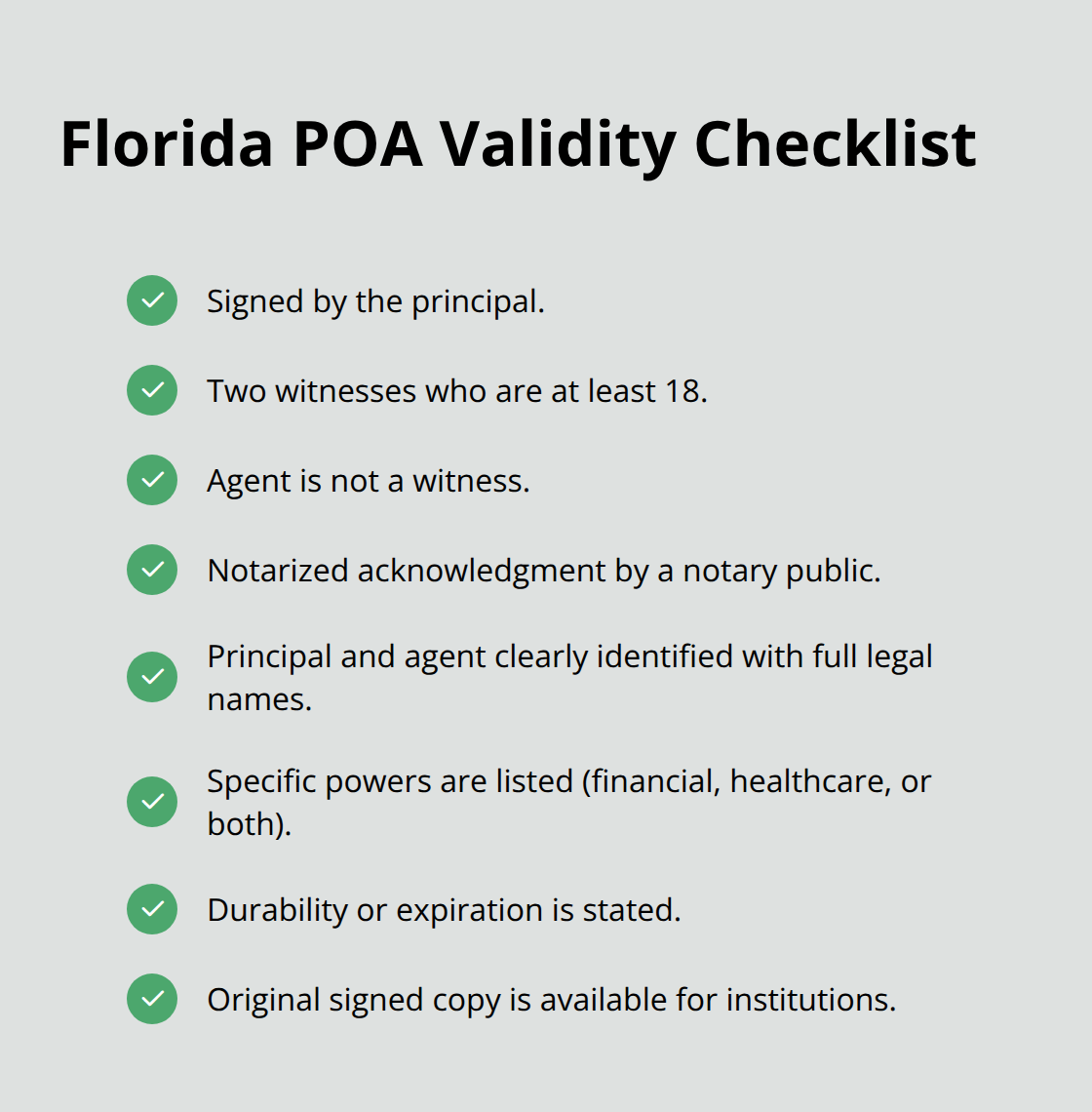
The document must also clearly identify you as the principal, name your agent with full legal name and address, specify which powers you grant (financial, healthcare, or both), and state whether the power is durable or limited in duration. Florida courts have consistently held that vague language about your agent’s authority creates disputes that require litigation to resolve, adding thousands in legal fees when the whole point of a power of attorney is avoiding court involvement.
What Makes a Power of Attorney Legally Valid
Florida Statute 709.2202 sets out the exact requirements your document must meet. You must sign the power of attorney, and two witnesses who are at least 18 years old must observe your signature. Your agent cannot serve as one of these witnesses, and a notary public must acknowledge the document. The power of attorney must clearly state your name as the principal and include your agent’s full legal name and address. You must specify which powers you grant-financial authority, healthcare decisions, or both-and indicate whether the power is durable or expires on a specific date. Vague or ambiguous language about your agent’s authority creates legal disputes that courts must resolve through expensive litigation. Banks, title companies, and healthcare providers will scrutinize the document to confirm your agent’s authority matches what they need to accomplish.
Selecting an Agent Who Can Handle the Responsibility
Selecting the right agent matters more than most people realize because this person will control your finances or make medical decisions when you cannot. Your agent must be someone you trust completely with sensitive information and significant responsibility, not someone you feel obligated to name because of family relationships. Many Florida residents select a spouse or adult child without considering whether that person has the temperament, financial literacy, or time to manage complex matters like investment accounts or real estate transactions. A poor choice leaves your affairs in chaos or creates family conflict over whether your agent is acting in your best interest. Consider naming a successor agent in case your first choice becomes unavailable through death or unwillingness to serve. Avoid naming co-agents with equal authority because disagreements between them can paralyze decision-making when action is urgent. The power of attorney document should specify whether your agent can delegate authority to others, and Florida law permits agents to hire professionals like accountants or attorneys to assist with complex tasks. Discuss the role with your chosen agent before finalizing the document to confirm they understand the responsibilities and will actually accept the position when needed.
Mistakes That Render Powers of Attorney Unenforceable
Common errors that destroy the legal validity of powers of attorney include using someone else’s template without customizing it for your specific situation, failing to address both financial and healthcare decisions separately, and omitting your signature or notarization entirely. A document so broad or vague that institutions cannot determine what authority actually exists will face rejection from banks and healthcare providers. You must ensure the notarization occurs in front of a qualified notary public (not just any witness), and the notary must complete all required sections of the acknowledgment form. Backdating a power of attorney or creating one after you have already lost capacity makes the document invalid and unenforceable. Failing to specify whether the power is durable means it automatically terminates if you become incapacitated, defeating the primary reason most people create these documents. Naming someone as your agent without their knowledge or consent creates problems when they refuse to serve or discover responsibilities they never anticipated. The document must be an original signed copy (not a photocopy) for most financial institutions and healthcare providers to accept it.
Final Thoughts
A power of attorney in Florida protects your family from financial chaos and expensive court proceedings when incapacity strikes. The document itself costs far less than guardianship litigation, yet most Florida residents never create one until crisis forces the issue. Establishing a durable financial power of attorney and a separate healthcare power before you need them eliminates the uncertainty that leaves families scrambling for court intervention. Your agent gains immediate authority to pay bills, manage accounts, and handle property matters the moment incapacity occurs, preventing creditors from collecting unpaid debts and keeping your financial life stable during your most vulnerable period.
Creating a valid power of attorney in Florida requires attention to specific legal requirements that templates and online services frequently overlook. Notarization matters, witness signatures matter, and clear language about your agent’s authority matters. A document that fails these requirements sits worthless in a drawer while your family faces the exact guardianship proceedings you intended to avoid. Selecting the right agent also shapes whether your power of attorney actually protects your interests or creates family conflict and financial mismanagement.
We at Family, Estate & Mediation Law understand the specific requirements Florida law imposes and the mistakes that render otherwise well-intentioned documents unenforceable. If you’re ready to protect your family from the financial and emotional burden of guardianship proceedings, contact us to discuss your situation and create a power of attorney that actually works when you need it most.