Most St. Augustine residents put off estate planning because they think it’s only for the wealthy or elderly. The truth is that without a solid plan in place, your family could face years of probate delays, unexpected tax bills, and costly disputes over your assets.
At Family, Estate & Mediation Law, we’ve seen firsthand how the right St. Augustine estate planning strategy protects what matters most. This guide walks you through the documents you need, the mistakes to avoid, and how to build a plan that actually works for your family.
Why Estate Planning Matters in St. Augustine
Florida’s Probate System Creates Real Delays
Florida’s probate system moves slowly, and St. Augustine families often underestimate how long it takes. When someone dies without a plan, their estate enters probate court, where it typically takes 6 to 12 months to close-sometimes stretching to 2 years for complicated cases. During this time, the family cannot access funds, sell property, or settle debts. The Florida court system processes thousands of estates annually, and delays compound when documents are missing or unclear.
Probate costs money that most families don’t anticipate. Court fees, attorney fees, and administrative costs typically consume 3 to 7 percent of the estate’s value. A $500,000 estate could lose $15,000 to $35,000 just in probate expenses. This is why trusts and other strategies that bypass probate entirely make financial sense for St. Augustine families.
Tax Situations Hit Harder Than Most Expect
Florida residents face specific tax situations that most don’t anticipate. While Florida has no state income tax-a major advantage-federal estate taxes still apply to estates exceeding $13.61 million as of 2024. For married couples, this threshold doubles to $27.22 million.
Many families make the mistake of thinking small estates don’t need planning. Even moderate estates face capital gains taxes on inherited property, and without proper titling, beneficiaries pay taxes on the full stepped-up value rather than receiving tax-free appreciation. Beneficiary designations on retirement accounts and life insurance policies often override what a will states, yet most people never review these after major life changes like divorce or remarriage. A surviving spouse might accidentally name an ex-partner as the beneficiary of a $300,000 life insurance policy simply because the designation was never updated.
Protecting Your Family’s Immediate Needs
The real reason to plan now is protecting what your family actually needs. When a parent dies without a clear plan, the surviving spouse must petition the court to become the administrator, often facing delays before accessing joint accounts or managing property. Young children require a guardian, and without a will naming one, the court decides-sometimes placing them with relatives you wouldn’t have chosen. Medical decisions fall to whoever the court appoints, which might not align with your wishes.
Digital Assets Create Hidden Complications
Digital assets complicate everything further. Most families have no inventory of online bank accounts, cryptocurrency, email accounts, or social media profiles. When someone dies, accessing these accounts becomes a legal nightmare without proper documentation. Creating a detailed asset inventory stored securely (including usernames, passwords, and account locations) saves families months of frustration and prevents financial loss from forgotten accounts.
This foundation of understanding probate delays, tax exposure, and family protection needs shapes what documents your St. Augustine family actually requires.
Key Estate Planning Documents Every St. Augustine Family Needs
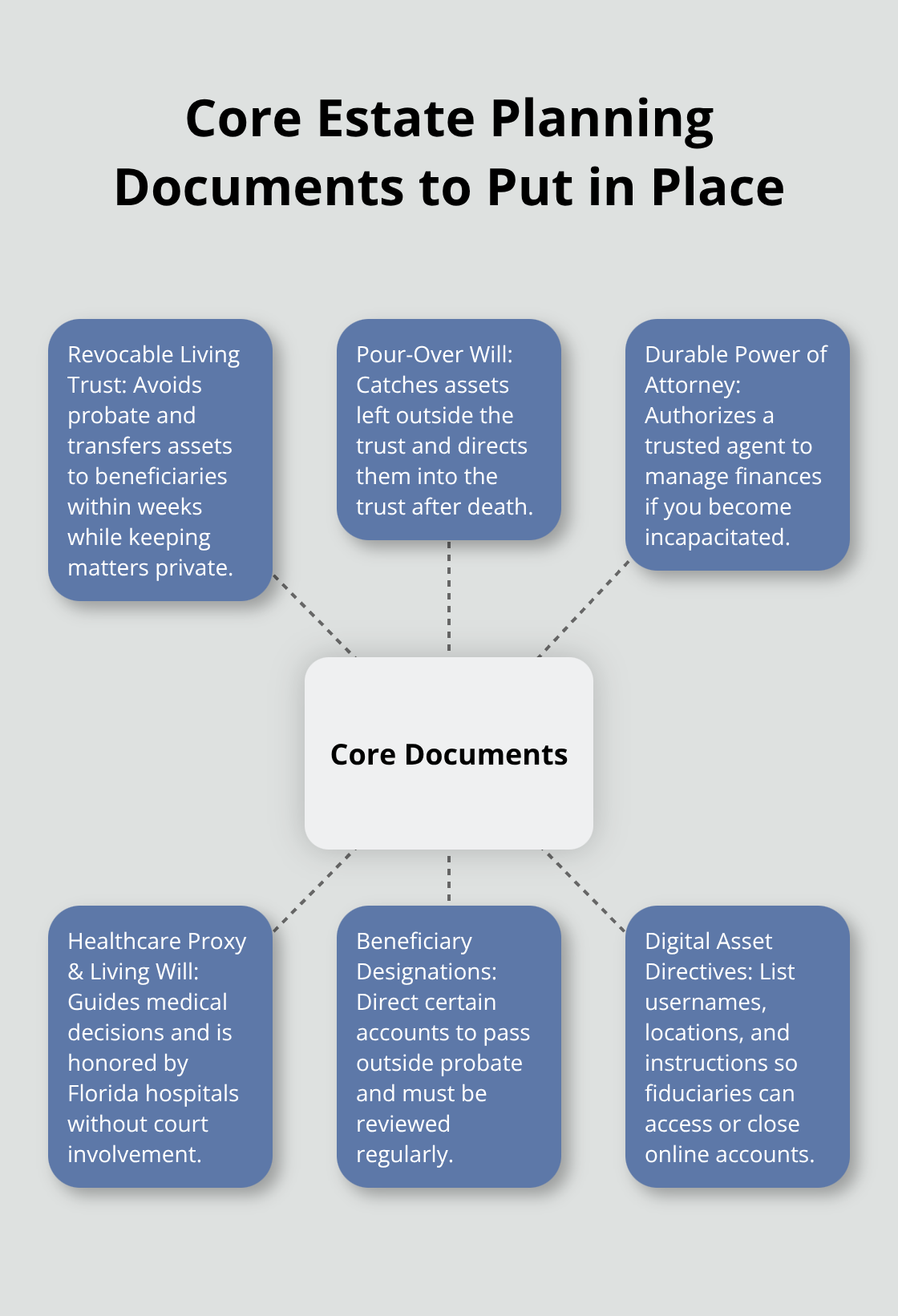
A will alone won’t protect your family from probate delays or tax complications. We at Family, Estate & Mediation Law recommend a comprehensive approach using multiple documents tailored to Florida law. A revocable living trust bypasses probate entirely, allowing your assets to transfer directly to beneficiaries within weeks rather than months. Unlike a will, a trust remains private and avoids court involvement altogether.
How Trusts Save Your Family Time and Money
For a $500,000 estate, a trust saves your family $15,000 to $35,000 in probate costs while eliminating the 6 to 12-month court process. Florida law allows you to fund a trust with real estate, bank accounts, investment accounts, and personal property during your lifetime. The moment you transfer assets into the trust’s name, probate no longer applies to those assets when you die. A pour-over will catches any assets accidentally left out, directing them into the trust after your death. This combination gives St. Augustine families the protection they need without the expense or delay.
Powers of Attorney Protect You Before Death
A durable power of attorney for finances lets someone manage your accounts and property if you become incapacitated before death. Without this document, your family must petition the court for guardianship or conservatorship, a costly and public process that takes months. A healthcare proxy and living will direct your medical treatment if you cannot communicate your wishes. Florida law specifically recognizes living wills, and hospitals honor them without court involvement. These documents cost $200 to $500 to prepare properly but prevent $5,000 to $15,000 in emergency guardianship proceedings. Digital asset directives should accompany these documents, listing usernames, account locations, and instructions for accessing or closing online accounts.
Beneficiary Designations Control Who Receives Your Assets
Retirement accounts, life insurance policies, and some bank accounts pass directly to named beneficiaries outside your will or trust. A 2023 Vanguard report found that 40 percent of account holders had outdated or missing beneficiary designations. If you divorce and forget to update your life insurance beneficiary, your ex-spouse receives the death benefit regardless of what your will states. St. Augustine residents should review these designations every three to five years or immediately after divorce, remarriage, or the birth of children. Naming a trust as beneficiary of retirement accounts offers more control than naming individuals, particularly when minor children are involved.
These documents form the foundation of protection, but many St. Augustine families overlook critical mistakes that undermine even the best-drafted plans.
Common Estate Planning Mistakes St. Augustine Residents Make
Outdated Documents Undermine Your Original Plan
Most St. Augustine families treat their estate documents as a one-time task, completed and forgotten. This approach creates serious problems. A 2022 study by Caring.com found that 60 percent of Americans with estate plans had not updated them in over three years, and 40 percent had never updated them at all. Life changes constantly-divorce, remarriage, the birth of children or grandchildren, significant financial shifts, health diagnoses-yet the documents stay frozen in time.
When you divorce and fail to update your beneficiary designations, your ex-spouse might still inherit your $250,000 life insurance policy or retirement account. Florida courts cannot override these designations, no matter what your will states. The designation controls everything. A St. Augustine resident who remarried without updating their trust might inadvertently leave everything to their first spouse’s children while their current spouse receives nothing. These situations happen regularly because people assume their original plan still works. They don’t.
You need a comprehensive review every three to five years or immediately after divorce, remarriage, birth of a child, significant inheritance, major property purchase, or diagnosis of a serious illness.
The Wrong Executor or Trustee Damages Your Estate
Selecting the wrong executor or trustee creates equally damaging consequences. Your executor manages your estate during probate, pays bills, files taxes, and distributes assets-a role that requires financial competence, organizational skills, and the ability to handle family conflict without bias. Many St. Augustine residents name their oldest child out of tradition, not ability.
If that child struggles with finances, lacks attention to detail, or cannot manage demanding family members, the estate suffers. Some families discover their chosen executor lives out of state, making local property management impossible, or they lack the time to handle the responsibilities properly. Corporate trustees (banks and trust companies) charge 0.5 to 2 percent of assets annually-substantial fees that drain the estate-while individual trustees who lack knowledge make costly mistakes.
Select someone with demonstrated financial responsibility, local presence, and the temperament to navigate difficult family dynamics. If no suitable family member exists, a professional fiduciary or corporate trustee becomes necessary.
Digital Assets Disappear Without Proper Documentation
Your digital assets compound these selection problems since most executors have no idea how to access cryptocurrency wallets, online business accounts, or cloud storage containing important documents. Without a detailed digital asset inventory (including usernames, passwords, security questions, and account locations stored securely), your executor wastes months trying to locate accounts or loses access entirely.
A single forgotten cryptocurrency wallet worth $50,000 disappears forever if nobody knows it exists or how to access it. Create a comprehensive list of all digital accounts, store it securely, and update it annually. Your executor needs this information to settle your estate properly and prevent permanent financial loss.
Final Thoughts
St. Augustine estate planning only protects your family if your documents reflect your current life, finances, and wishes. Life changes constantly-divorce happens, children arrive, property values shift, health diagnoses emerge-yet most people leave their plans untouched for years. This gap between your actual situation and your outdated documents is where families suffer the most damage.
Treat your estate plan as a living document that evolves with you. Review your will, trust, powers of attorney, and beneficiary designations every three to five years, and update immediately after major life events like remarriage or the birth of a grandchild. Create a detailed inventory of your digital assets and store it securely alongside your legal documents. Name an executor or trustee based on their actual ability to manage your estate, not family tradition.
We at Family, Estate & Mediation Law help St. Augustine families create plans that actually work within Florida law and your specific situation. Contact us at femlg.com to discuss your family’s needs and build the estate plan that protects what matters most.