
Many Florida families overlook revocable trusts when planning their estates, even though this tool offers significant advantages over traditional wills. A revocable trust gives you complete control during your lifetime while streamlining what happens to your assets afterward.
At Family, Estate & Mediation Law, we’ve seen firsthand how revocable trusts benefits extend far beyond simple asset transfer. This guide walks you through what these trusts actually do, why they matter for your situation, and how to set one up properly.
What a Revocable Trust Actually Is
The Core Structure and Your Control
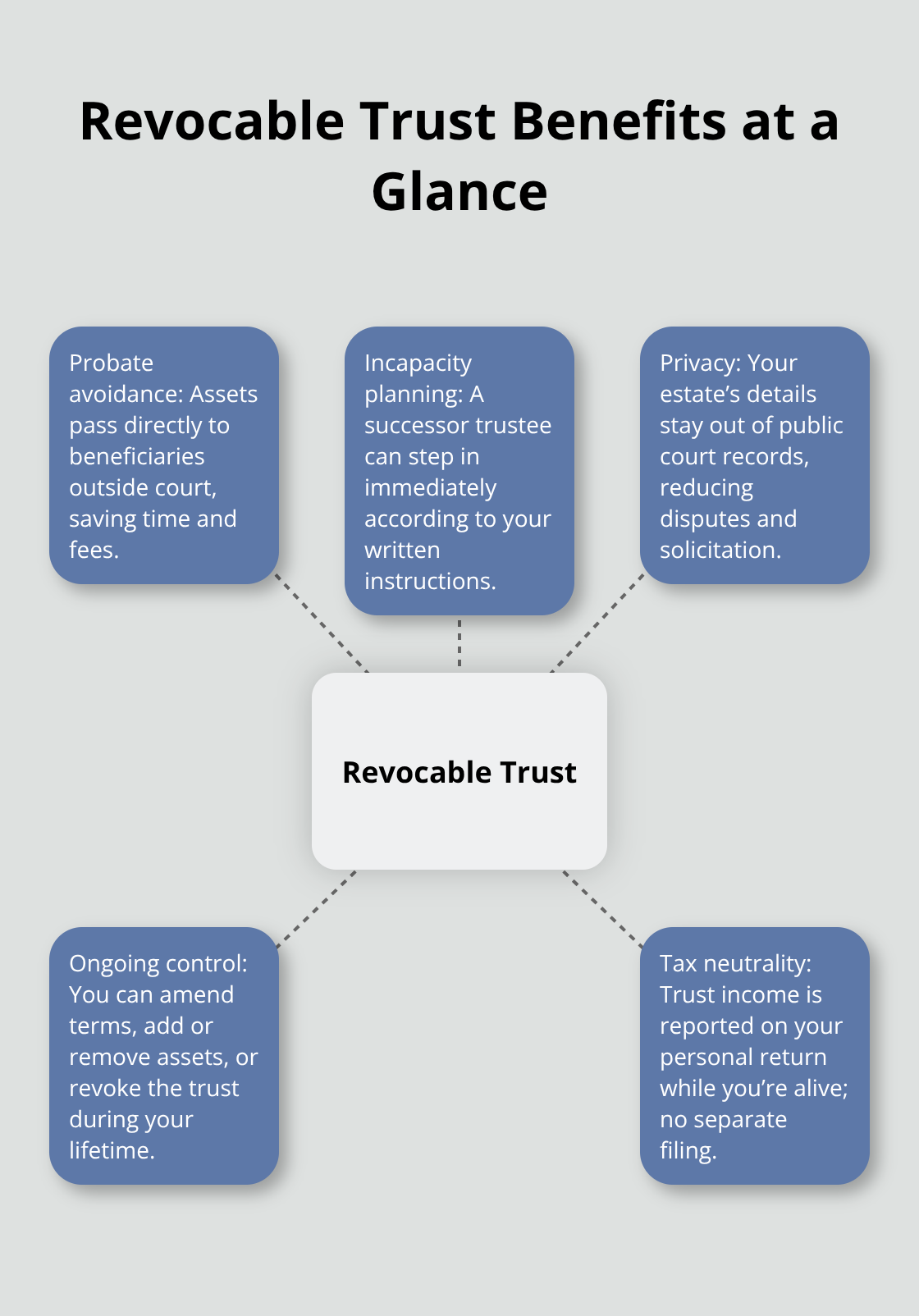
A revocable trust is a legal document that transfers ownership of your assets into a trust while you retain complete control during your lifetime. You act as the grantor (the person creating the trust) and the trustee (the person managing it), which means you can buy, sell, or modify assets exactly as you would in your personal name. The trust holds legal title to your property, but you keep all the benefits and income those assets generate. When you pass away or become incapacitated, a successor trustee you’ve named steps in to manage or distribute the assets according to your instructions without court involvement.
How Revocable Trusts Differ from Wills
This structure differs fundamentally from a will, which only takes effect after death and requires probate court to validate and distribute your estate. Florida’s probate process typically takes 6 to 12 months and costs between 3% and 7% of your estate’s value in fees and court costs, according to the Florida Bar. A revocable trust bypasses this entirely because assets held in the trust transfer directly to beneficiaries outside the probate system.
Planning for Incapacity
Unlike a will, a trust addresses what happens if you become unable to manage your affairs before death. Your successor trustee can immediately take over without waiting for a court guardianship proceeding, which in Florida can cost $5,000 to $15,000 in legal and court fees alone. This incapacity protection activates automatically based on your instructions, without requiring judicial intervention.
The Flexibility Advantage
You maintain full flexibility throughout your life; you can add or remove assets, change beneficiaries, or even dissolve the trust completely if circumstances change. This combination of control, privacy, and incapacity planning makes revocable trusts the foundation of serious estate planning for Florida families with meaningful assets. Understanding these mechanics sets the stage for recognizing the specific benefits that make revocable trusts so valuable for your family’s situation.
Why Revocable Trusts Save Florida Families Thousands
Probate Costs Drain Your Estate
Florida probate imposes substantial financial penalties on your family. When your estate enters probate, court filing fees, attorney fees, and personal representative fees collectively consume 3% to 7% of your estate’s total value according to the Florida Bar. A $500,000 estate loses $15,000 to $35,000 in costs alone.
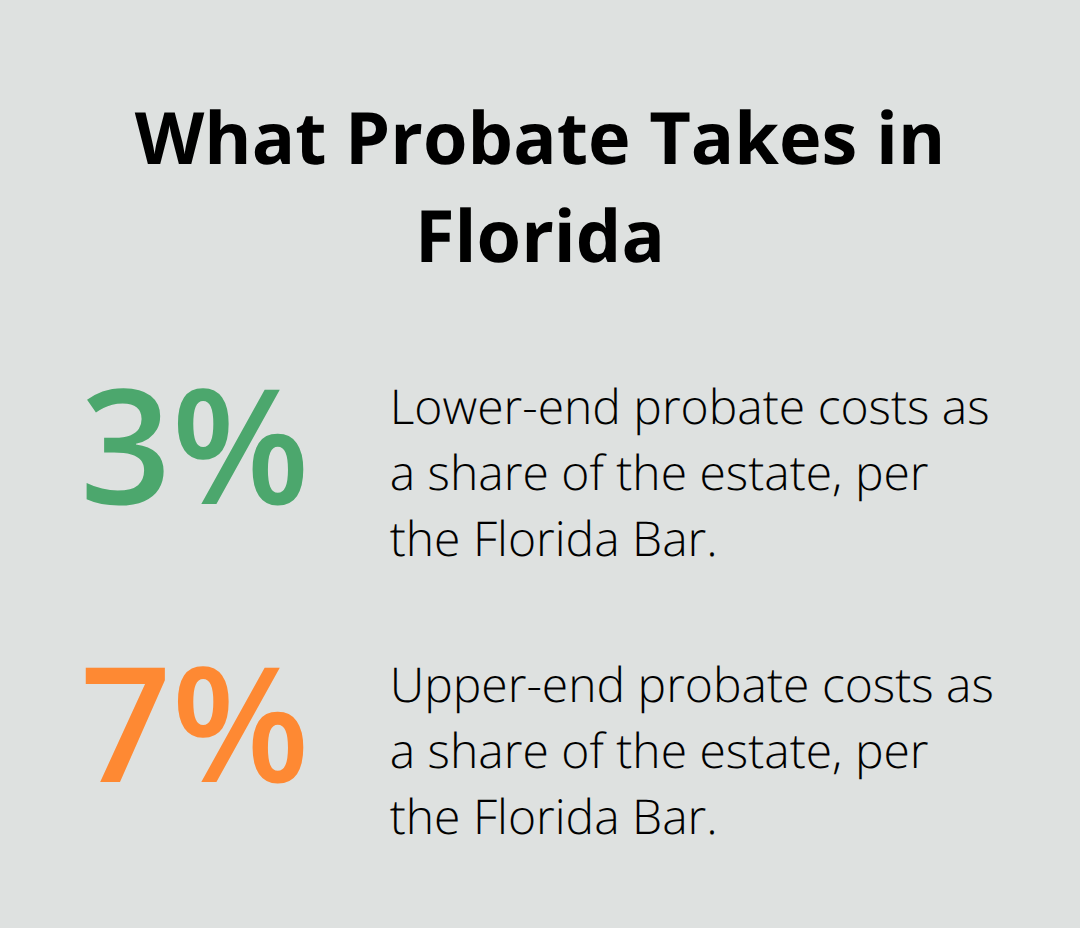
A revocable trust eliminates this expense entirely because assets transfer directly to beneficiaries outside the court system. Your family retains funds that would otherwise vanish into legal and court fees.
Speed Matters When Families Need Access to Funds
Probate delays create real hardship for your beneficiaries. Florida’s probate process typically stretches 6 to 12 months, meaning your family waits nearly a year to access inheritance funds. A trust-based transfer happens within weeks. For families who depend on inherited income or need liquid assets quickly (medical bills, mortgage payments, living expenses), this speed difference changes everything. Your successor trustee distributes assets according to your instructions without waiting for court approval.
Privacy Protects Your Family’s Financial Details
When your estate enters probate, your will becomes a public court record anyone can access. Your asset values, beneficiary names, and distribution amounts appear in public databases for anyone to review. A revocable trust keeps these details completely private because the trust document never enters the public record. Your family’s financial information remains confidential, protecting them from unwanted solicitation or disputes over your estate.
Incapacity Protection Prevents Expensive Guardianship
Incapacity protection through a revocable trust prevents costly guardianship proceedings. If you become unable to manage your affairs, Florida guardianship costs run $5,000 to $15,000 in legal and court fees, plus ongoing annual court costs. Your successor trustee steps in immediately without any court involvement, managing your finances based on your written instructions. This protection activates automatically when you need it most, avoiding the delay and expense of guardianship petitions that can take weeks or months to process.
Understanding Common Misconceptions About Trust Taxation
Many Florida families hesitate to establish revocable trusts because they worry about tax consequences. The reality differs significantly from this concern. A revocable trust does not trigger any additional income taxes during your lifetime because you report trust income on your personal tax return (the trust uses your Social Security number for tax purposes). The trust itself pays no separate taxes while you remain alive and in control. This tax neutrality makes revocable trusts an efficient planning tool that accomplishes your goals without creating unexpected tax burdens for your family.
Making Revocable Trusts Work for Your Situation
Understanding Tax Treatment During Your Lifetime
Tax concerns shouldn’t derail your trust planning, and they rarely do when you understand the actual rules. A revocable trust operates under your Social Security number during your lifetime, meaning trust income flows directly to your personal tax return exactly as if you held the assets outright. The IRS treats you and the trust as one entity while you’re alive, so no separate tax filing, no additional tax burden, and no surprise tax bills arrive because you established a trust. This tax neutrality persists throughout your life, making revocable trusts genuinely cost-free from a tax perspective while you retain complete control.
After your death, the trust becomes irrevocable and your successor trustee files a final trust tax return, but the primary benefit has already materialized: your family avoids probate and accesses funds without court delays or public disclosure. The real tax planning happens through what assets you place in the trust and how you structure distributions to beneficiaries, not through the trust document itself.
Funding Your Trust Determines Success or Failure
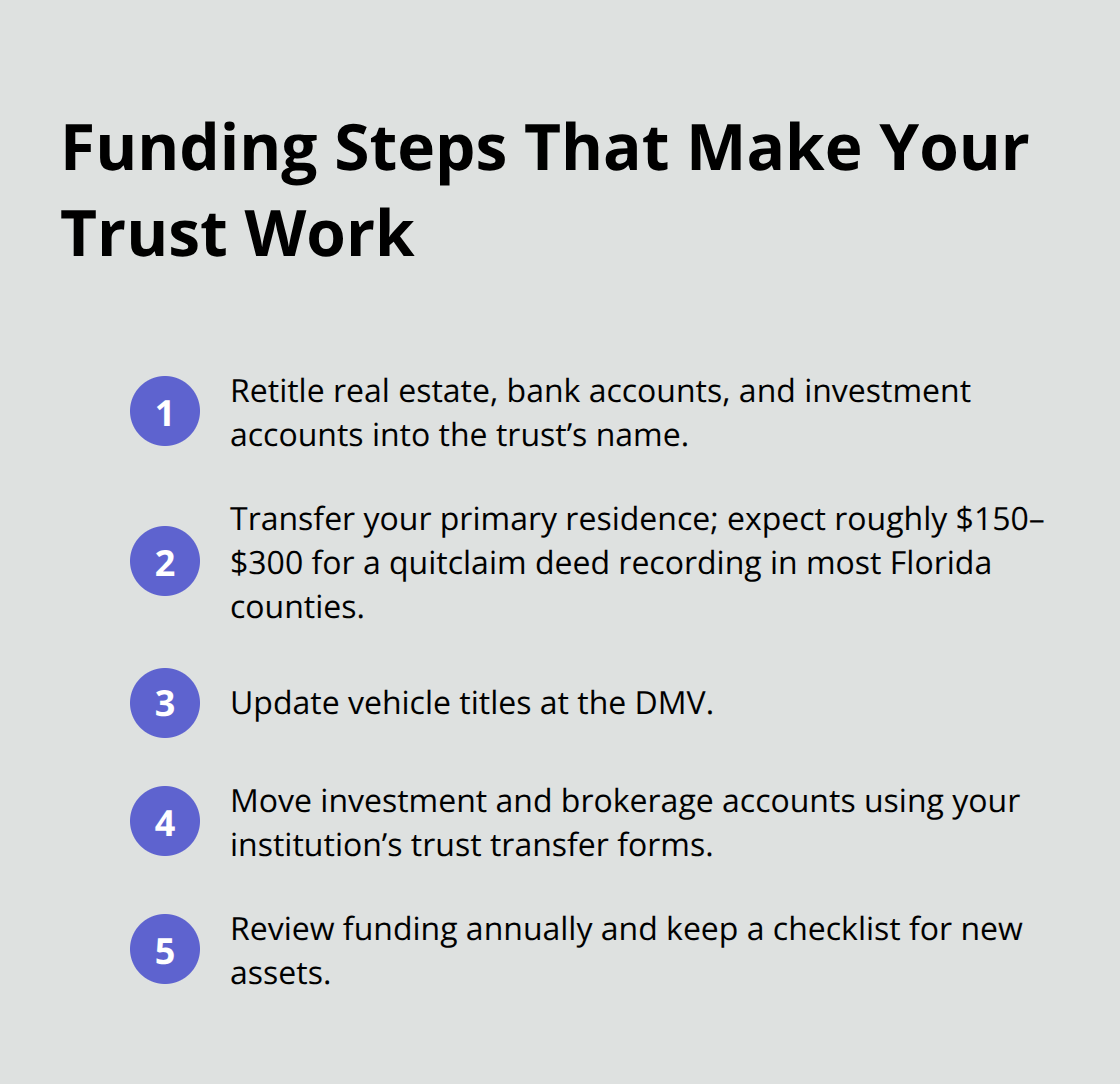
Funding your trust separates successful planning from failed intentions. Establishing a revocable trust means nothing if your assets remain titled in your personal name; you must retitle bank accounts, investment accounts, real estate, and other significant property into the trust’s name for the trust to actually work. Many Florida families create trusts then leave them unfunded, which defeats the entire purpose and forces their estates into probate anyway.
Start with your largest assets: primary residence, rental properties, investment accounts, and bank accounts holding substantial funds. For your primary residence, transferring it into your revocable trust costs roughly $150 to $300 for a quitclaim deed recording fee in most Florida counties (a minimal expense compared to the probate costs you’re avoiding). Vehicles transfer at your local DMV, and investment accounts move through a simple form your financial institution provides.
Maintaining Your Trust as Life Changes
Life changes create new assets needing trust protection. Inheritances, new property purchases, and business interests all require updates to your funding strategy. You should review your trust annually and maintain a funding checklist that you update whenever your circumstances shift. This approach ensures your trust actually controls the assets you intend to pass to your beneficiaries rather than leaving gaps that probate will exploit.
Final Thoughts
Revocable trusts remain the most practical estate planning tool for Florida families who want to avoid probate, protect their privacy, and plan for incapacity without court involvement. The revocable trusts benefits you’ve read about translate directly into thousands of dollars saved and months of time recovered for your family. Probate costs drain 3% to 7% of your estate while delays stretch months, yet a revocable trust eliminates both problems while keeping your financial details private.
Tax concerns shouldn’t hold you back from establishing a trust, since your trust operates under your Social Security number during your lifetime with no separate tax filing or additional burden. The real work happens in funding your trust properly-retitling your assets into the trust’s name so they actually transfer outside probate when you pass away or become incapacitated. Your successor trustee can act immediately if you become unable to manage your affairs, avoiding costly guardianship proceedings that run $5,000 to $15,000 in legal and court fees.
Your next step is straightforward: gather information about your current assets, identify your intended beneficiaries, and determine whether a revocable trust fits your situation. We at Family, Estate & Mediation Law Group work with Northeast Florida families to build estate plans that protect what matters most. Contact us to discuss whether a revocable trust makes sense for your situation and how to set one up properly.