
A power of attorney gives someone you trust the legal authority to make decisions on your behalf when you can’t. Without one, your family could face delays, conflicts, and costly court proceedings during medical emergencies or financial crises.
We at Family, Estate & Mediation Law help families in St. Augustine and Palatka, FL create POA documents that protect their interests and prevent unnecessary complications. This guide walks you through the types of POA available, how to set one up in Florida, and why this document matters for your family’s security.
What a Power of Attorney Actually Does
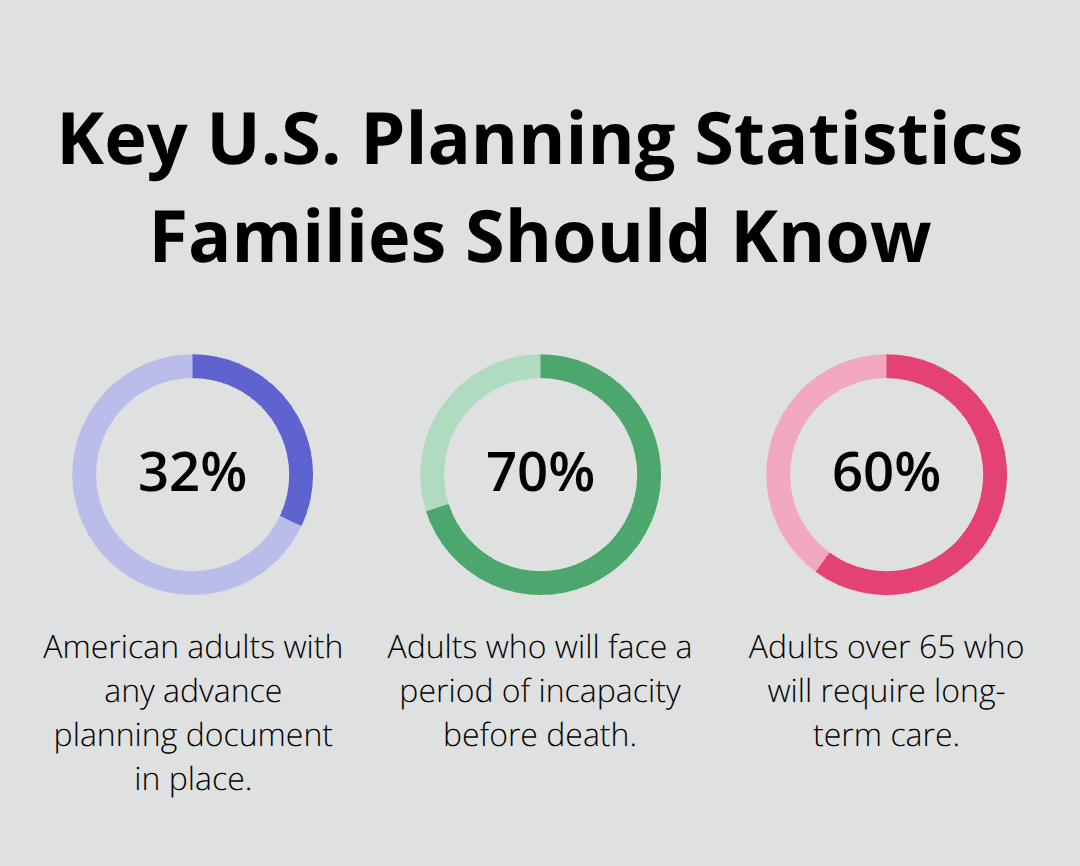
A power of attorney is a legal document that transfers decision-making authority to someone you choose, called an agent or attorney-in-fact. This person acts on your behalf immediately or only when you become incapacitated, depending on how you structure the document. The American Bar Association reports that only 32% of American adults have any form of advance planning document in place, which means the vast majority of families face unnecessary complications when medical or financial decisions arise.
Florida’s Legal Requirements for POA
In St. Augustine and Palatka, FL, Florida law requires your POA to be in writing, signed by you, and notarized to be valid. The document must clearly state your intent and identify your agent with specificity. Without this clarity, banks and healthcare providers will reject the document, leaving your family unable to access accounts or make critical medical choices. The legal purpose of a POA is straightforward: it prevents your family from needing court intervention through guardianship or conservatorship proceedings, which cost between $5,000 and $15,000 in legal fees and take months to complete.
When POA Becomes Non-Negotiable
Your family needs a POA before a crisis hits, not after. A sudden stroke, heart attack, or accident can render you unable to communicate your wishes within hours. If you have no POA in place, your spouse cannot access your business accounts, your adult children cannot authorize medical treatment, and your assets sit frozen while the court appoints a guardian. Florida’s guardianship process requires a physician’s certification, court filing, and a hearing-all while time-sensitive decisions pile up.
Healthcare decisions matter most in these moments: 70% of adults will face a period of incapacity before death, according to research from the Older Adults Policy Institute. A financial POA lets your agent pay bills, manage investments, and handle real estate transactions. A healthcare POA authorizes medical decisions about treatment, hospitalization, and end-of-life care. Many families in our region face situations where out-of-state adult children need to act quickly for aging parents, and a properly drafted POA eliminates delays that could cost thousands in emergency care or missed financial deadlines.
How POA Stands Apart From Other Documents
A POA differs fundamentally from a will, which only takes effect after death and has no authority during your lifetime. A will cannot authorize anyone to pay your bills tomorrow or decide on surgery next week. A living trust transfers assets into a trust structure and names a successor trustee but only controls assets titled to the trust-it does not grant authority over healthcare or assets outside the trust. A healthcare directive addresses medical decisions but provides no financial authority.
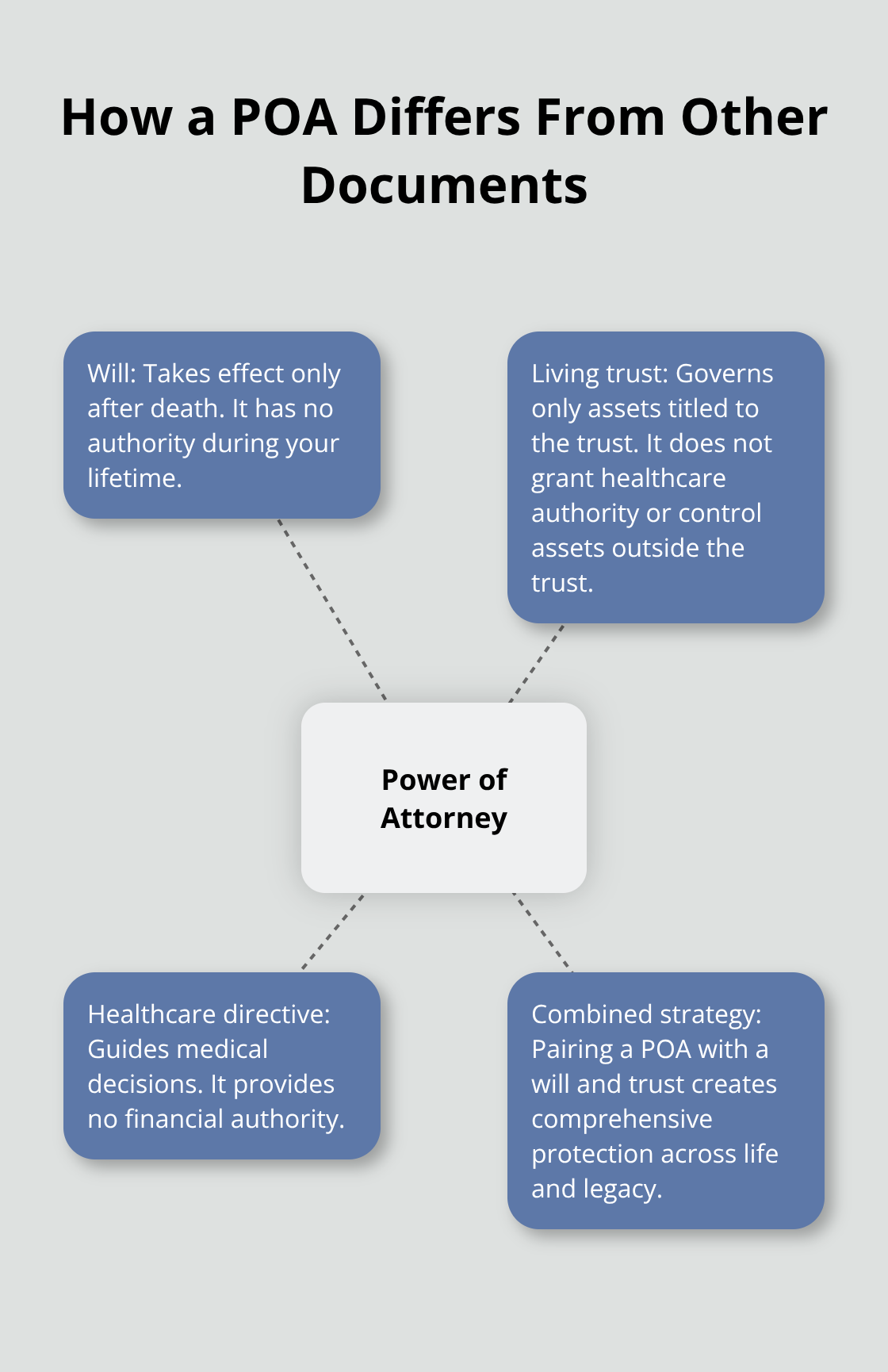
A POA combined with a will and trust creates a comprehensive protection strategy that covers your needs while alive and your legacy after death. Many families mistakenly believe a will handles everything, then face paralysis when a parent becomes ill before passing. The distinction matters because timing determines which document applies: POA works now, will works later, and trust works for both depending on how assets are titled. Understanding these differences prepares you to select the right POA type for your family’s specific situation.
Which Power of Attorney Type Does Your Family Actually Need
Healthcare Decisions Require Immediate Legal Authority
A durable power of attorney for healthcare authorizes your agent to make medical decisions if you cannot, including treatment approvals, hospital choices, and end-of-life care decisions. This document takes effect immediately upon signing unless you specify it becomes effective only upon incapacity, which is called a springing POA. Healthcare POAs matter because 60% of adults over 65 will require long-term care at some point in their lives, according to the U.S. Department of Health and Human Services, yet most families have no one legally authorized to speak for them when doctors need answers within hours. Your agent under a healthcare POA cannot access your financial accounts or sell your home-only medical choices fall within this authority, which is why this document stands alone from financial authority.
Financial Authority Covers Assets and Transactions
A financial power of attorney grants your agent the ability to manage bank accounts, pay bills, file taxes, manage investments, and handle real estate transactions on your behalf. Florida law allows this document to take effect immediately, which matters if you need help managing finances while still living. Many families use financial POAs for aging parents who can no longer handle complex tax situations or for business owners who want a backup if they travel frequently. The cost difference matters here: a financial POA costs $200 to $500 to draft properly in Florida, whereas a guardianship to handle the same financial matters costs $5,000 to $15,000 and requires court involvement.
Limited POAs Restrict Authority to Specific Acts
A limited power of attorney restricts your agent’s authority to specific acts or timeframes, such as authorizing someone to sell a particular property, handle a single real estate transaction, or manage affairs only during your absence. Limited POAs work well for military families deployed overseas, business owners traveling internationally, or situations where you need help with one specific matter but want no broader authority granted. Florida recognizes all three types equally under state law, but the practical difference lies in scope: healthcare POA controls medical decisions, financial POA controls money and assets, and limited POA controls only what you explicitly authorize.
Combining POA Types Closes Protection Gaps
Most families need both a durable healthcare POA and a financial POA to cover medical and financial emergencies, then add limited POAs only when specific situations demand restricted authority. The mistake many families make is choosing only one type, leaving gaps when crises involve both medical and financial decisions simultaneously. A healthcare POA alone leaves your bills unpaid and your accounts frozen. A financial POA alone leaves your medical treatment decisions in limbo. Families in St. Augustine and Palatka, FL who establish both documents avoid these gaps entirely.
Moving From Theory to Action
Once you understand which POA types your family needs, the next step involves selecting the right person to serve as your agent and understanding Florida’s specific execution requirements. If you’re ready to protect your family’s future, estate planning services can guide you through the process.
Setting Up Your POA in St. Augustine and Palatka, FL
Selecting the Right Agent for Your Family
The person you choose as your agent makes or breaks your POA’s effectiveness. This person will have legal authority to act on your behalf, potentially controlling access to your bank accounts, medical decisions, and property transactions. You need someone who is trustworthy, organized, and willing to act in your interest even when decisions are uncomfortable.
Many families default to naming their oldest child or spouse without considering whether that person actually has the financial literacy, emotional stability, or time to handle complex decisions. Florida law allows you to name anyone over 18, but practical reality demands someone local or willing to travel to St. Augustine or Palatka to handle in-person banking, medical consultations, and document signing. If your chosen agent lives out of state, they may face delays accessing your accounts or attending necessary medical appointments.
Name a successor agent as backup in case your first choice becomes unavailable, dies, or becomes incapacitated themselves. This simple addition prevents your POA from becoming worthless if your primary agent cannot serve when needed.
Florida’s Strict Execution Requirements
Your POA must meet specific legal standards, or banks and healthcare providers will reject it outright. Florida law requires your POA to be in writing, signed by you in the presence of a notary public, and the notary must verify your identity and capacity. You do not need witnesses for a financial POA in Florida, though many families add them anyway for extra protection.
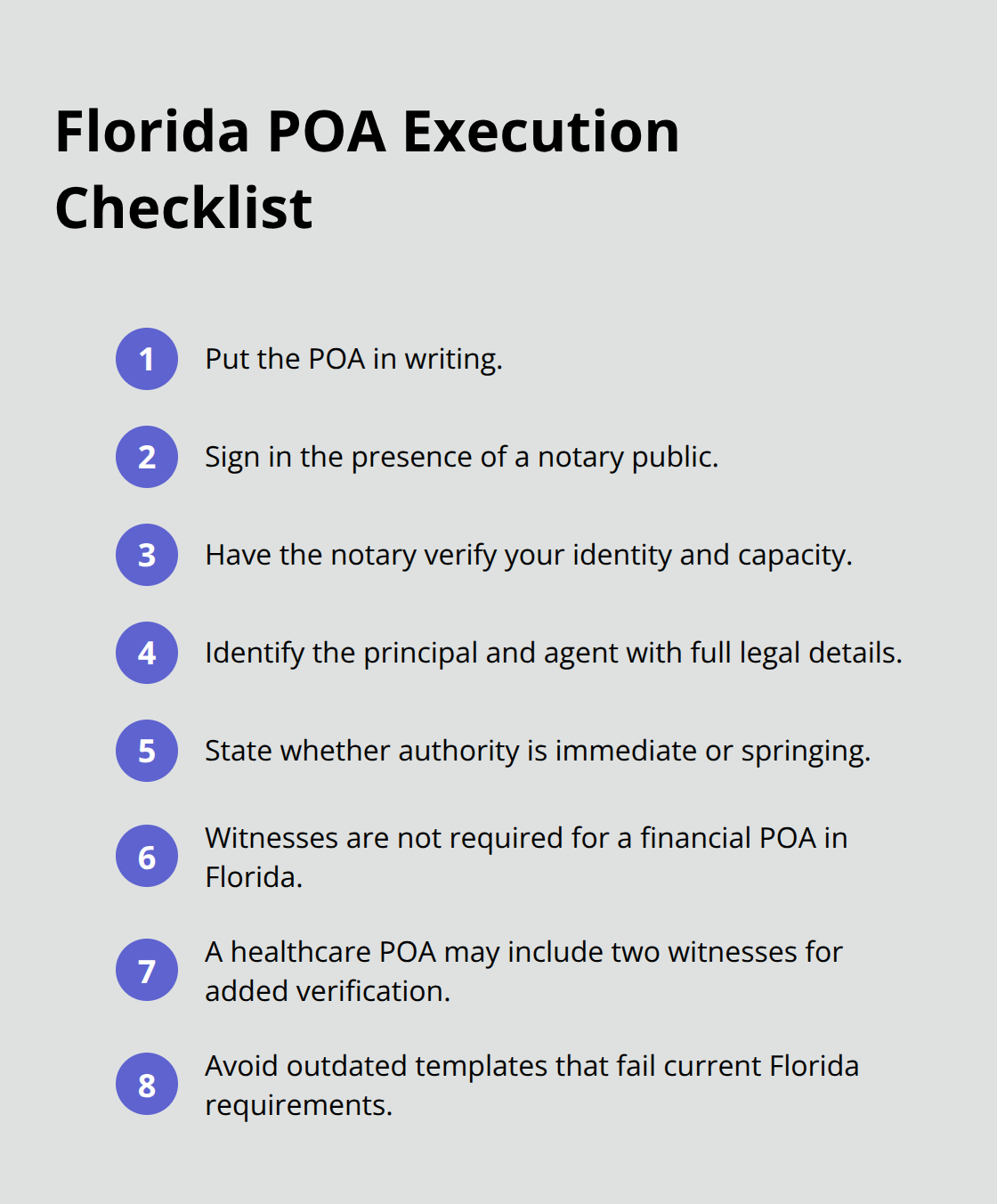
A healthcare POA follows the same notarization requirement but can include two witnesses if you prefer additional verification. The document must clearly identify you as the principal, name your agent with full legal name and address, and specify whether the authority begins immediately or only upon your incapacity. Many families make the mistake of using outdated templates from the internet that fail Florida’s current requirements, resulting in rejection by banks and healthcare providers.
Compliance With Florida Statutes
Your POA must comply with Florida Statutes Chapter 709 for financial authority and Chapter 765 for healthcare authority. These statutes establish the precise language, formatting, and execution procedures that financial institutions and hospitals recognize. Improper execution creates delays when you need decisions made quickly-a rejected POA during a medical emergency or financial crisis leaves your family powerless.
Once executed and notarized, your POA is immediately valid and requires no filing with any government office. Some families choose to record their healthcare POA with the county clerk’s office in St. Johns County or Putnam County for additional notice, though this step is optional and not required for validity.
Timing and Immediate Effectiveness
Your POA takes effect on the date you sign it (unless you specify it becomes effective only upon incapacity, which is called a springing POA). Immediate effectiveness means your agent can act on your behalf starting the day after notarization, which matters if you need help managing finances or medical decisions while still capable of making choices yourself. A springing POA activates only when you become incapacitated, which requires medical certification and can create delays when time matters most.
Choose immediate effectiveness if you want your agent to help with current financial or healthcare matters. Choose springing POA only if you want to retain full control until incapacity occurs and you have a clear process for determining when that incapacity begins.
Ready to protect your family with a properly executed POA? Contact us today to discuss your estate planning needs in St. Augustine and Palatka.
Final Thoughts on POA for Families
A power of attorney for families eliminates the guesswork when medical or financial decisions demand immediate action. Without one, your family faces months of court delays, thousands in legal fees, and painful disagreements about what you would have wanted. The difference between having a POA and lacking one often determines whether your family can pay your bills on time, authorize necessary surgery, or access your accounts during crisis.
Medical emergencies strike without warning, and a stroke or accident can leave you unable to communicate within hours. Your agent steps in immediately with legal authority to direct your care and manage finances, while your family avoids the guardianship process entirely (which costs $5,000 to $15,000 and requires court involvement). Your chosen agent makes decisions aligned with your values rather than leaving those choices to a judge who knows nothing about you.
Financial decisions pile up during incapacity, as bills continue to arrive, mortgage payments come due, and investment accounts require attention. A financial POA lets your agent handle these matters without court intervention, preventing damage to your credit, loss of property, or missed tax deadlines. We at Family, Estate & Mediation Law help families across St. Augustine and Palatka, FL create POA documents that actually work when needed-contact our estate planning team to discuss your family’s protection plan today.