Your home is likely your biggest financial asset, yet many homeowners overlook the need for proper estate planning. Without a clear plan in place, your property could face probate delays, unexpected tax burdens, and family disputes after you’re gone.
We at Family, Estate & Mediation Law in St. Augustine and Palatka, FL help homeowners protect their homes and secure their families’ futures through strategic planning. The right approach now prevents costly mistakes later.
Why Your Home Needs Protection Now
Your home represents far more than shelter-it’s typically your largest financial asset, often worth hundreds of thousands of dollars. For most homeowners in St. Augustine and Palatka, FL, residential property accounts for 60-80% of their total net worth, according to Federal Reserve data. Without proper estate planning, that asset faces a precarious future.
Probate Creates Immediate Problems
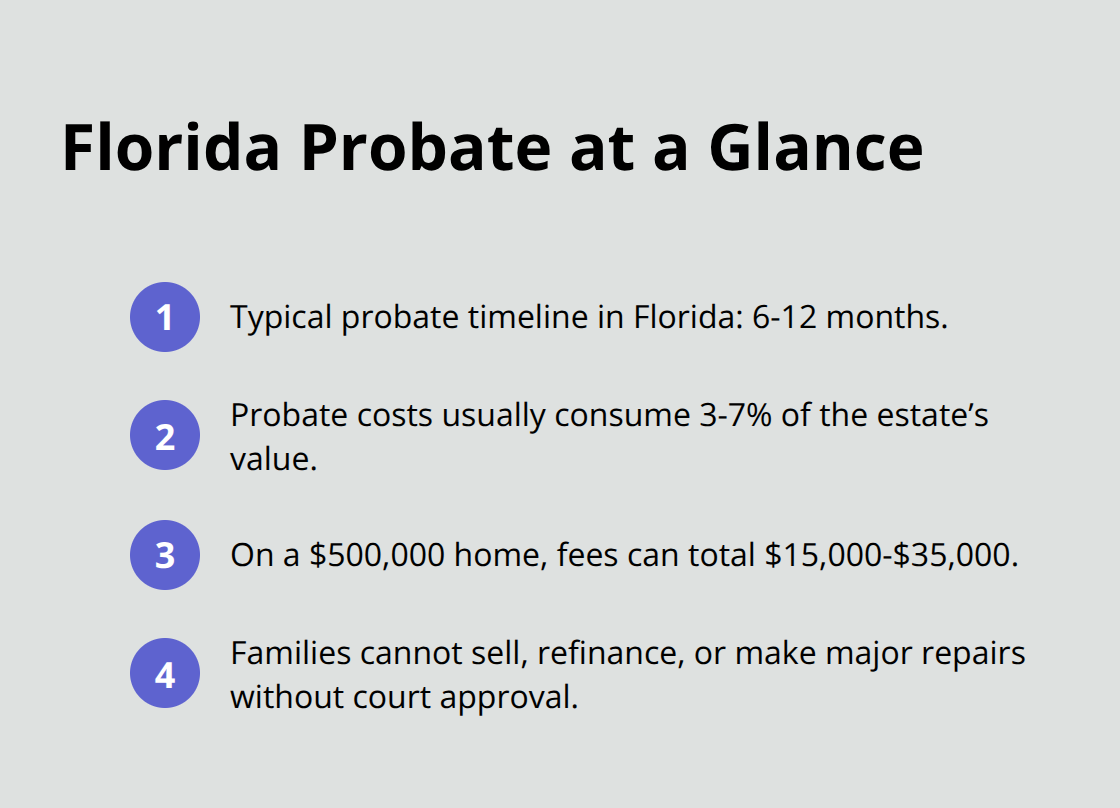
When you pass away without a clear plan, your home enters probate court, a process that typically takes 6-12 months in Florida and can stretch longer if disputes arise among heirs. During this time, your property remains tied up while the court validates your will, inventories assets, and distributes everything according to state law. Your family cannot sell the home, refinance it, or make major repairs without court approval.
The estate pays probate costs-filing fees, attorney fees, and court costs-that can easily consume 3-7% of your estate’s total value. For a $500,000 home, that translates to $15,000-$35,000 in unnecessary expenses that could have gone to your heirs instead.
Property Taxes Hit Harder Than Most Realize
Florida’s stepped-up basis rule provides one significant advantage, but homeowners often fail to leverage it. When property transfers through your estate, heirs receive a stepped-up basis, meaning they inherit the home at its current market value rather than your original purchase price. This eliminates capital gains taxes on appreciation during your lifetime-a substantial benefit that disappears if you fail to structure ownership properly.
However, many homeowners overlook how quickly property taxes, maintenance costs, and insurance drain an estate during probate. A $400,000 home might cost $400-600 monthly in taxes and insurance alone while sitting in probate limbo. Over a year-long probate process, that amounts to $4,800-$7,200 in expenses reducing what your heirs ultimately receive. Additionally, if your home carries a mortgage or outstanding liens, these debts remain the estate’s responsibility until resolved, further depleting assets available for distribution.
Co-Ownership Disputes Destroy Family Harmony
Homeowners who delay planning often assume their heirs will simply inherit the property and move forward. That assumption proves costly. Florida homeowners without clear transfer mechanisms frequently create situations where multiple heirs become co-owners, complicating any future sale or refinance. One heir might want to sell while another wants to keep the property, triggering family conflict and potentially forcing a partition sale where the court orders the property sold and proceeds divided.
These disputes consume time, money, and relationships that proper planning would have prevented entirely. The solution requires action now-establishing clear ownership instructions, selecting appropriate transfer mechanisms, and understanding tax implications before crisis forces expensive decisions. The next section explores specific strategies that protect your home and prevent these costly mistakes.
How to Transfer Your Home Without Probate
Beneficiary Deeds Offer Speed and Simplicity
Beneficiary deeds and transfer-on-death mechanisms offer Florida homeowners straightforward alternatives to probate that actually work. A beneficiary deed allows you to name who receives your home after death, and the property transfers automatically upon your passing, typically within weeks rather than the 6-12 months probate demands. Florida Statute 689.11 authorizes these deeds, and they cost virtually nothing to prepare compared to the thousands probate consumes.
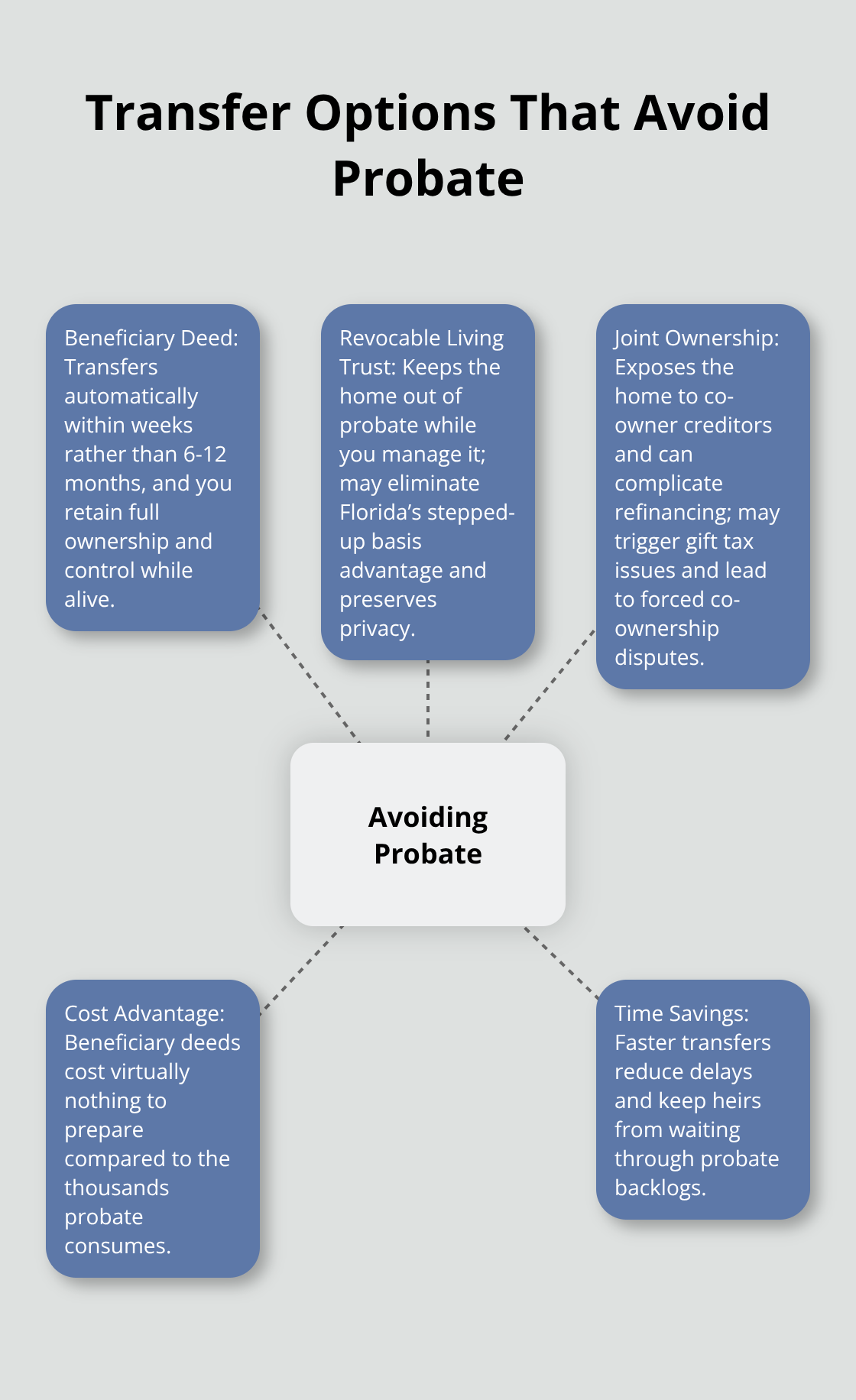
The critical advantage: you retain full ownership and control while alive, meaning you can still sell, refinance, or modify the deed anytime. No one else gains rights until you die. Many homeowners in St. Augustine and Palatka, FL overlook this option simply because they don’t know it exists, defaulting instead to probate-heavy wills that cost their families tens of thousands in unnecessary fees and delays.
Revocable Living Trusts Provide Maximum Control
Revocable living trusts represent a powerful tool for homeowners with substantial property. When you transfer your home into a trust during your lifetime, the property avoids probate entirely while you maintain complete control. You serve as trustee, manage the property normally, and designate successor trustees to handle distribution after your death. This approach eliminates the stepped-up basis advantage Florida offers through probate, so you should consult a tax professional before choosing this route for high-appreciation properties. The trust structure protects privacy as well-unlike wills, trusts remain confidential documents that don’t appear in public court records.
Joint Ownership Creates Unexpected Complications
Joint ownership appears simple but creates serious problems most homeowners don’t anticipate. When you add a child or spouse as a joint owner to avoid probate, you expose the property to their creditors’ claims, complicate refinancing, and potentially trigger gift tax consequences. If one joint owner becomes incapacitated, the other cannot act without court intervention. Worse, joint ownership with multiple heirs creates forced co-ownership after your death, leading to the family disputes and partition sales discussed earlier. The method you select depends entirely on your specific situation, property value, and family circumstances.
Selecting the Right Transfer Strategy
Each transfer mechanism carries distinct advantages and drawbacks that shift based on your circumstances. A beneficiary deed works well for straightforward situations where you want a single heir to inherit your home cleanly. A trust provides flexibility for complex family situations, multiple properties, or substantial estates. Joint ownership rarely serves homeowners well and typically creates more problems than it solves. The wrong choice now forces your heirs to navigate costly complications later-complications that proper planning eliminates entirely. Understanding which mistakes homeowners make most frequently helps you avoid the pitfalls that drain estates and fracture families.
Estate Planning Mistakes That Cost Homeowners Thousands
Outdated Documents Create Expensive Problems
Most homeowners in St. Augustine and Palatka, FL update their wills once and assume the work is complete. That assumption creates expensive problems. Life changes constantly-marriages, divorces, births, significant property appreciation, or inheritance of additional assets-yet many people never revisit their estate documents. Florida courts see this pattern repeatedly: a homeowner dies with a will naming an ex-spouse as executor, or documents that fail to account for a home purchased years after the original plan was drafted. The IRS estimates that outdated estate documents cost families an average of $8,000-$15,000 in unnecessary taxes and legal fees during probate.
Outdated beneficiary designations on retirement accounts or life insurance often override your will entirely, meaning your home transfers according to an old plan rather than your current wishes. A homeowner who remarries but forgets to update their trust might inadvertently leave everything to a first spouse, cutting out current children entirely. These aren’t theoretical problems-they happen regularly because people treat estate planning as a one-time event rather than a document that requires periodic review.
Florida law doesn’t mandate updates, so the responsibility falls entirely on you. Most professionals recommend reviewing your documents every three to five years, or immediately after major life events like property sales, inheritance, remarriage, or significant changes in your children’s circumstances.
Tax Implications for Heirs Demand Careful Planning
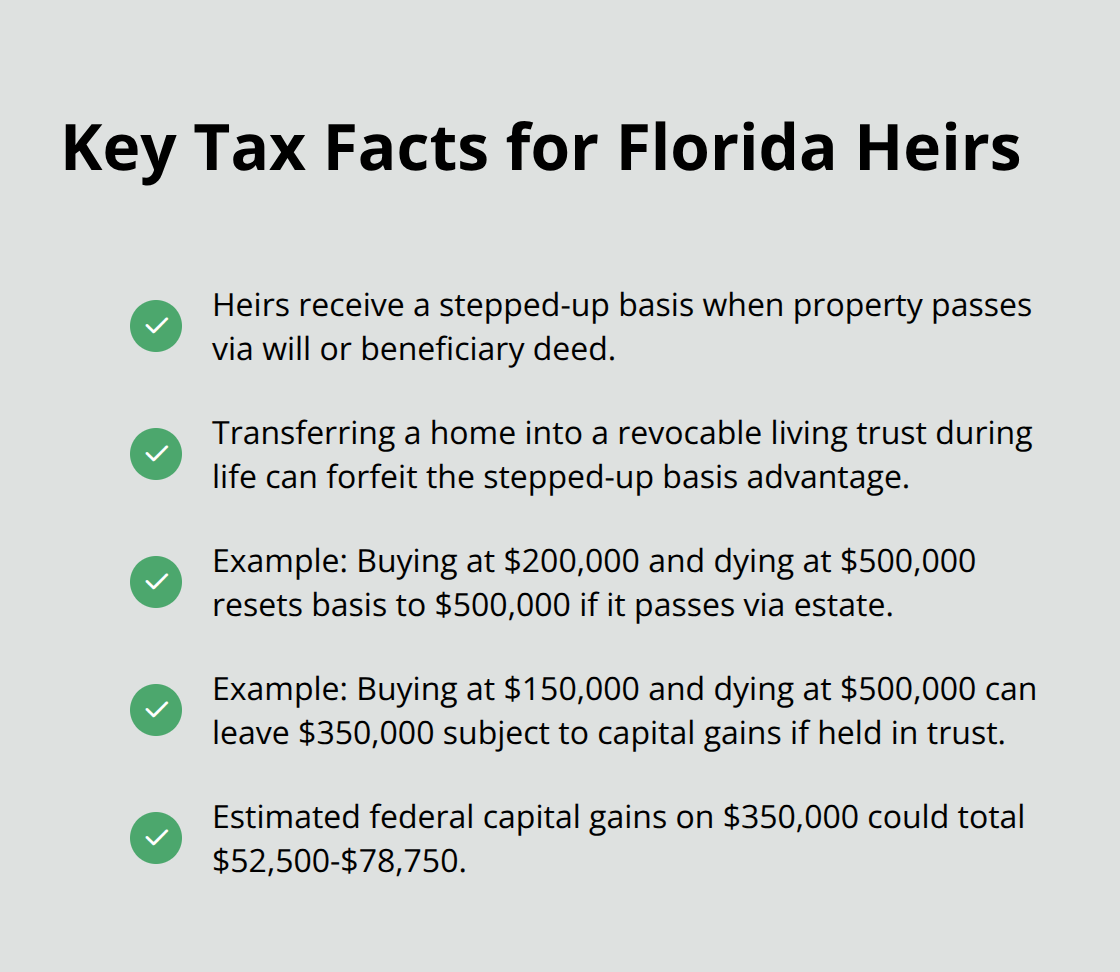
Ignoring tax implications for heirs represents the second critical mistake, particularly regarding capital gains and the stepped-up basis advantage Florida law provides. Many homeowners structure their estates to minimize probate without considering that their choice eliminates the stepped-up basis benefit entirely. When property passes through your estate via will or beneficiary deed, heirs receive a stepped-up basis at your death date value-meaning if you bought a home for $200,000 and it’s worth $500,000 when you die, your heirs inherit it valued at $500,000, avoiding $300,000 in capital gains taxes if they sell immediately.
However, if you transfer property into a revocable living trust during your lifetime to avoid probate, you forfeit this advantage, and your heirs inherit at your original cost basis. For a $500,000 home purchased for $150,000, that difference means your heirs owe capital gains taxes on $350,000 of appreciation if they sell. At current federal rates, that could mean $52,500-$78,750 in unnecessary taxes.
Beneficiary Designations and Property Tax Coordination
Many homeowners fail to coordinate beneficiary designations with their overall estate plan, creating situations where life insurance proceeds or retirement account distributions go to unintended recipients while the home goes elsewhere, throwing off the carefully planned distribution scheme. Property tax implications also matter-Florida’s homestead exemption provides substantial tax breaks for primary residences, but that exemption transfers to heirs only under specific circumstances that many people overlook.
Additionally, leaving property without explicit ownership instructions forces heirs and courts to interpret your intentions through probate litigation, a process that costs $15,000-$30,000 in attorney fees alone for typical estates. The wrong structural choices now (whether beneficiary deeds, trusts, or joint ownership) create cascading tax consequences that compound over years and significantly reduce what your heirs ultimately receive.
Final Thoughts
Your home represents your family’s financial security and legacy. Homeowner estate planning directly determines whether your heirs inherit smoothly or face months of probate delays, unexpected tax bills, and family conflict. The strategies outlined above-beneficiary deeds, trusts, and careful ownership structures-work only when you implement them thoughtfully based on your specific circumstances.
The mistakes homeowners make are preventable. Outdated documents, overlooked tax implications, and unclear ownership instructions cost families thousands in unnecessary expenses and legal fees. These problems don’t arise from complexity; they arise from inaction, and a homeowner who takes time now to structure their estate properly eliminates the costly complications that force their heirs into difficult decisions later.
We at Family, Estate & Mediation Law in St. Augustine and Palatka, FL help individuals and families across Northeast Florida navigate estate planning with practical strategies that preserve both relationships and legacies. Contact Family, Estate & Mediation Law to discuss your homeowner estate planning needs with professionals who understand Florida law and your family’s unique circumstances.