
A healthcare directive is one of the most overlooked documents families create. Without one, hospitals and loved ones face impossible decisions during medical crises.
At Family, Estate & Mediation Law, we’ve seen firsthand how healthcare directive basics protect both your wishes and your relationships. This guide walks you through what you need to know and how to take action.
What a Healthcare Directive Actually Does
The Core Function of a Healthcare Directive
A healthcare directive is a legal document that gives someone the power to make medical decisions on your behalf if you cannot. It’s not a living will, not a do-not-resuscitate order, and not a general power of attorney. Those are separate documents with different purposes. A healthcare directive specifically addresses one thing: who decides your medical care when you’re unable to decide.
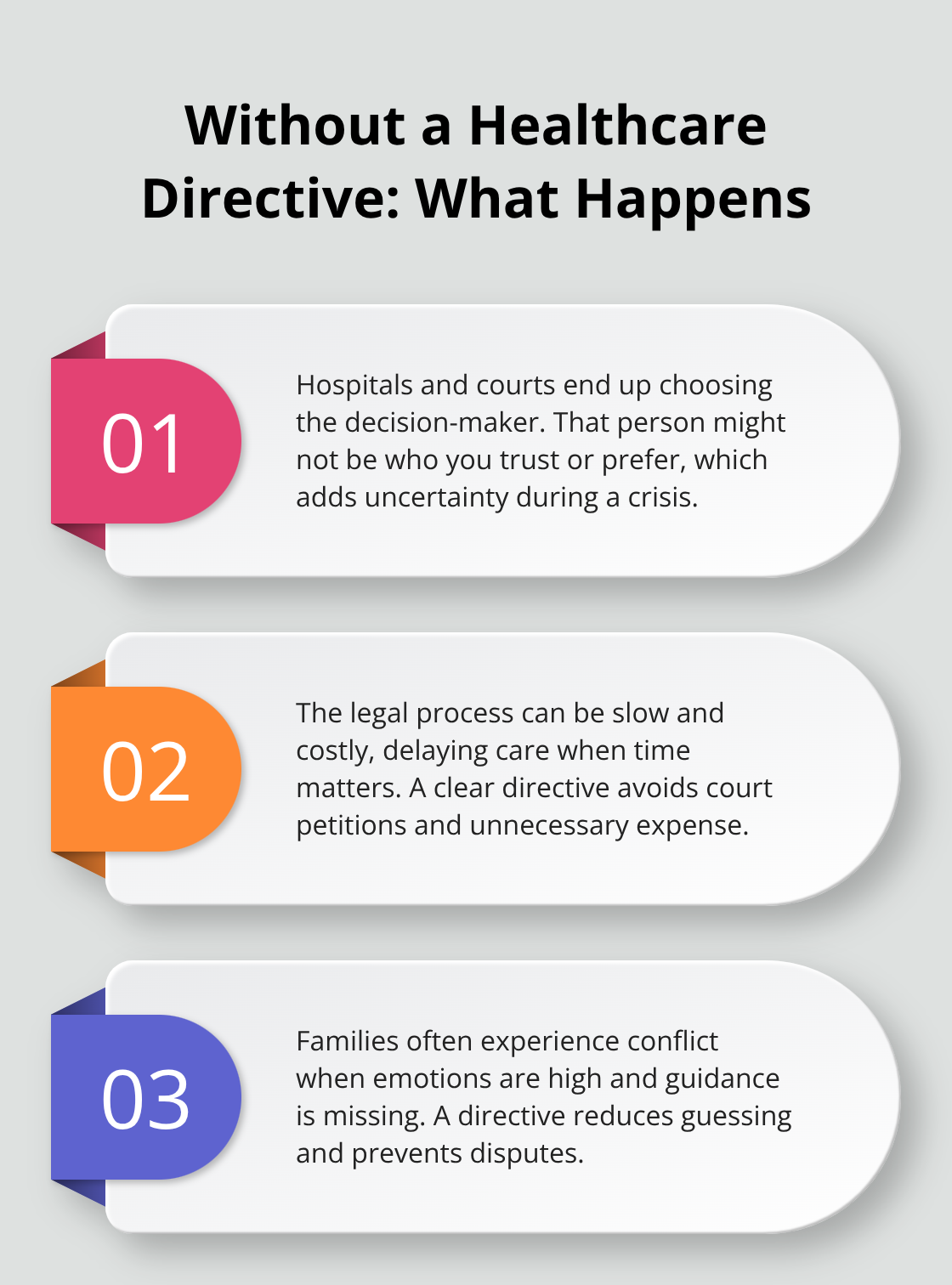
In most states, including Florida, this document is called a healthcare power of attorney or healthcare proxy designation. The person you name, called your healthcare agent or proxy, receives authority to speak with doctors, review medical records, and choose treatments based on your wishes. Without this document, hospitals turn to state law to determine who can make decisions, which often means following a legal priority list that may not match your actual preferences. That process takes time, costs money, and frequently creates family conflict precisely when emotions run highest.
Why Automatic Authority Doesn’t Exist
The biggest mistake couples and families make is assuming their spouse or adult children automatically have decision-making authority. They don’t. Hospital staff must follow state law, not family relationships. Situations arise where a spouse must hire an attorney and petition a court to make medical decisions for their partner because no healthcare directive exists. That’s expensive, slow, and completely avoidable.
Common Misconceptions That Delay Action
Many people confuse a healthcare directive with end-of-life wishes, thinking it only applies if they’re dying. In reality, your healthcare agent can make decisions about any medical treatment when you’re incapacitated, whether that results from surgery, illness, injury, or temporary unconsciousness. Another common misconception is that creating one locks you into specific choices forever. Healthcare directives should be reviewed and updated every three to five years, especially after major life changes like marriage, divorce, or significant health events.
What Happens Without One
The practical reality is this: if you don’t name someone in writing, hospitals and courts will decide for you, and that decision-maker might not be the person you want. This uncertainty affects not only your medical care but also the emotional burden placed on your family members. The next step involves understanding exactly what components your healthcare directive needs to function effectively and protect your interests.
What Goes Into Your Healthcare Directive
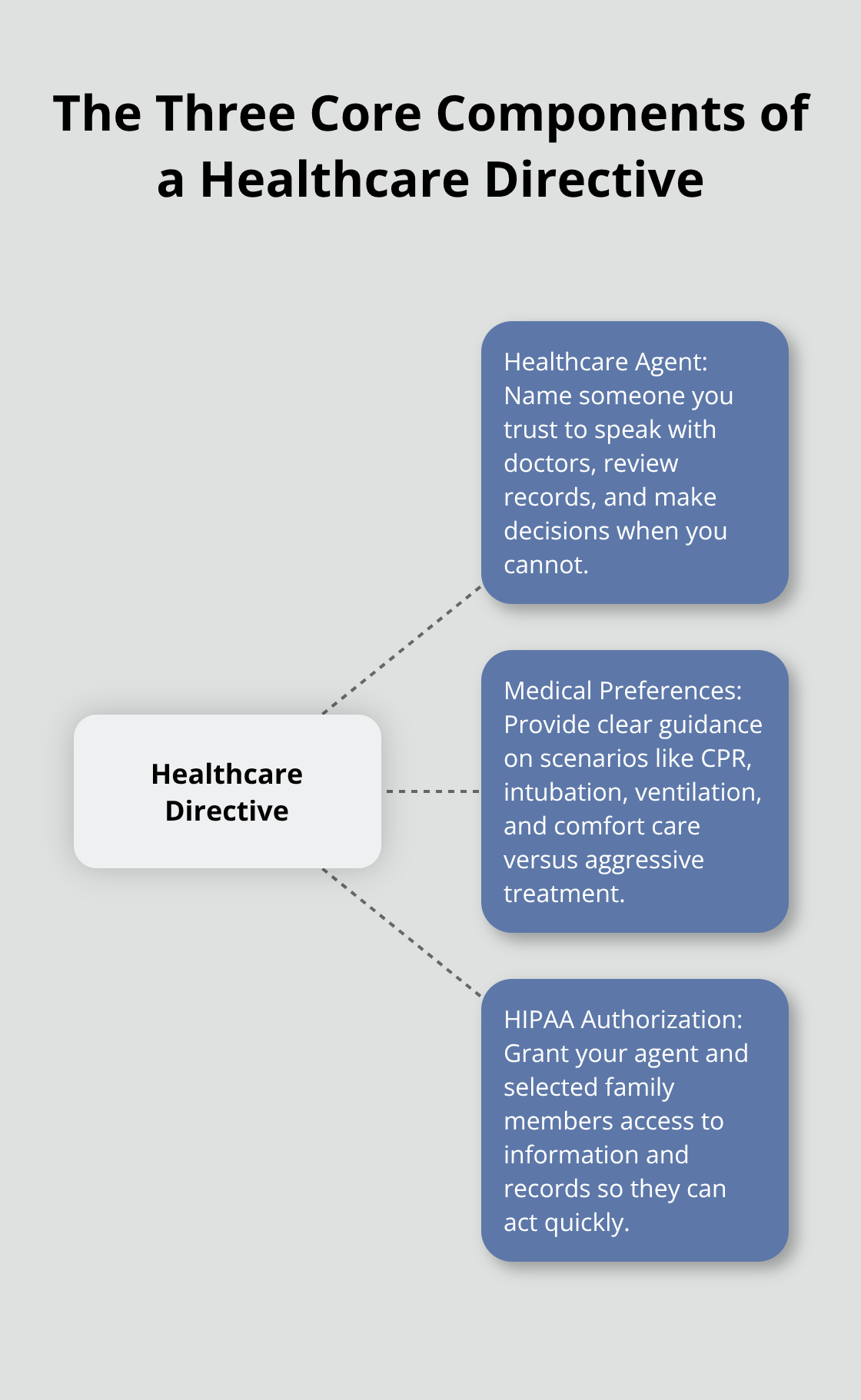
Your healthcare directive only works if it contains the right information and names the right person. Hundreds of healthcare directives fail because they’re incomplete or unclear about critical decisions. The three core components-your healthcare agent, your medical preferences, and HIPAA authorization-form the foundation of a document that actually protects you when it matters most.
Choosing the Right Healthcare Agent
The person you name as your healthcare agent carries enormous responsibility. This isn’t an honorary position. When you’re unconscious in an ICU, your agent makes decisions about surgery, ventilators, feeding tubes, and medication. Most people choose a spouse or adult child, but that choice should be intentional, not automatic.
Your healthcare agent must be willing to have difficult conversations with doctors, comfortable advocating for unpopular decisions, and able to set aside their own emotions to honor your wishes. Some people name someone who lives too far away to visit the hospital, which creates practical problems during medical crises. Others choose someone who has never shown the emotional stability to handle high-pressure situations.
Talk directly with your chosen agent before naming them. Tell them what you expect, what medical scenarios concern you most, and whether they’re comfortable making decisions that might conflict with family members’ opinions. Name a successor agent as well. If your first choice becomes unavailable, incapacitated, or unwilling to serve, your medical decisions shouldn’t stall while family members argue about who takes over.
Stating Your Medical Preferences Clearly
Vague wishes create problems. Saying you don’t want extraordinary measures tells your agent nothing concrete. Instead, address specific scenarios: What if you suffered a severe stroke and couldn’t communicate but could live for years in a nursing home? What if you developed advanced dementia? What if you needed a feeding tube after a surgery that didn’t go as planned?
Address whether you want CPR attempted, whether you’d accept intubation and mechanical ventilation, and under what circumstances you’d want comfort care instead of aggressive treatment. Medical crises happen fast, and doctors need clear direction, not guesses. Many people assume their agent will know what they want, but that assumption often fails when decisions must happen immediately.
Some people benefit from completing a values statement that explains the reasoning behind their choices. Instead of just writing no feeding tubes, you might explain: I value independence and dignity more than longevity, so if I can’t eat or communicate, I don’t want to be kept alive artificially. That context helps your agent make decisions in situations you never anticipated.
Your healthcare directive should address organ and tissue donation if that matters to you. Without written instruction, hospitals cannot honor donation wishes if family members object.
HIPAA Authorization Protects Information Access
Federal privacy law prevents doctors from discussing your medical condition with anyone-including your spouse or adult children-without written authorization. Your healthcare directive must include HIPAA authorization language that explicitly allows your healthcare agent and possibly other family members to access your medical records and receive information about your condition.
Without this authorization, your agent might arrive at the hospital and doctors will refuse to answer questions about your diagnosis, treatment options, or prognosis. Try naming two or three people who can receive medical information, not just your healthcare agent. Your spouse might be your agent, but you might also want your adult daughter to have access to information in case she needs to help coordinate care or support decisions.
Be specific about what information they can access. Some people prefer that information sharing remain limited to certain conditions or circumstances. Your HIPAA authorization should also address who can access your medical records after your death. Without explicit instruction, some hospitals restrict access even for immediate family members.
The document must be clear, dated, and signed in front of witnesses or a notary, depending on your state’s requirements. A healthcare directive that sits in a drawer unsigned or improperly executed has zero legal power when hospitals need it. With these three components in place, you’ve created a document that actually guides your medical care. The next step involves understanding how to create this document properly and keep it current as your life changes.
Creating and Updating Your Healthcare Directive
Drafting Your Healthcare Directive Properly
Online template services charge $50 to $150 and provide generic forms that often miss state-specific requirements. Many templates fail to include proper witness or notary procedures, which means the document won’t hold up when hospitals need it. Florida requires healthcare directives to be signed in front of two witnesses or a notary public, and those witnesses cannot be your healthcare agent, your agent’s spouse, or certain healthcare providers. Getting this wrong means starting over.
An attorney can ask clarifying questions about your medical preferences that online forms never address. The cost typically runs $200 to $400, a modest expense compared to the legal fees required if hospitals must petition a court to determine who makes your medical decisions. If you choose the online route, verify that your state recognizes the form, have it notarized even if not required, and give copies to your healthcare agent and primary doctor before any medical crisis occurs.
Timing Your Updates and Life Changes
Your healthcare directive isn’t a set-it-and-forget-it document. Life changes demand updates. You should review your directive every three to five years, but update it immediately after marriage, divorce, the birth of children, significant health changes, or if your chosen healthcare agent becomes unavailable or moves far away. Many people name their spouse as agent, then go through divorce and never update the document, leaving an ex-partner with medical decision-making authority.
Storing and Sharing Your Document
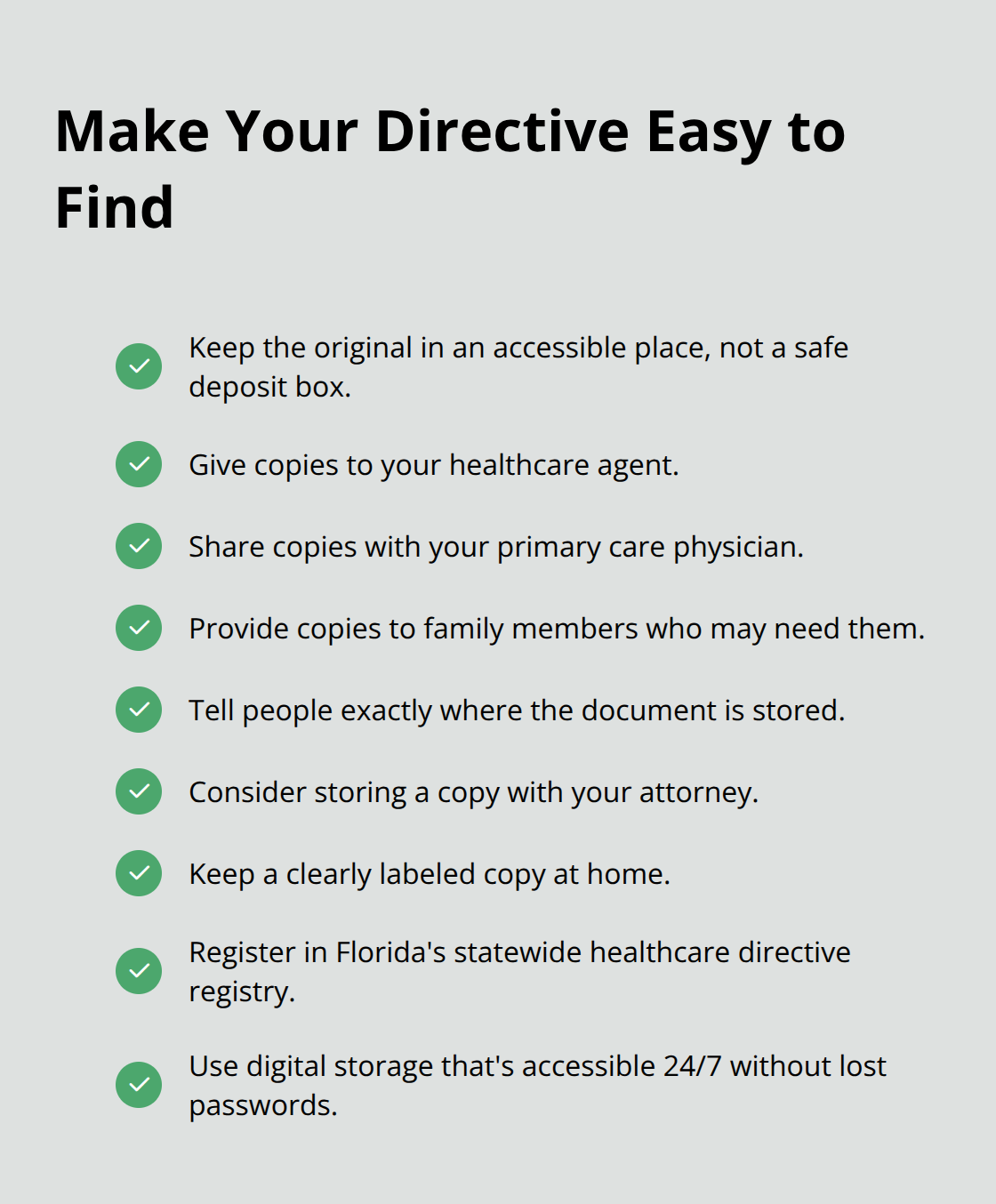
Keep your original signed copy in an accessible location, not a safe deposit box that requires bank access during a medical emergency. Give copies to your healthcare agent, your primary care physician, and any family members who might need to reference it. Tell people where the document lives-hospitals cannot help if nobody knows the directive exists. Some people store copies with their attorney, keep a copy at home in a clearly marked folder, and provide another to their agent.
Florida hospitals participate in the statewide registry for healthcare directives, so registering your document there adds another layer of accessibility. Digital storage services exist, but verify they’re accessible 24/7 without passwords that might be lost during a crisis.
Having the Conversation That Matters
Handing someone a 10-page document and saying you’ve named them as your medical decision-maker isn’t communication. Sit down with your healthcare agent, discuss specific scenarios, explain your reasoning, and answer their questions. That conversation transforms a legal document into actual guidance your agent can follow when facing difficult choices under pressure.
Final Thoughts
A healthcare directive isn’t optional planning for people who might need it someday-it’s immediate protection for your medical wishes and your family’s peace of mind. Without one, hospitals make decisions based on state law, not your values, and your spouse has no automatic authority to speak for you. Your adult children cannot access your medical information, and the people you trust most face legal barriers precisely when they need to help you most.
Medical crises don’t announce themselves, so you could face surgery tomorrow, suffer an accident next week, or experience a sudden illness that leaves you unable to communicate. When that happens, a properly drafted healthcare directive becomes the document that guides every decision about your care and tells doctors what you want. It empowers the person you’ve chosen to speak for you and prevents family members from guessing about your preferences or fighting over what you would have wanted.
Start this week by choosing your healthcare agent, writing down your medical preferences for specific scenarios, and getting the document properly signed and notarized. We at Family, Estate & Mediation Law help individuals and families across Northeast Florida create healthcare directives that protect your wishes and your relationships, and we’re ready to draft yours today.