Most Florida residents don’t realize their email accounts, cryptocurrency, social media profiles, and online banking represent real property that needs protection. When someone passes away, their digital assets often disappear into digital limbo because families don’t know how to access them or what they’re worth.
At Family, Estate & Mediation Law, we’ve seen firsthand how digital assets probate Florida cases become unnecessarily complicated when there’s no plan in place. The good news is that protecting your online legacies doesn’t require technical knowledge-it requires the right documentation and strategy.
What Digital Assets Actually Are
Digital assets represent anything of value you own online that doesn’t physically exist. We at Family, Estate & Mediation Law see this category expand constantly as Florida residents accumulate more online property. Your email accounts hold financial records and personal communications worth protecting. Cryptocurrency holdings stored in digital wallets can represent significant wealth. Social media profiles, domain names, and online businesses generate real income or hold sentimental value. Cloud storage containing family photos and documents matters tremendously to heirs. Online banking and investment accounts need seamless transition to beneficiaries. Subscription services, digital libraries, and streaming accounts have monetary value. Loyalty programs and airline miles represent actual purchasing power. NFTs and digital art collections appeal increasingly to younger estate owners.
Why Florida Probate Courts Struggle With Digital Property
Florida’s probate system wasn’t designed for the digital age, creating genuine complications for families. Traditional probate focuses on physical property and bank accounts, leaving digital assets in legal gray areas. Courts have limited guidance on how to value cryptocurrency or determine ownership of social media accounts. The Revised Uniform Fiduciary Access to Digital Assets Act, adopted by Florida, provides some framework but leaves significant questions unanswered. Without explicit instructions in your will or trust, executors face months of delays trying to access accounts. Financial institutions frequently refuse to grant access to deceased persons’ accounts without court orders, even to spouses or adult children. This creates situations where valuable digital property sits inaccessible while probate proceeds slowly.
The Real Numbers Behind Digital Estates
Americans hold approximately 191 million cryptocurrency wallets, according to 2024 blockchain research. The average person maintains between 100 and 200 online accounts according to password management studies. Digital assets now represent between 10 and 20 percent of total estate value for residents under 55.
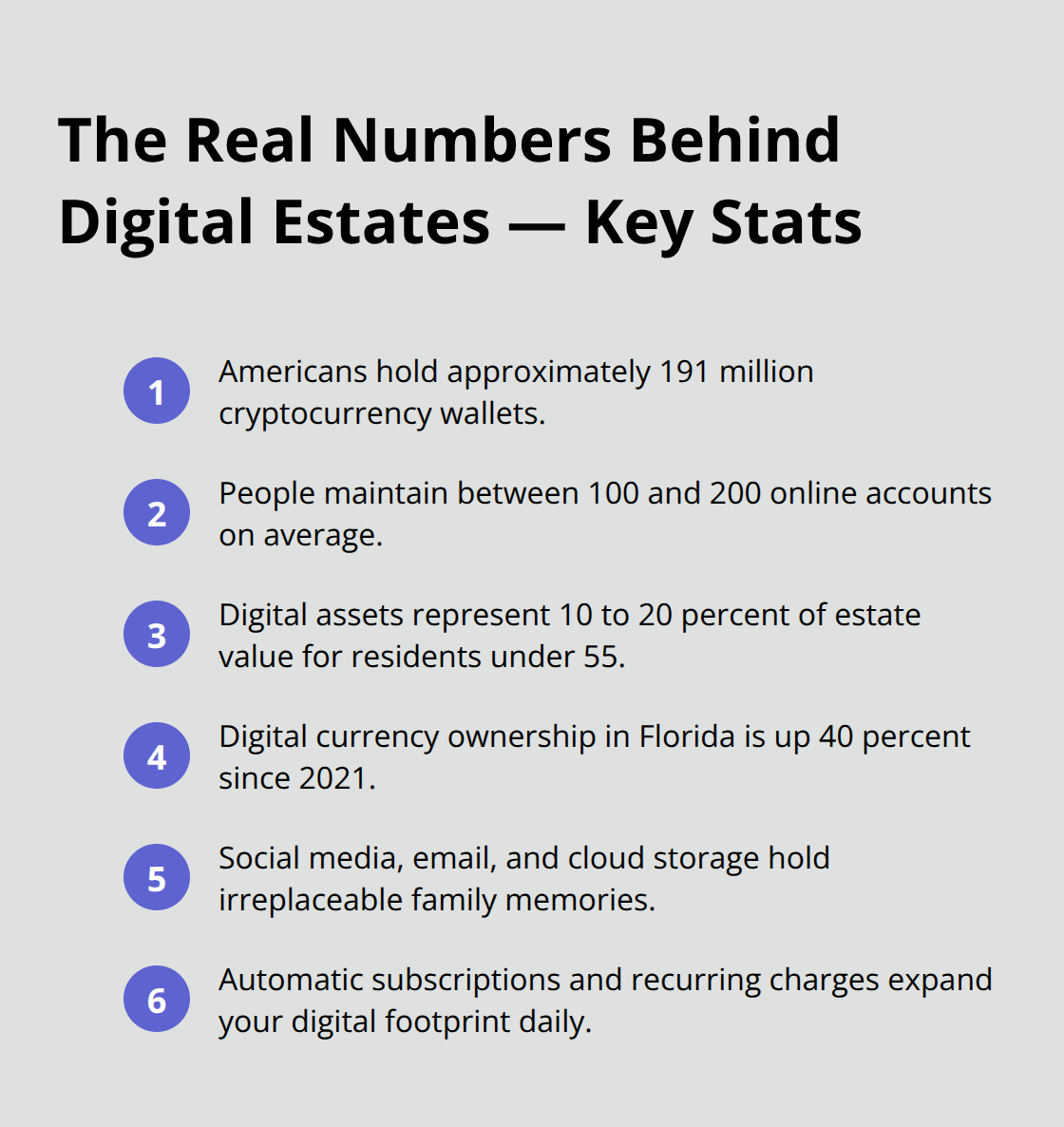
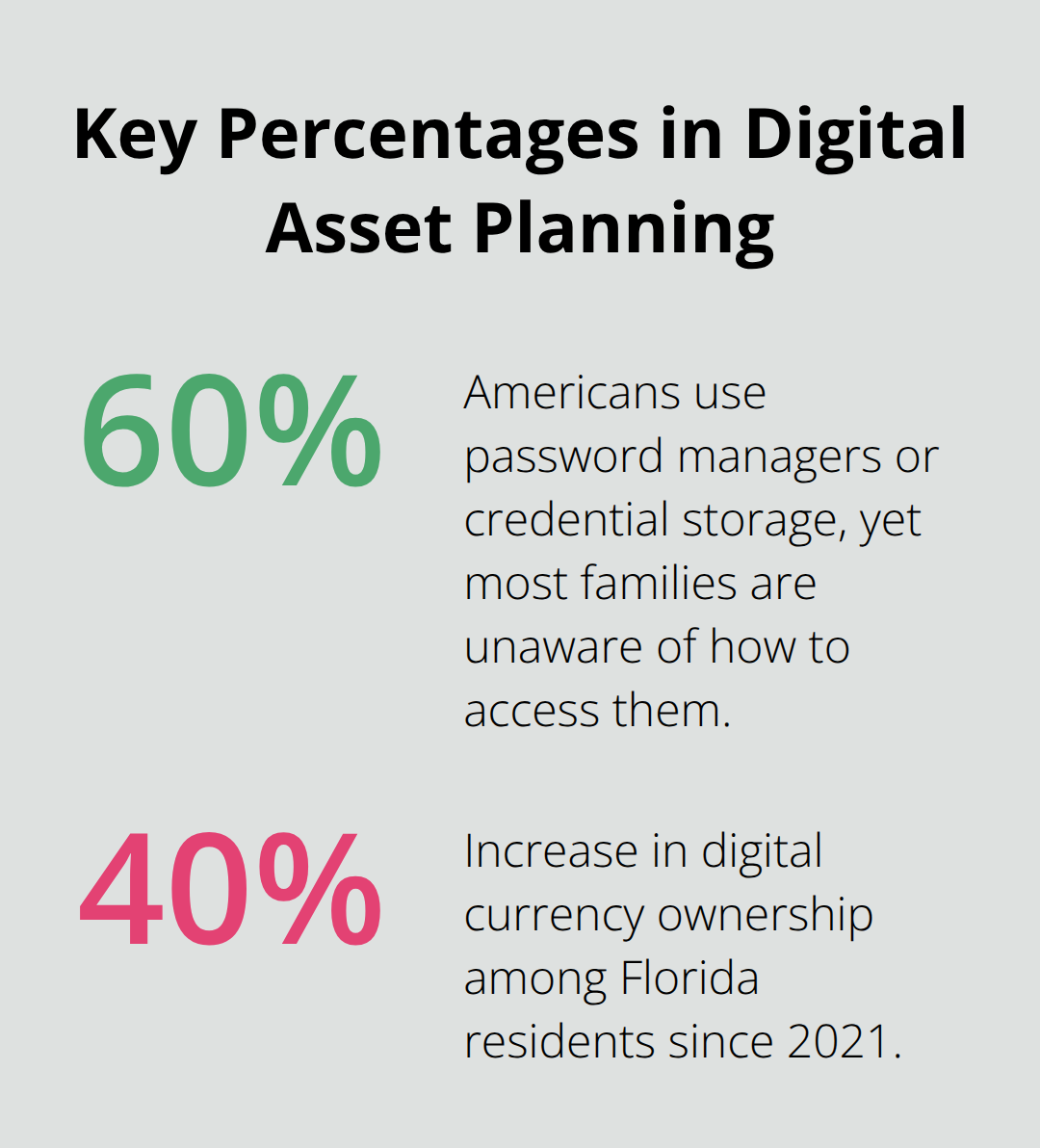
Social media accounts, email, and cloud storage alone contain irreplaceable family memories worth documenting. Online businesses and freelance income streams generate ongoing revenue that heirs need immediate access to. Your digital footprint grows daily through automatic subscriptions and recurring transactions that beneficiaries may not know exist. Florida residents increasingly hold significant cryptocurrency holdings, with digital currency ownership up 40 percent since 2021. These assets require specific planning beyond what traditional estate documents address.
What Happens When You Don’t Plan
Families who lack digital asset documentation face serious obstacles during probate. Executors spend weeks or months attempting to locate accounts, passwords, and access information scattered across devices and notebooks. Financial institutions (and social media platforms) demand court orders before they release any information about deceased account holders. Heirs lose access to irreplaceable photos, messages, and documents stored in cloud accounts. Online businesses stop generating revenue because no one can access the administrative controls. Cryptocurrency wallets remain frozen indefinitely, with funds potentially lost forever if private keys disappear. The longer probate takes, the more damage occurs to digital property and the greater the frustration for your family. This is precisely why identifying and documenting your digital assets now prevents chaos later.
Managing Digital Assets During the Probate Process
Locating Your Digital Assets Requires a Systematic Approach
Finding digital assets during probate presents a genuine challenge because most people scatter passwords across multiple locations-sticky notes in desk drawers, phone notes, password managers they never told anyone about, or nowhere at all. Start with a complete audit of where your accounts actually exist. Check your email inbox for password reset confirmations, account notifications, and subscription receipts going back several years. These emails reveal digital properties you may have forgotten about entirely. Look through your browser’s saved passwords, cloud storage accounts, and any password management tools like LastPass or 1Password. Ask yourself where money leaves your bank account monthly-those recurring charges point directly to digital assets requiring access. Most people discover they maintain far more accounts than they realized, from obscure cryptocurrency exchanges to abandoned social media profiles holding valuable content.
Understanding Why Access Becomes Complicated
The challenge intensifies when executors must locate these accounts without your documented roadmap. Financial institutions hold firm on their policies: they won’t grant access to deceased persons’ accounts without either explicit authorization documents or court orders. A court order takes weeks or months to obtain, meaning valuable digital property sits frozen while probate crawls forward. This delay matters tremendously for online businesses generating revenue, cryptocurrency holdings, or cloud storage containing time-sensitive documents. Each platform operates under different rules, creating a fragmented landscape that confuses even organized families. Banks and investment firms have established procedures for account transfer, though they move slowly. Social media platforms like Facebook and Instagram have specific processes for memorialized accounts or content transfer, but they require official death documentation and proof of heirship.
How Different Platforms Handle Transfers
Cryptocurrency exchanges typically won’t transfer holdings without a court order, even to direct heirs, because blockchain transfers are irreversible. Email accounts present particular complications because they often serve as the master key to other accounts-losing email access means losing password recovery options for everything else. Cloud storage providers like Google Drive and OneDrive offer beneficiary access options if you set them up beforehand. Cryptocurrency held on exchanges can transfer to heirs if you’ve designated beneficiaries directly with those platforms.
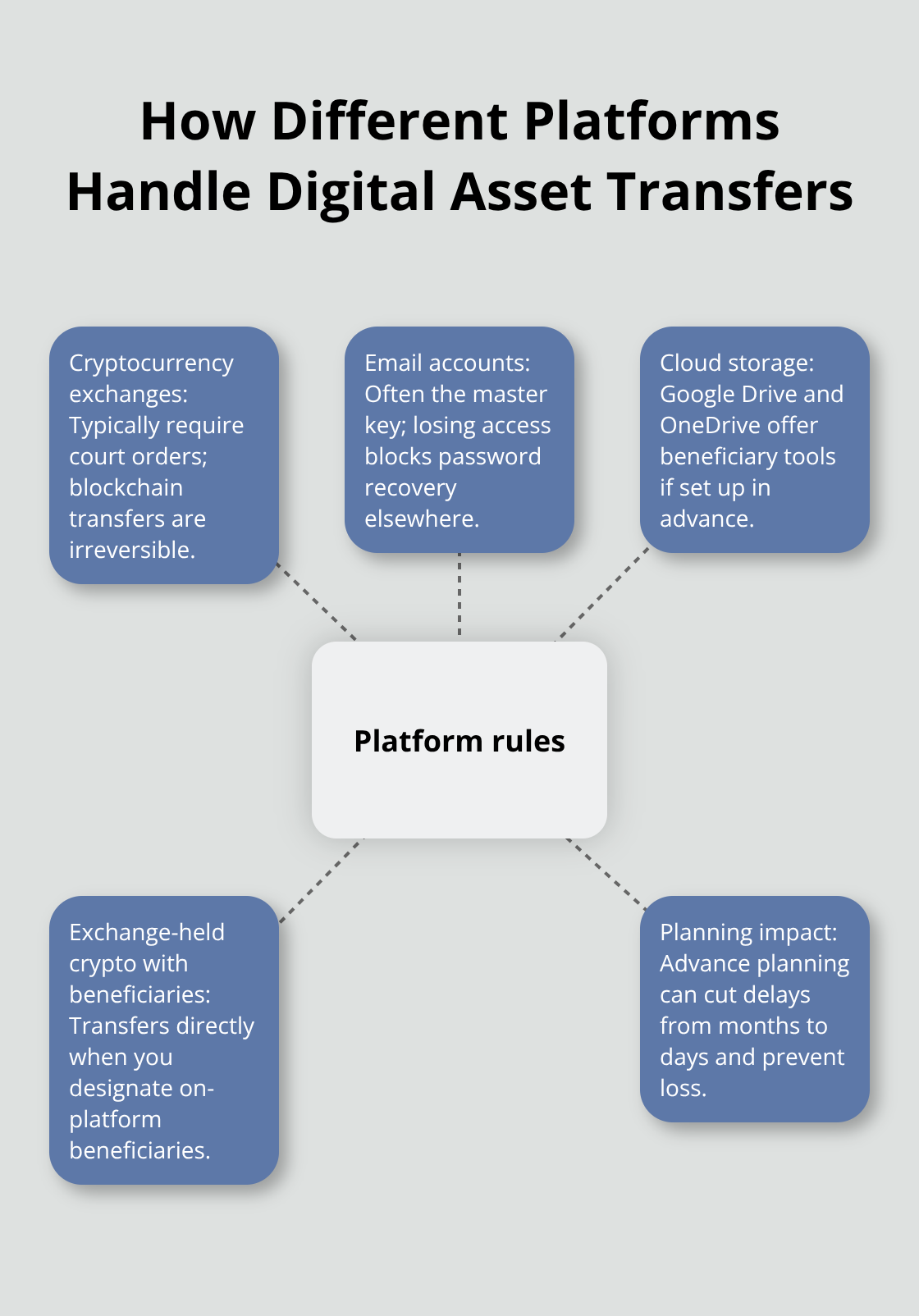
The pattern is clear: advance planning reduces probate delays from months to days and prevents digital properties from disappearing entirely.
Planning Now Prevents Probate Delays Later
The most efficient path forward involves updating your estate planning documents now to include specific digital asset instructions and designations. Your will or trust should explicitly list major digital assets, identify where credentials are stored, and authorize your executor to access accounts without court intervention where legally possible. Some states now recognize digital asset powers of attorney, which provide immediate access without waiting for probate to conclude. Family, Estate & Mediation Law Group can help you structure these documents to address your specific digital holdings and ensure your executor has clear authority to act. With over 50 years of combined experience, our team understands how digital assets complicate probate and how proper planning prevents those complications from affecting your family.
Common Challenges and How to Avoid Them
Authentication Systems Block Access After Death
Authentication systems designed to protect your accounts become formidable barriers after death. Financial institutions and platforms implement multi-factor authentication, biometric verification, and security questions specifically to prevent unauthorized access-which means they also prevent authorized access when you’re no longer alive to confirm your identity. Executors face a harsh reality: platforms treat deceased account holders the same way they treat hackers.
A 2023 survey from the Pew Research Center found that 60 percent of Americans use password managers or some form of credential storage, yet most never inform their families where these systems exist or how to access them. This creates an immediate problem during probate. An executor might locate your email account but cannot reset the password without access to your phone number or recovery email.
Cryptocurrency and Financial Platform Barriers
Cryptocurrency exchanges demand photo identification and proof of death plus proof of heirship before releasing funds-a process averaging 60 to 90 days even with complete documentation. Social media platforms require death certificates, notarized affidavits, and sometimes court orders to transfer or memorialize accounts. Without advance planning, your executor spends months chasing down credentials, contacting platform support teams, and obtaining legal documents just to access assets your family already owns.
Missing Documentation Creates Permanent Loss
The second major obstacle stems from incomplete or nonexistent documentation about what you actually own digitally. Most Florida residents maintain no central record of their digital assets, leaving executors to piece together account information from scattered sources. Your executor might find a cryptocurrency wallet address on an old laptop but no record of the password or private key-making those holdings permanently inaccessible.
Bank statements reveal subscription charges to services your family never knew existed. Email inboxes contain password reset confirmations from accounts you abandoned years ago. Cloud storage accounts sit undiscovered because no one knew to look for them.
Ownership Disputes Over Digital Property
Disputes over digital property ownership arise frequently when multiple people claim rights to accounts or assets. A business partner might claim ownership of social media accounts your deceased family member managed. Adult children disagree with spouses over who should inherit cryptocurrency holdings. Without documented instructions in your will or trust, these disputes consume probate time and family relationships.
Create a Digital Asset Inventory Now
A comprehensive digital asset inventory prevents months of delays and eliminates confusion about your intentions. This simple document lists each account, its approximate value, where credentials are stored, and who should inherit it. Store this inventory alongside your will and trust, and inform your executor where to find it immediately after your death. Family, Estate & Mediation Law Group can help you structure these documents to address your specific digital holdings and provide your executor with clear authority to act.
Final Thoughts
Start building your digital asset inventory today by listing every account that holds value or meaning-your email, banking, cryptocurrency, social media, cloud storage, and any online business accounts. Write down approximate values where applicable and note which beneficiary should inherit each asset. Store this inventory in a secure location alongside your will and trust, and tell your executor exactly where to find it.
Documenting passwords and access information requires a practical system that balances security with accessibility. Password managers like LastPass or 1Password work well because they store credentials securely while allowing you to grant your executor access through a master password or emergency contact feature. Never store passwords in plain text files or sticky notes; instead, use your password manager’s built-in sharing features or create a sealed envelope with instructions for your executor to open only after your death.
The most important step involves updating your estate plan to address digital assets specifically in your will or trust. Your documents should explicitly authorize your executor to access digital accounts, transfer cryptocurrency, manage social media profiles, and handle online businesses without requiring court intervention. We at Family, Estate & Mediation Law help Northeast Florida families structure their estate plans to address digital assets probate Florida situations and provide executors with clear authority to act immediately-contact us to update your estate plan and protect your digital legacy.