Many Floridians believe a will is enough to protect their family’s future. The truth is that trust creation steps in Florida offer far greater control, privacy, and asset protection than wills alone.
At Family, Estate & Mediation Law, we guide clients through the entire process of building a trust that works for their specific situation. Whether you’re in St. Augustine, Palatka, or anywhere across Florida, this guide walks you through each stage from initial planning to ongoing management.
Why Trusts Beat Wills for Florida Families
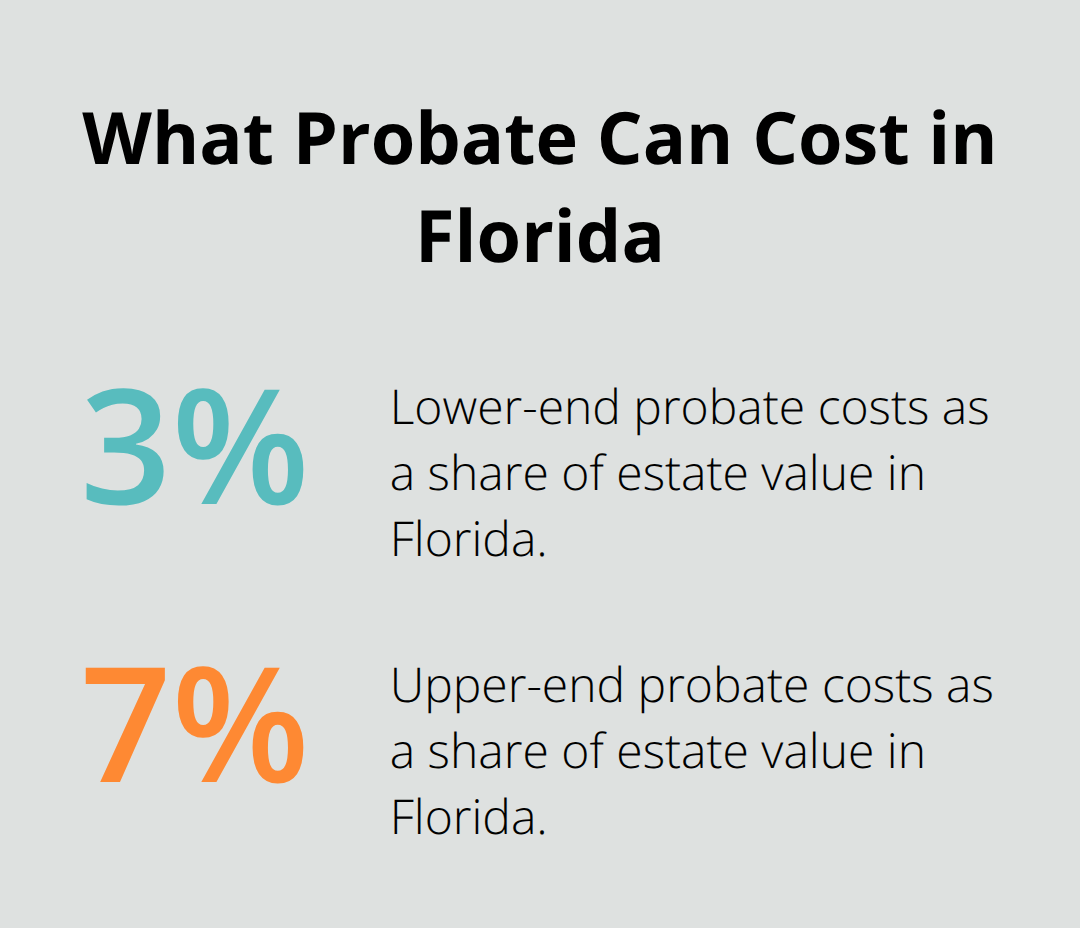
Most people in St. Augustine and Palatka assume a will handles everything after death. It doesn’t. A will only directs who gets your assets after probate-a public, expensive, time-consuming court process that averages 7 to 12 months in Florida and costs between 3% to 7% of your estate’s value according to the American College of Trust and Estate Counsel. A trust, by contrast, transfers assets directly to beneficiaries outside probate, keeping details private and reducing costs dramatically. Wills also become public record; anyone can read them online.
Trusts remain confidential. Additionally, wills only take effect after your death, leaving no plan if you become incapacitated. A revocable living trust provides immediate management structure and protects your assets while you’re alive. Florida law recognizes trusts as superior vehicles for asset protection, privacy, and control-yet many families still rely solely on wills because they don’t understand the real differences.
The Privacy and Protection Advantage
When you create a trust in Florida, your financial details stay completely private. Probate proceedings are public, meaning creditors, distant relatives, and anyone else can challenge your will or make claims against your estate. Trust distributions happen privately between you and your trustee with zero court involvement. This matters significantly for families with blended children, substantial assets, or privacy concerns. Additionally, trusts protect assets from creditors more effectively than wills do. A properly structured trust shields your legacy from your beneficiaries’ creditors, divorces, and poor financial decisions-something a will cannot accomplish.
Incapacity Planning That Wills Miss
Here’s what wills cannot do: they say nothing about what happens if you become mentally or physically unable to manage your affairs. Trusts address this gap by naming a successor trustee who takes over immediately if you’re incapacitated. Without a trust, your family must go to court and petition for a guardianship or conservatorship-expensive, public proceedings that cost $3,000 to $5,000 and take months to establish. With a revocable living trust, your designated successor simply steps in and manages everything according to your instructions. This avoids court involvement entirely and keeps decisions within your family rather than in a judge’s hands.
Understanding these differences sets the foundation for your next decision: determining what type of trust structure actually fits your family’s needs and financial situation.
Building Your Trust in St. Augustine and Palatka
Phase One: Initial Consultation and Goal Setting
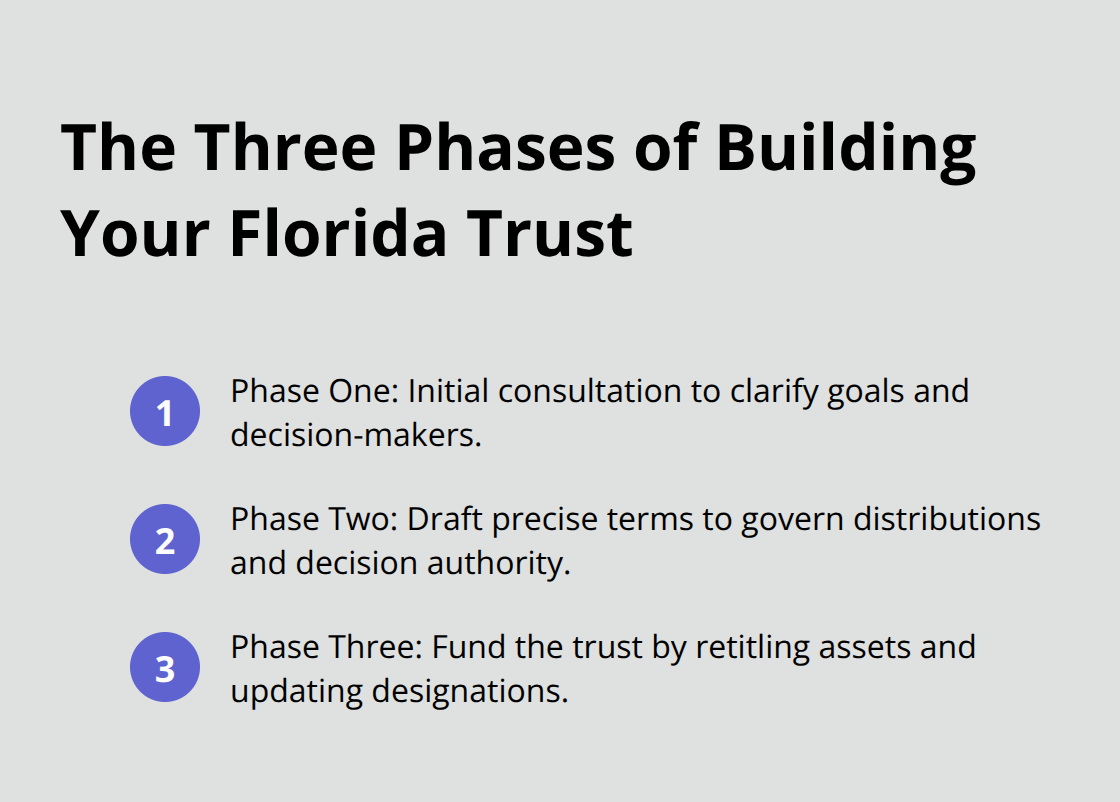
Creating a trust requires three distinct phases, each with specific actions that determine whether your trust actually protects your assets or leaves gaps. The initial consultation is where you clarify your goals and assess your financial situation. During this meeting, you answer hard questions: Who will manage your trust if you become incapacitated?
Should your children receive their inheritance all at once or over time? Do you have blended family issues, minor children, or substantial assets requiring creditor protection? These aren’t theoretical exercises-they directly shape your trust structure.
You must map out your complete financial picture, including real estate, investments, business interests, and digital assets. Many people overlook digital assets entirely, yet the average American holds approximately $55,000 in digital property according to the Pew Research Center. Your trust document must account for these assets or they’ll fall outside your trust’s protection. This phase typically takes one to two hours and establishes the foundation for everything that follows.
Phase Two: Drafting Your Trust Document
Drafting your trust document is where precision matters enormously. A poorly drafted trust creates ambiguity that beneficiaries and trustees will argue about later, potentially leading to costly court battles. Your trust document must specify exactly how assets transfer, when distributions occur, and who makes decisions if disputes arise. Florida Statute 736.0103 permits considerable flexibility in trust language, but this flexibility creates traps for the unprepared.
Some people attempt to use generic online templates, but these rarely account for Florida-specific requirements or your family’s unique circumstances. The language you choose in your trust document determines how your trustee interprets your wishes and whether your beneficiaries can challenge distributions later. Vague or contradictory language invites litigation that costs thousands of dollars to resolve.
Phase Three: Funding Your Trust
Funding your trust is the phase people consistently neglect, yet it’s where your trust either works or fails. A trust only protects assets titled in the trust’s name. If you create a trust but leave your house, investments, and bank accounts in your personal name, those assets bypass your trust entirely and go through probate anyway. Funding requires retitling property deeds, updating beneficiary designations on retirement accounts, and transferring bank accounts into the trust.
This process takes weeks to months depending on how many assets you own and whether you have out-of-state property. Real estate transfers typically require 10-14 business days for recording, and financial institutions often take 30 days or longer to process account transfers. Some assets (like retirement accounts) need special handling to avoid tax penalties, which is why coordination with your financial advisor matters significantly.
What Happens After Funding
Once you fund your trust completely, your assets sit protected outside probate, ready for seamless transfer to your beneficiaries. But a funded trust isn’t a set-it-and-forget-it document. Life changes-marriages, divorces, births, deaths, significant asset purchases, and tax law changes-all create reasons to review and potentially modify your trust structure.
Managing and Updating Your Trust After Creation
Your trust isn’t static. Life happens-marriages end, children are born, assets grow, tax laws shift, and your priorities change. A trust that made perfect sense five years ago might create problems today if you haven’t reviewed it. We at Family, Estate & Mediation Law recommend reviewing your trust every three to five years at minimum, though certain life events demand immediate attention. Florida law allows considerable flexibility in trust modifications, but only if you take action while you’re still mentally competent and able to make decisions. Waiting too long eliminates your options entirely.
Why Regular Reviews Protect Your Legacy
The most common mistake we see in St. Augustine and Palatka is clients who fund their trust meticulously, then never look at it again for a decade. Meanwhile, their financial situation transforms, their family structure changes, and Florida tax code updates introduce new strategies they could have used. Real estate values shift significantly-the average Florida home appreciated roughly 3.5% annually between 2015 and 2024 according to the U.S. Census Bureau-meaning your asset protection strategy from 2019 may no longer reflect your actual wealth distribution.
If you acquired out-of-state property, your trust document might not address that property’s management or distribution, creating gaps in your protection. Beneficiary circumstances matter too. A child who was financially responsible in 2018 might struggle with addiction or divorce in 2026, requiring you to modify distribution terms to protect their inheritance from creditors or former spouses. Your successor trustee might have moved away, become incapacitated, or developed a conflict of interest that makes them unsuitable to manage your trust anymore.
Events That Demand Immediate Action
Certain events absolutely require immediate trust updates, not in three to five years. A major inheritance you receive must transfer into your trust, or it will bypass your trust structure entirely and create probate problems for your beneficiaries. A significant business acquisition needs trust documentation that addresses succession planning and management continuity.
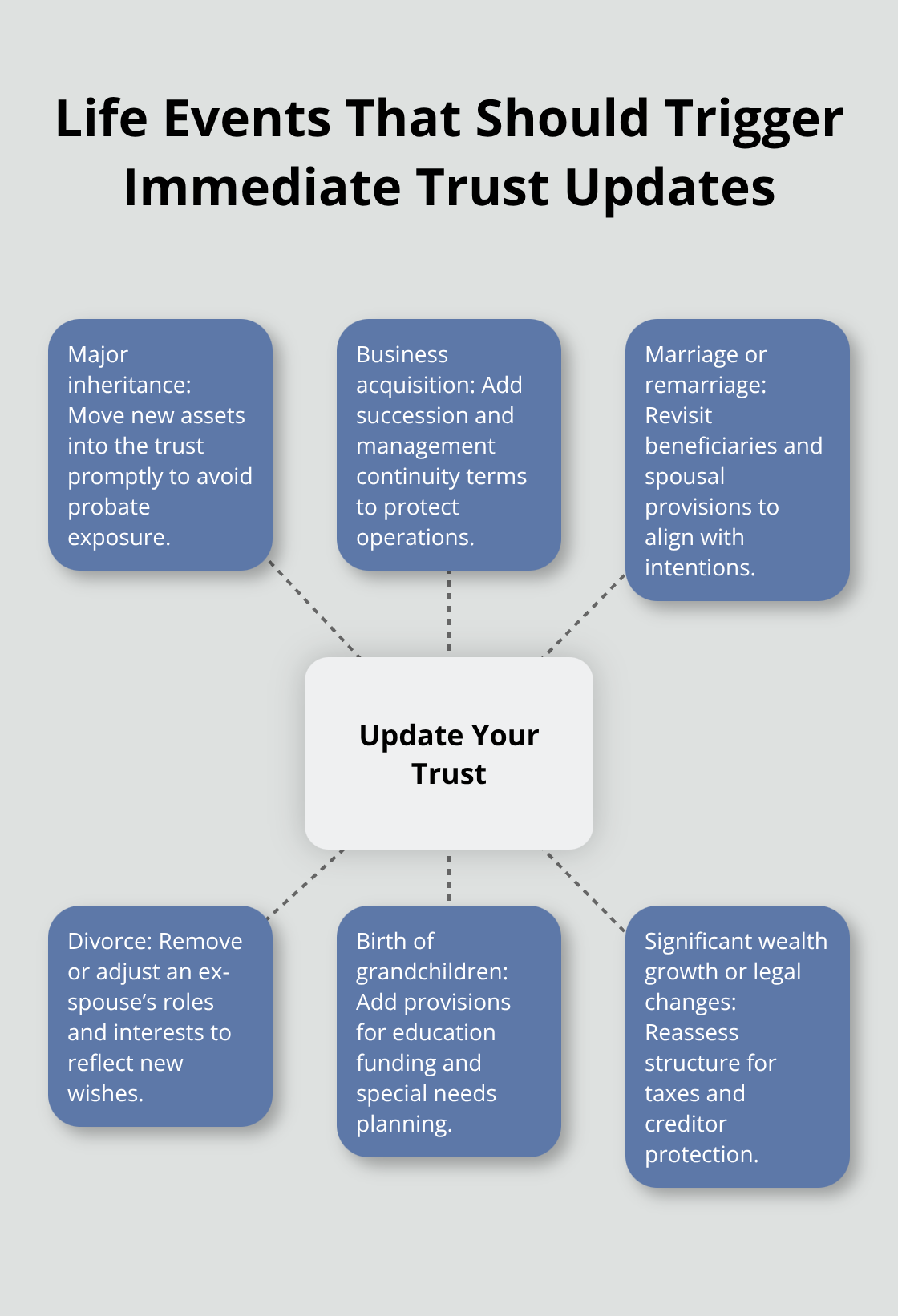
Marriage or remarriage triggers the need to review beneficiary designations and confirm your new spouse understands your trust’s terms and your intentions. Divorce requires careful trust modification to remove an ex-spouse as beneficiary or successor trustee, depending on your wishes. The birth of grandchildren might necessitate adding trust provisions that protect their inheritance and address education funding or special needs planning.
Wealth Growth and Legal Changes
A substantial increase in net worth-whether from business growth, inheritance, or real estate appreciation-may require trust restructuring to address updated estate tax strategies or creditor protection concerns. State law changes also matter. Florida legislators periodically modify trust statutes, and what was optimal planning in 2020 might be suboptimal in 2026 given new protections or requirements.
When any of these events occur, contact Family, Estate & Mediation Law to evaluate whether modifications are necessary. Waiting weeks or months after a major life change allows unnecessary risks to accumulate.
Final Thoughts
Trust creation steps in Florida require commitment, but the payoff justifies the effort. Trusts outperform wills in privacy, asset protection, and incapacity planning-three advantages that wills simply cannot match. You now understand the three phases of building a trust: clarifying your goals, drafting precise language, and funding your assets properly. A funded trust only works if you maintain it through regular reviews and updates when life changes occur.
Many people in St. Augustine and Palatka understand trusts intellectually but never move forward because they hesitate about the next step or worry about costs. The expense of creating a trust pales compared to the probate costs, court battles, and family conflict that result from inaction. A guardianship proceeding alone costs $3,000 to $5,000 and takes months, while probate averages 7 to 12 months and consumes 3% to 7% of your estate’s value.
Starting your trust creation process begins with a conversation about your specific situation. We at Family, Estate & Mediation Law handle the complexity so you don’t have to worry about whether your trust document complies with Florida law or whether you’ve funded it correctly. Schedule your initial consultation and take control of your family’s future.