
Many people in St. Augustine and Palatka think a will is all they need for their estate plan. The reality is far more complex, and the wills and trusts options available to you can make a significant difference in how your family inherits and what they pay in taxes.
At Family, Estate & Mediation Law, we help families understand which approach works best for their situation. This guide breaks down the real differences between these tools and shows you how to build protection that actually fits your life.
What a Will Actually Does (and Doesn’t)
A will is a legal document that tells the court how you want your property distributed after you die. That’s it. Many people in St. Augustine and Palatka believe a will handles everything in an estate plan, but it doesn’t. A will only covers assets titled in your individual name. If you have a payable-on-death bank account, a life insurance policy with a named beneficiary, or retirement accounts like an IRA or 401k, those bypass your will entirely and go directly to whoever you named as beneficiary. Joint accounts with rights of survivorship also skip the will. This means a will controls far less of your estate than most people think.
The Probate Process in Florida
The real problem emerges when you die. Your will must go through Florida probate court, which is a public process that takes time and costs money. According to the American Academy of Estate Planners and Counselors, the average probate case in Florida takes between 8 and 12 months, though complex estates can take significantly longer. Court filing fees, attorney fees, and personal representative compensation all reduce what your family actually receives.
Why Florida Probate Costs Your Family Money
Florida probate isn’t optional if your will controls significant assets. The personal representative (executor) must file your will with the court, notify creditors, pay debts and taxes, and account for every transaction. The personal representative can collect compensation from the estate, typically between 3% and 5% of the estate value depending on complexity. If your estate is worth $500,000, that’s $15,000 to $25,000 in compensation alone.
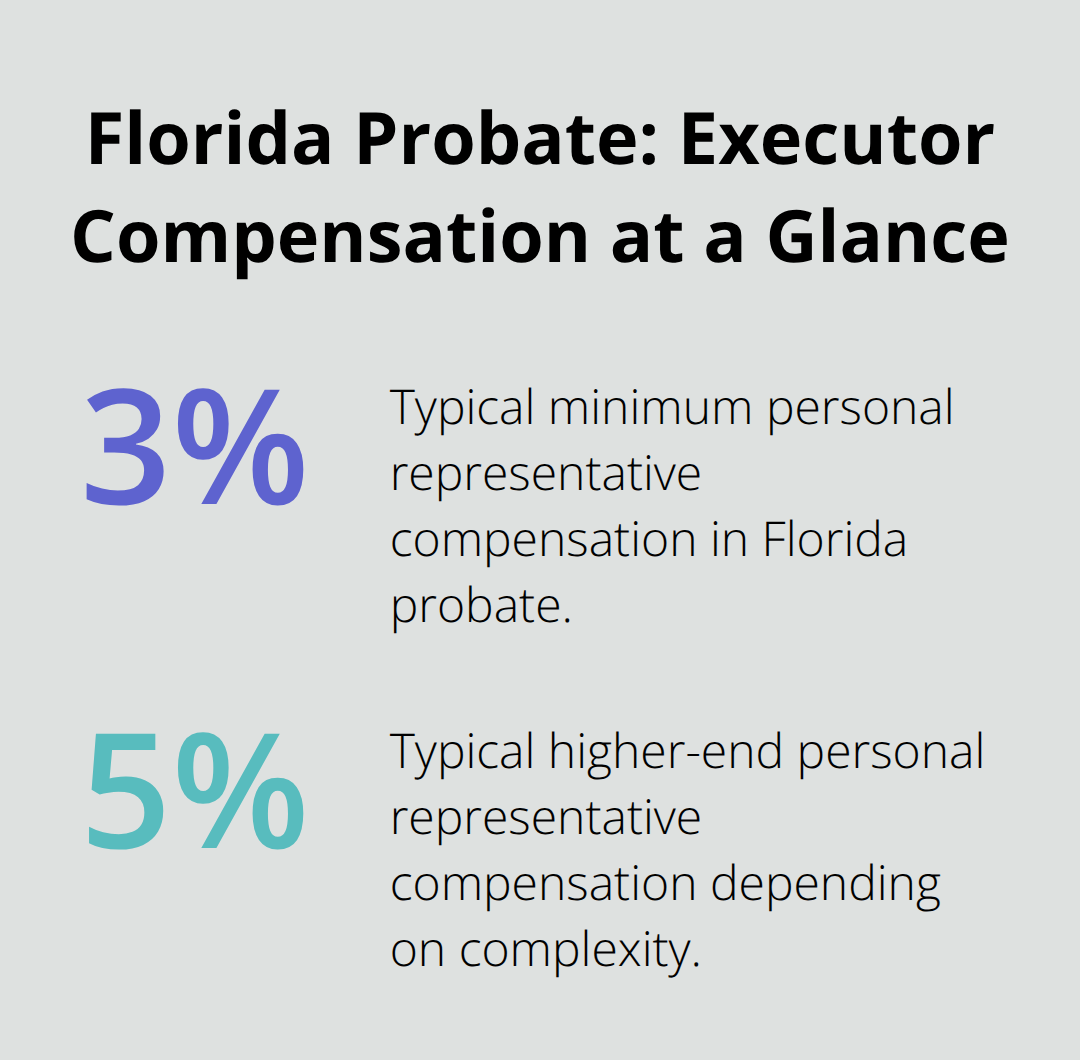
Add attorney fees, court costs, and the time delay, and probate becomes expensive.
Common Misconceptions About Wills
Many families in Northeast Florida discover probate costs only after a loved one passes. Some mistakenly believe that if they name someone as executor in their will, probate goes faster or costs less. It doesn’t. The court still controls the process and requires the same steps. Another misconception is that a will avoids probate. It doesn’t. A will is the document that triggers probate. If you want to avoid probate, you need different tools-which is where trusts enter the picture and why many families benefit from exploring them instead.
How Trusts Stop Probate Before It Starts
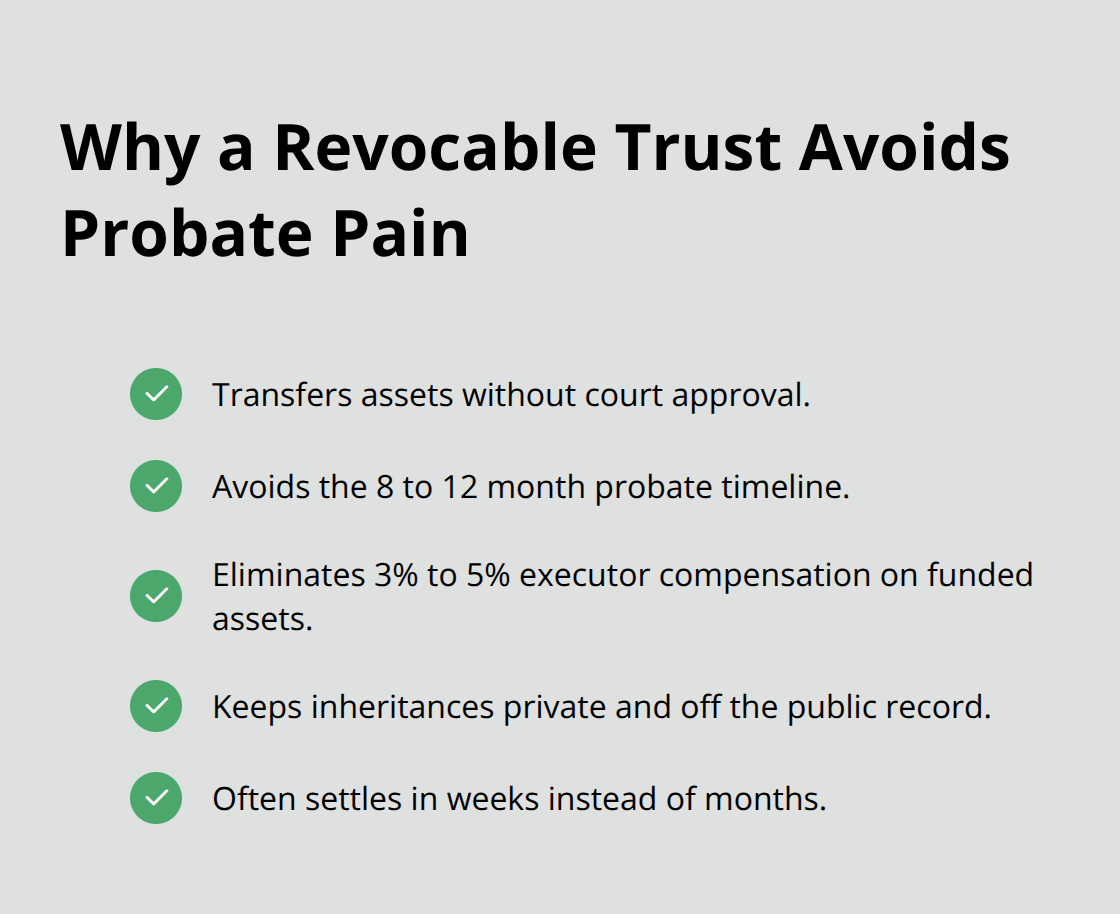
A trust is a legal structure that holds your assets during your lifetime and distributes them after you die, completely outside the probate court system. Unlike a will, a trust requires no court approval, public filing, or the lengthy delays Florida probate creates. When you place assets into a revocable trust and fund it properly, those assets transfer to your beneficiaries immediately upon your death with no court involvement. This means your family avoids the 8 to 12 month probate timeline, along with the executor compensation fees that typically run 3% to 5% of estate value. For a $500,000 estate, that’s $15,000 to $25,000 in fees eliminated entirely. The National Council of Probate Judges reports that trust-based estates settle in weeks rather than months, and your family’s inheritance remains completely private since no court documents become public record.
Revocable Trusts Give You Control While You’re Alive
A revocable trust lets you control your assets exactly as you do now, with one critical difference: the assets are titled in the trust’s name rather than your individual name. You can change the trust terms, add or remove assets, or dissolve it entirely at any time during your life. You remain the trustee managing everything, so nothing changes about how you operate day-to-day. When you become incapacitated or pass away, a successor trustee you’ve named steps in to manage the trust or distribute it according to your instructions.
This structure solves a major problem that wills create: if you become unable to manage your affairs before you die, a will does nothing to help. Your family would need to go to court for a guardianship or conservatorship, which is expensive and public. A revocable trust with a named successor trustee avoids this entirely. If you’re hospitalized or diagnosed with a condition affecting your mental capacity, your successor trustee can manage your finances and property immediately without court involvement.
Irrevocable Trusts Protect Assets and Reduce Taxes
Irrevocable trusts work differently and serve specific purposes. Once you place assets into an irrevocable trust, you cannot change it or remove assets without the beneficiary’s permission. This sounds restrictive, but it protects assets powerfully. Irrevocable trusts remove assets from your taxable estate, which reduces or eliminates federal estate taxes for larger estates. They also protect assets from creditors and lawsuits in ways revocable trusts cannot. Families in St. Augustine and Palatka often use irrevocable life insurance trusts to keep life insurance proceeds out of their taxable estate, potentially saving hundreds of thousands in taxes. The tradeoff is clear: you lose control to gain tax protection and creditor protection.
Tax Strategy and Asset Protection Work Together
For families with significant assets or complicated situations, combining trust structures creates real tax savings. Florida has no state income tax or state estate tax, which is a major advantage. However, federal estate taxes still apply if your estate exceeds $13.61 million in 2024, according to the IRS. That threshold drops to $6.8 million in 2026 unless Congress changes current law. If your estate approaches these numbers, irrevocable trusts become financially necessary rather than optional.
A couple with a $3 million estate might benefit from a revocable trust to avoid probate, while their adult children’s inheritance could flow into irrevocable trusts to protect assets from future divorces or creditor claims. Specialized trusts like qualified personal residence trusts let you transfer your home at a reduced tax value while continuing to live there. Charitable remainder trusts provide income during your lifetime while supporting causes you care about. These aren’t theoretical strategies for wealthy families only. Many middle-class families in Northeast Florida benefit from these structures when their specific circumstances warrant them.
Deciding Between Revocable and Irrevocable Options
The choice between revocable and irrevocable trusts depends entirely on your goals and financial situation. Revocable trusts work best for families who want probate avoidance, privacy, and incapacity planning without sacrificing control. Irrevocable trusts work best for families who prioritize tax reduction and creditor protection over flexibility. Some families use both structures simultaneously (a revocable trust for most assets and an irrevocable trust for specific purposes like life insurance). Your actual numbers, family situation, and long-term objectives determine which approach makes sense. Contact us to discuss how these tools work together in a comprehensive plan that protects your family and your legacy.
Choosing Between Wills, Trusts, or Both
When a Will Alone Falls Short
A will alone makes sense only in narrow circumstances, and most families in St. Augustine and Palatka don’t fall into that category. If your estate is small (under $75,000), you have minimal assets outside retirement accounts and life insurance, and you’re comfortable with your family waiting 8 to 12 months in probate court, a will technically works. But even then, it’s not the best choice. The real issue is that a will creates problems it doesn’t solve. If you become incapacitated tomorrow, your will sits in a drawer useless while your family petitions the court for guardianship. That costs $3,000 to $5,000 in legal fees and gives a judge control over your medical and financial decisions. A revocable trust costs roughly the same to establish but eliminates this risk entirely. For most families in Northeast Florida, the math heavily favors a trust-based plan. You pay similar upfront costs but gain probate avoidance, privacy, incapacity protection, and faster settlement. Unless your situation is genuinely minimal, a will-only approach leaves your family vulnerable and your plan incomplete.
Why Most Families Benefit From Adding a Trust
Families earning $100,000 annually or with home equity exceeding $300,000 should seriously consider a revocable trust as their primary document, not a will. This includes most middle-class households in our area. A revocable trust eliminates probate fees (3% to 5% of estate value), keeps your inheritance private, and handles incapacity without court involvement. If you have a blended family, minor children, or concerns about a beneficiary’s ability to manage money, a trust gives you control over how and when distributions happen. You can structure it so a spendthrift child receives income gradually rather than a lump sum, or so funds support a child with special needs without disqualifying them from government benefits. These protections simply don’t exist in a will. For families with assets approaching the federal estate tax threshold of $13.61 million in 2024, adding an irrevocable trust becomes financially essential. Even at $2 million in combined assets, a properly structured plan using both revocable and irrevocable trusts can save $200,000 to $400,000 in taxes across generations. Many families hesitate because they believe trusts are complex or expensive, but the complexity comes from doing nothing and forcing your family to navigate probate, taxes, and uncertainty.
How Wills and Trusts Work Together
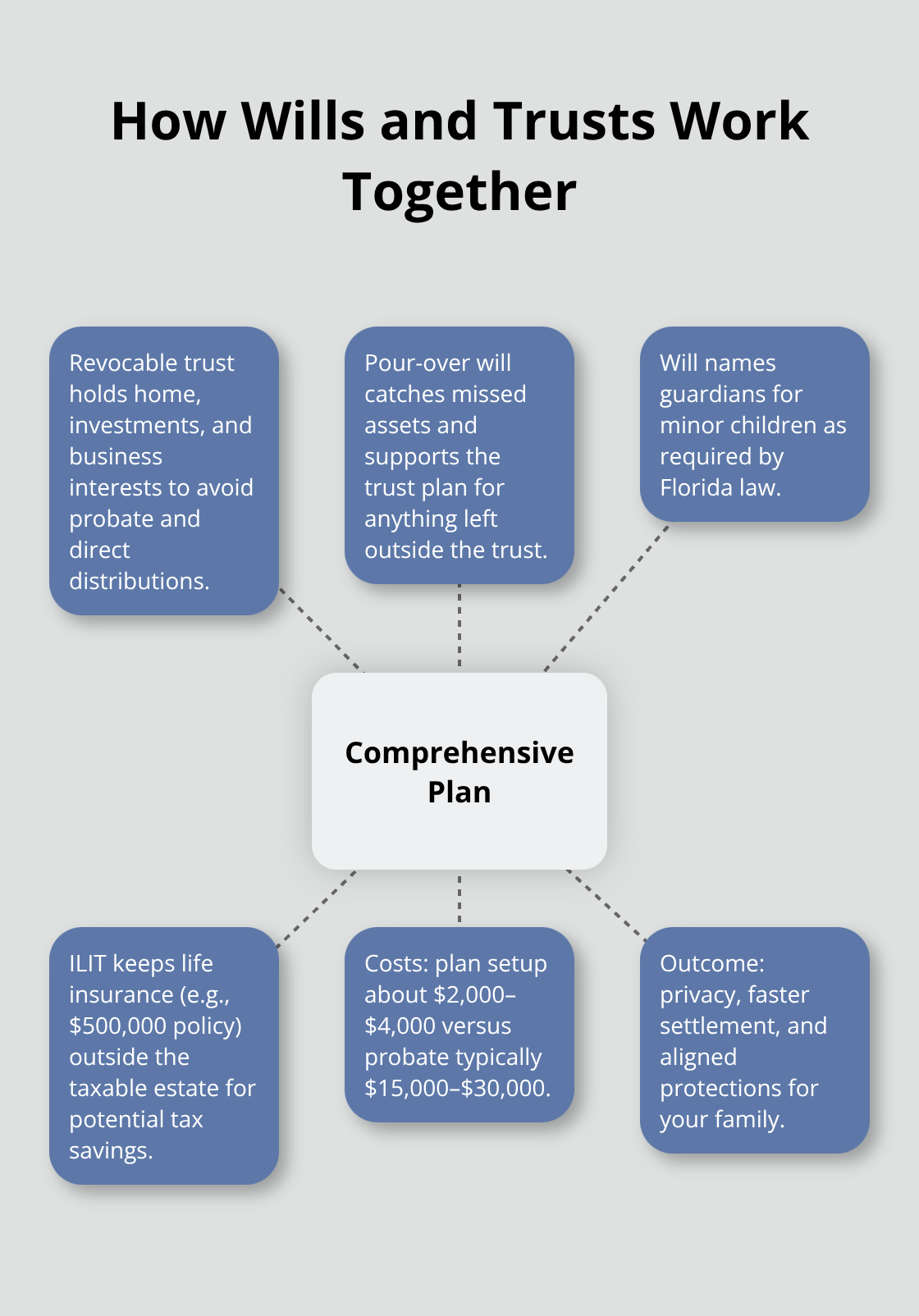
The strongest estate plans use wills and trusts together, not one or the other. Your revocable trust holds your major assets and avoids probate, while your will serves as a safety net for anything accidentally left out of the trust. This is called a pour-over will, and it catches assets you forgot to transfer or acquire after your plan was drafted. Your will also names guardians for minor children, which a trust cannot do. Florida law requires guardianship nominations in a will, making a will essential if you have young kids. Additionally, your will can direct assets into trusts for your children’s benefit, creating ongoing management and protection even after you’re gone. A comprehensive plan might look like this: a revocable trust holding your home, investment accounts, and business interests; a pour-over will naming guardians and catching any missed assets; and possibly an irrevocable life insurance trust keeping a $500,000 policy outside your taxable estate. The cost to establish this complete structure runs $2,000 to $4,000 depending on complexity, which sounds significant until you compare it to probate costs (typically $15,000 to $30,000 for a moderate estate) or the tax liability your family faces without proper planning.
Family, Estate & Mediation Law helps families in St. Augustine and Palatka build plans that match their actual situation rather than forcing every family into the same template.
Final Thoughts
A will and a trust solve different problems, and understanding those differences shapes your entire estate plan. A will directs the court how to distribute your assets after you die, but it triggers probate, costs your family 3% to 5% of your estate in fees, and does nothing if you become incapacitated. A trust holds your assets outside probate, transfers them privately to your beneficiaries in weeks, and lets a successor trustee manage everything if you’re unable to.
Your next step is honest assessment of your situation. Write down your assets, identify who should inherit them, consider whether you have minor children or a blended family, and estimate your total estate value. If you own a home, have retirement accounts, or carry life insurance, you likely have more than $300,000 in assets-that number alone suggests a revocable trust makes financial sense.
For most families in St. Augustine and Palatka, the wills trusts options available mean choosing a trust-based plan as your foundation, not a will-only approach. We at Family, Estate & Mediation Law help families across Northeast Florida build plans that match their actual circumstances. Visit www.femlg.com to discuss your situation and learn which approach works best for protecting your family and your legacy.