Most people spend years building retirement savings but never connect those accounts to their overall estate plan. This disconnect costs families thousands in unnecessary taxes and creates confusion when decisions need to be made.
At Family, Estate & Mediation Law, we see how retirement planning and estates work best when they’re coordinated from the start. The good news is that aligning both plans now prevents expensive problems later.
Why Retirement and Estate Planning Must Work Together
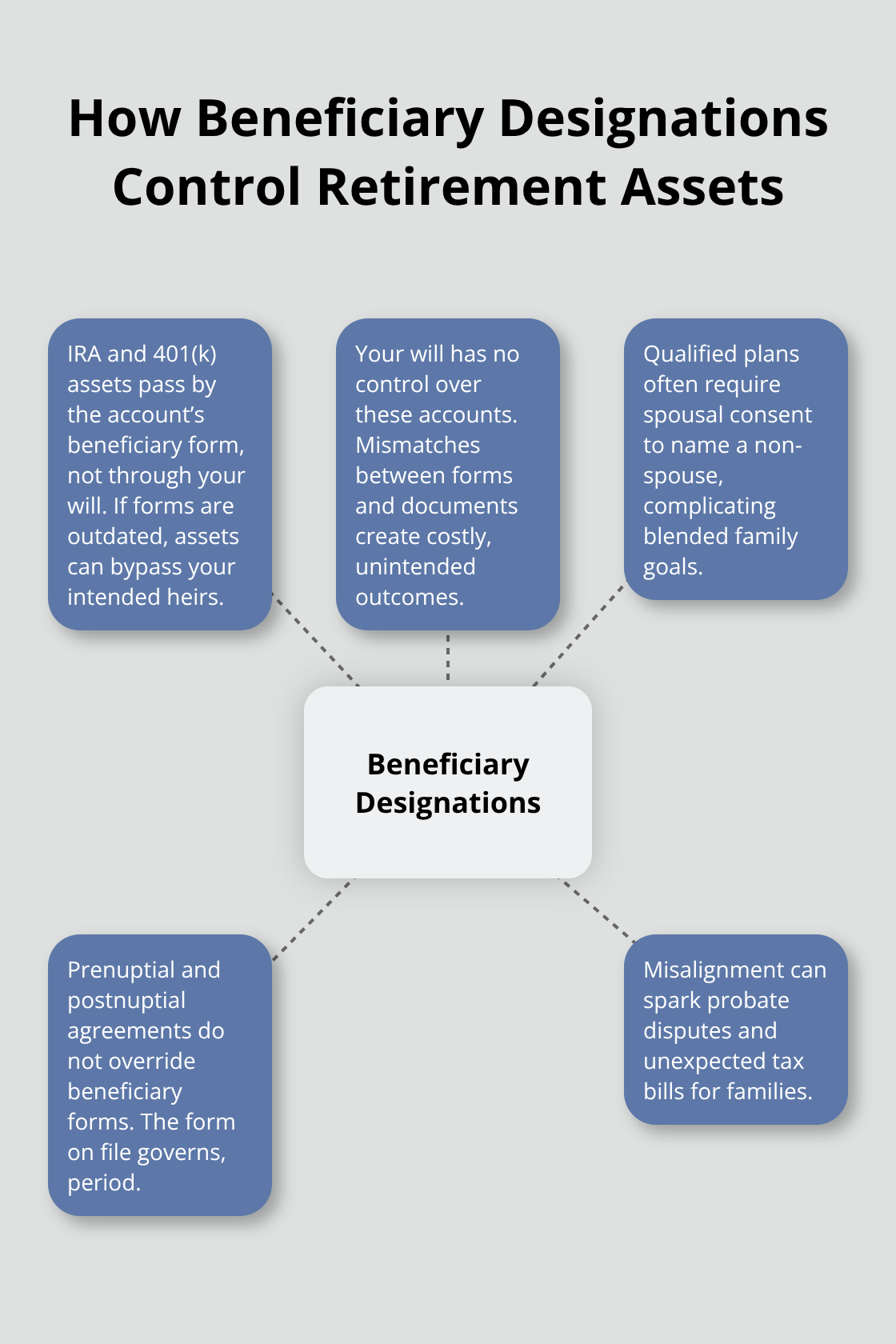
Retirement accounts and estate documents operate under completely different legal rules, yet most people never coordinate them. A traditional IRA passes to beneficiaries through the account’s designation form, not through your will. A 401(k) follows the same path. This means your will has zero control over where these assets go, regardless of what you write in it. If your beneficiary designation still lists an ex-spouse or names your estate as the default recipient, that’s exactly where the money flows when you die-no exceptions, no do-overs.
How Beneficiary Designations Override Your Will
Federal law governing qualified retirement plans typically requires a married spouse’s consent to name anyone other than the spouse as a beneficiary. This creates additional complications if you want assets to pass to your children instead. Prenuptial or postnuptial agreements do not override these designations either. Families face forced probate disputes and unexpected tax bills because retirement accounts were never aligned with their actual wishes.
Tax Consequences of Misalignment
The tax impact of disconnected plans hits hard and fast. When retirement assets pass to non-spouse beneficiaries under the SECURE Act of 2019, those heirs must withdraw the entire account balance within ten years and pay income taxes on every dollar. A surviving spouse, by contrast, can roll the account into their own IRA and defer distributions until age 73, then take required minimum distributions based on their longer life expectancy. This difference can cost a child hundreds of thousands in accelerated taxes over a decade.
Strategic planning-such as naming a trust as the beneficiary or using Roth conversion strategies to move money into tax-free accounts before retirement-can dramatically reduce this burden. Without coordination between your retirement plan documents and your estate plan, these tax-saving moves never happen. The Social Security Administration data shows that delaying Social Security to age 70 boosts monthly benefits by approximately 32 percent compared to claiming at full retirement age, yet many people claim early without considering how this interacts with required minimum distributions from IRAs or the tax implications of their overall withdrawal strategy.
Blended Families and Unintended Disinheritance
Blended families face the sharpest consequences of misalignment. A parent remarries and wants retirement assets ultimately to go to adult children, not a new spouse. If the beneficiary designation lists the spouse and the estate plan trusts are silent or contradictory, the children receive nothing when the first parent dies. Even well-drafted trust language dissolves when the retirement plan’s beneficiary designation points elsewhere.
The solution requires updating every account’s designation form to name a trust as beneficiary, then drafting that trust to coordinate distributions. An A/B trust structure works well here: Trust A provides for the surviving spouse during their lifetime and Trust B preserves assets for the children after both spouses pass. Skipping this coordination is the fastest way to accidentally disinherit the people you intended to protect. These account-level decisions directly affect which assets your family actually receives, which is why the next section examines the specific components that make integration work.
How to Align Your Retirement Accounts With Your Estate Goals
Update Beneficiary Designations on All Retirement Accounts
Beneficiary designations on retirement accounts and insurance policies rank as the single most overlooked step in estate planning, yet they cost families more money than nearly any other mistake. Your IRA, 401(k), pension, and life insurance policy each have their own beneficiary forms that sit in filing cabinets at financial institutions, completely separate from your will and trust. When you update your will, these designations do not automatically change. Federal law treats them as independent contracts between you and the financial institution.
A typical couple needs approximately $315,000 in medical expenses during retirement, excluding long-term care costs. If your retirement accounts are not structured to pass tax-efficiently to the people who will need that money, you hand a portion of your savings to the IRS instead of your family. Start by requesting the actual beneficiary designation forms from every retirement account you own, then compare those names to who you actually want to receive the money.
Navigate Spousal Consent Requirements and Blended Family Situations
Federal law requires your spouse’s written consent to name anyone else as primary beneficiary on qualified plans like 401(k)s and pensions. This creates real complications if you are in a blended family and want assets to ultimately reach your adult children rather than a new spouse.
The solution involves naming a carefully drafted trust as the beneficiary on the designation form itself, not just in your will. This single action prevents the surviving spouse from inheriting assets you intended for your children while still providing them security during their lifetime. A trust-based approach gives you control over how and when distributions occur, protecting both your spouse’s immediate needs and your children’s long-term interests.
Leverage Roth Conversions and Tax-Efficient Structures
Structuring assets to minimize taxes during retirement requires moving beyond the default approach of holding everything in traditional IRAs and 401(k)s. Roth conversions offer substantial tax advantages when timed correctly. Converting money from a traditional IRA to a Roth IRA removes those assets from your taxable estate, and all future growth occurs tax-free for your heirs if the account remains open for at least five years.
Morgan Stanley research indicates that as retirement approaches, adopting a more conservative investment strategy protects your principal and manages sequence-of-returns risk during the withdrawal phase. These tax-saving moves never happen without coordination between your retirement plan documents and your overall estate strategy.
Establish Clear Powers of Attorney and Healthcare Directives
Healthcare and financial power of attorney documents require the same attention as beneficiary designations. A durable power of attorney for finances allows a trusted person to manage your accounts if you become incapacitated, while a healthcare proxy makes medical decisions aligned with your values. These documents must name specific individuals with clear authority to act immediately, not vague language that delays decisions when time matters most.
A living will documents your end-of-life preferences and prevents your family from guessing what you would have wanted during a medical crisis. These directives work hand-in-hand with your beneficiary designations to create a complete picture of your wishes.
Coordinate Social Security Claims With Retirement Withdrawals
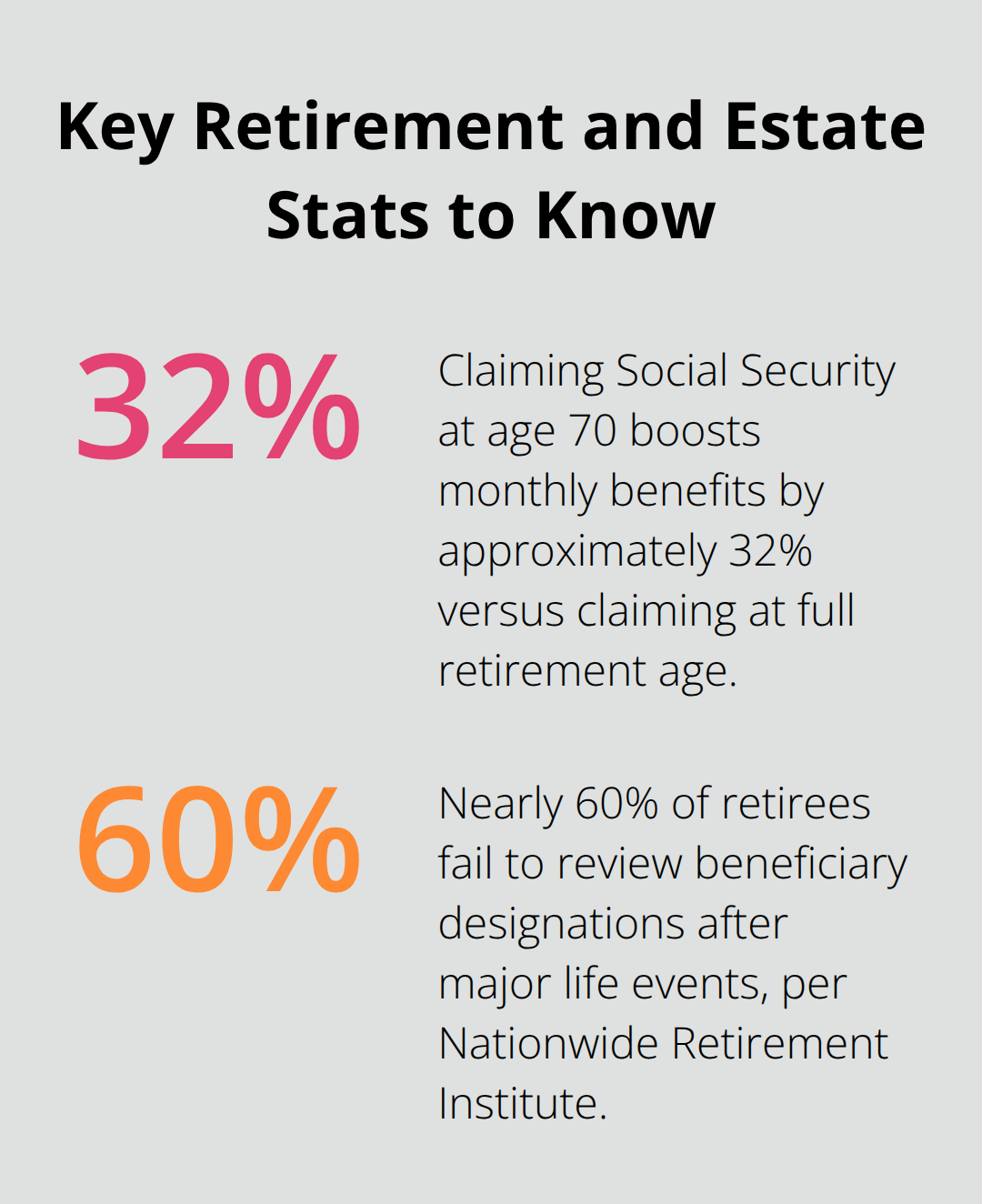
The Social Security Administration data shows that claiming benefits at age 70 instead of full retirement age boosts your monthly payment by approximately 32 percent. This decision intersects directly with your required minimum distribution strategy and overall tax planning. Coordinate when you claim Social Security with how much you withdraw from retirement accounts each year, because both affect your total tax liability and how long your assets will last.
The timing of these decisions shapes whether your retirement savings sustain you through a multi-decade retirement or deplete prematurely, which is why the next section examines the common mistakes that derail even well-intentioned plans.
Common Mistakes That Drain Retirement Savings and Complicate Estates
Outdated Beneficiary Designations Cost Families Hundreds of Thousands
Most people never touch their beneficiary designations after the initial setup, which means documents written years ago still control where money flows when you die. A divorce happens, children are born, or a second marriage occurs-yet the IRA still lists an ex-spouse as primary beneficiary because the form sits untouched in a filing cabinet. The Nationwide Retirement Institute’s research shows that nearly 60 percent of retirees fail to review beneficiary designations after major life events. This single oversight hands assets to people you no longer want to support while your actual family fights through probate to access what remains.
A client remarries and assumes their new will handles everything, only to discover that their 401(k) automatically passed to a former spouse under the old designation form. The fix takes fifteen minutes-requesting updated forms from your financial institution and submitting new paperwork-but the cost of inaction runs into hundreds of thousands of dollars. Update designations immediately after divorce, remarriage, births, or deaths. Then set a calendar reminder to review every three years, because life changes faster than most people update their paperwork.

Wrong Asset Structures Force Unnecessary Taxes and Probate Delays
Holding assets in the wrong structure creates a second drain on retirement savings and complicates estate administration. Many people title their home in joint tenancy with a child, thinking this avoids probate, yet joint ownership exposes the property to the child’s creditors and divorce claims while creating unintended gift tax consequences. Retirement accounts held in your individual name without a trust designation force assets through probate, triggering unnecessary delays and legal fees that could have been avoided with proper planning.
A traditional IRA passing directly to adult children triggers the SECURE Act’s ten-year distribution rule, meaning they pay income taxes on the entire balance within a decade rather than spreading distributions over their lifetime. Conversely, a Roth IRA designated to a trust-based structure allows tax-free growth for heirs if the account remains open for at least five years, according to Morgan Stanley guidance on retirement asset structuring. The solution requires matching asset titles to your overall strategy. Retirement accounts should name a properly drafted trust as beneficiary, not your estate. Real property should transfer through a revocable living trust to avoid probate entirely. Bank accounts and investment accounts should be retitled to your trust during your lifetime, not left in individual names.
Outdated Documents Leave Your Plan Vulnerable to Tax Law Changes
Outdated or incomplete estate documents represent the third critical failure that drains retirement savings and creates family conflict. A will written ten years ago does not account for the SECURE Act changes that now govern how your heirs inherit retirement assets. Your power of attorney may lack the specific language needed to authorize Roth conversions or other tax planning moves if you become incapacitated. A healthcare directive written before modern medical technology may not reflect your actual wishes about life-sustaining treatment.
Fidelity research indicates that healthcare costs consume a substantial portion of retirement savings, yet most people’s medical directives fail to address long-term care preferences or cost-containment decisions. The SECURE 2.0 Act’s adjustment to required minimum distribution ages (now rising to 75 in 2033) makes document updates essential. Your documents must explicitly authorize your financial power of attorney to make tax-advantaged decisions, name specific individuals with clear authority rather than vague language, and coordinate with beneficiary designations on every account. Without these updates, your family executes an outdated plan that contradicts your current wishes and wastes thousands in taxes that updated documents would have prevented.
Final Thoughts
Retirement planning and estates work best when you treat them as one coordinated system rather than separate financial pieces. The mistakes outlined in this post-outdated beneficiary designations, misaligned asset structures, and incomplete documents-cost families thousands in unnecessary taxes and create conflict during already difficult times. You can prevent these problems entirely with planning that integrates your retirement accounts and estate documents from the start.
Taking action now means reviewing every beneficiary designation form, updating your power of attorney and healthcare directives, and structuring assets to match your actual goals. A Roth conversion strategy that makes sense today becomes impossible to execute if you wait until incapacity strikes. A trust-based beneficiary designation that protects your children in a blended family requires time to draft and implement correctly (the cost of addressing these issues now is minimal compared to the thousands your family will spend untangling misaligned accounts after you pass).
We at Family, Estate & Mediation Law Group work with individuals and families across Northeast Florida to align retirement and estate planning into a cohesive strategy. Whether you need to update beneficiary designations, restructure retirement assets, or draft documents that reflect current tax law, contact us to schedule a consultation and ensure your retirement savings and estate plan work together to protect your legacy.