Trust planning for families is one of the most overlooked decisions parents make. Most families focus on earning wealth but spend little time protecting it across generations.
At Family, Estate & Mediation Law, we see firsthand how the right trust structure prevents costly mistakes, reduces taxes, and keeps assets out of probate. This guide walks you through coordinating multiple trusts to match your family’s specific goals and values.
What Trusts Actually Do for Your Family’s Wealth
Avoiding Probate and Protecting Your Timeline
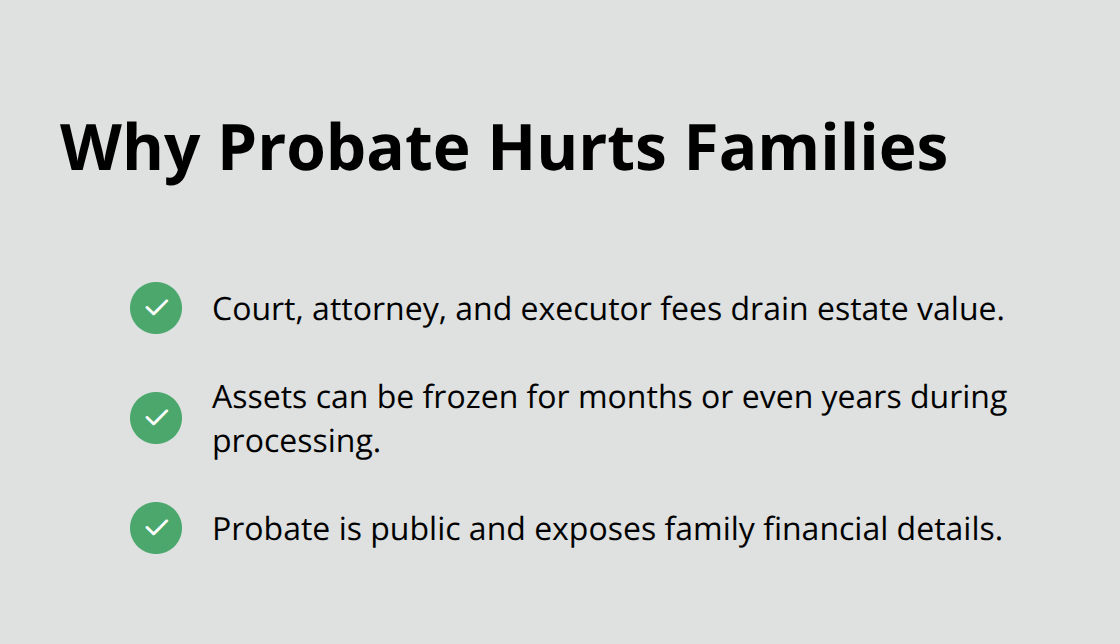
Probate is expensive, slow, and public. When someone dies without a trust, their estate typically enters probate court, where assets sit frozen for months or even years while lawyers and courts process paperwork. In Florida, probate commonly takes 6 to 12 months, though complex estates stretch far longer. During this time, heirs receive nothing while court fees, attorney costs, and executor commissions drain 3% to 7% of the estate’s value.
A revocable living trust bypasses probate entirely for assets titled to the trust, meaning your family avoids court involvement and receives distributions weeks after your death instead of waiting over a year.
Keeping Your Financial Details Private
The privacy advantage matters significantly. Probate records become public documents, exposing your family’s finances and asset distribution to anyone with internet access. Trusts remain private, keeping your financial details confidential and away from public scrutiny.
Reducing Estate Taxes Through Strategic Trust Structures
Estate taxes hit families hard when they’re not addressed. The federal estate tax exemption sits at $13.61 million per person in 2024, but it drops to $7 million in 2026 unless Congress acts. For families approaching or exceeding these thresholds, the difference between a simple will and a coordinated trust strategy can mean hundreds of thousands in taxes. Irrevocable trusts, when funded strategically, remove assets from your taxable estate permanently, protecting that growth for your beneficiaries. A Grantor Retained Annuity Trust (GRAT) transfers appreciation to the next generation at minimal tax cost-you keep annuity payments while future growth passes tax-free. An Irrevocable Life Insurance Trust (ILIT) removes life insurance proceeds from your estate, providing liquid funds your family needs immediately without adding to the tax burden.
Directing How and When Beneficiaries Receive Assets
Trusts let you direct exactly when and how your beneficiaries receive money, something a will cannot do effectively. You can delay distributions until a child reaches age 35, tie payouts to educational milestones, or require that a beneficiary match dollar-for-dollar any charitable contributions they make. This control prevents a 21-year-old from inheriting $500,000 and spending it recklessly. If a beneficiary faces creditor claims, divorce, or poor financial judgment, trust protections keep inherited assets safe from their creditors.
Expressing Your Values Through Trust Documents
The trust document becomes your voice after you’re gone, spelling out your values and intentions in ways that probate court simply cannot honor. Most families discover too late that without these protections (a single lawsuit or bad decision from a beneficiary can wipe out generational wealth), the assets you spent decades building disappear. Understanding how trusts work sets the foundation for the next step: coordinating multiple trusts to address your family’s specific goals and circumstances.
Building Multiple Trusts That Work Together
One trust rarely solves every family situation. Families with multiple children, blended marriages, business interests, and charitable goals struggle when they try to force everything into a single revocable living trust. The better approach uses separate trusts for distinct purposes, each addressing specific risks and values while coordinating toward one unified legacy plan.
Structuring Separate Trusts for Different Family Circumstances
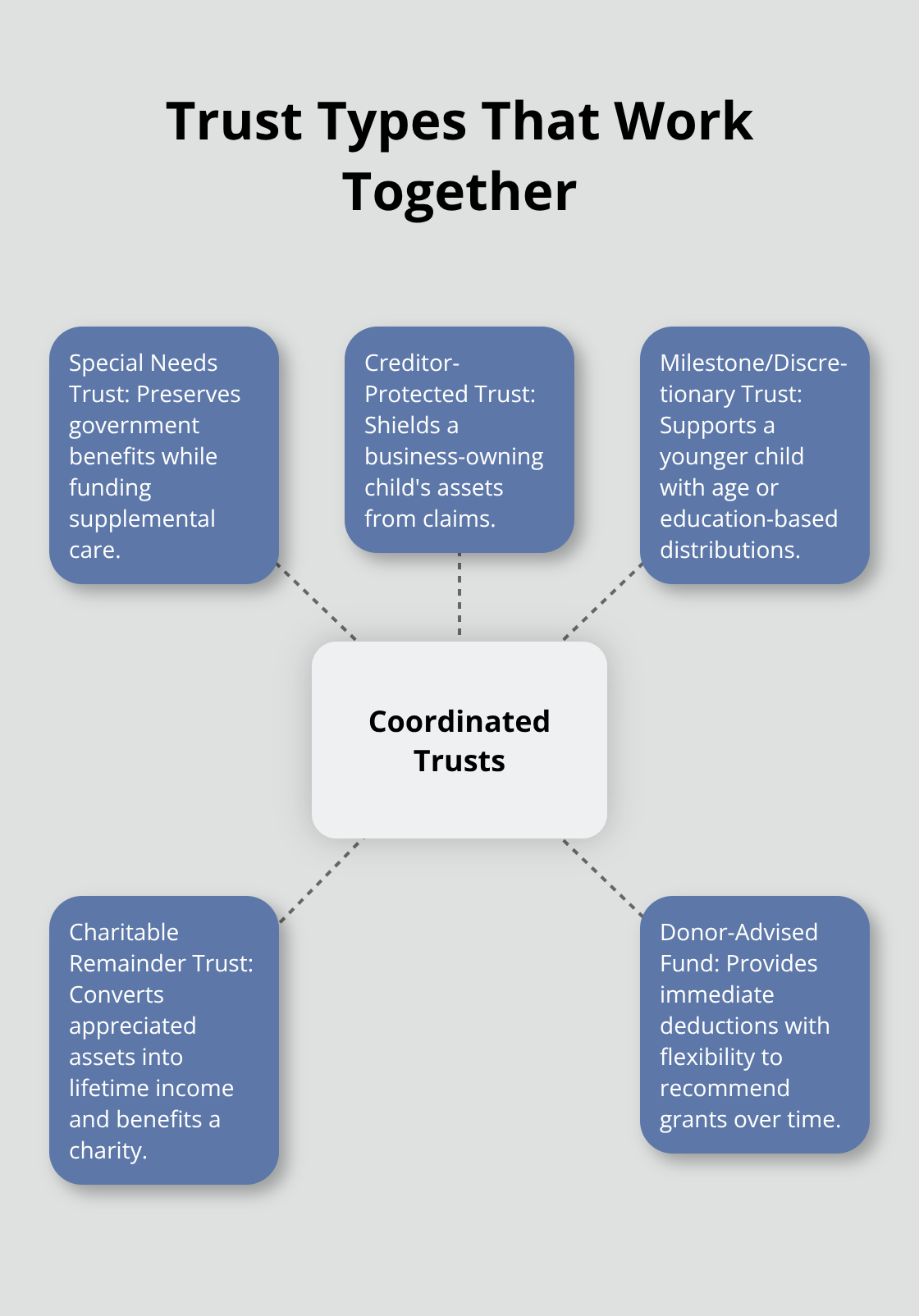
A parent with three adult children might establish one trust for a child with special needs to preserve government benefits, a second trust for a business-owning child with creditor exposure, and a third for a younger child still building financial responsibility. Each trust operates independently with its own trustee and distribution rules, yet all three work within the parent’s overall estate strategy. This separation prevents a single trustee mistake or family conflict from derailing the entire plan.
Using Charitable Trusts to Align Philanthropy with Wealth Transfer
A charitable remainder trust lets you donate appreciated real estate or stock while receiving income for life, then passing remaining assets to your chosen charity-solving both your liquidity needs and philanthropic goals simultaneously. A donor-advised fund offers simpler administration than a private foundation while giving you immediate tax deductions and the flexibility to recommend grants over time. The key difference matters: if you have $2 million in concentrated stock and want to support education, a charitable remainder trust converts that stock into diversified income without triggering capital gains tax on the sale, whereas a donor-advised fund works better if you want tax deductions now but need to decide which organizations to fund later.
Adapting Trusts Across Generational Timelines
Most families underestimate how much their distribution values shift across generations. A 65-year-old parent might prioritize income stability for a surviving spouse, but that same trust should shift to growth for grandchildren decades later. Standalone trusts let you build these transitions into the document itself. One trust could provide income to your spouse for life, then distribute principal to children at specific ages, while a separate dynasty trust for grandchildren accumulates and compounds without distributions, maximizing generational wealth transfer. This structure prevents a trustee from having to choose between competing interests-the documents already spell out who receives what and when.
Selecting the Right Trustee for Each Trust’s Purpose
Naming the right trustee for each trust matters more than most families realize. A corporate trustee handles multiple trusts professionally but charges fees that might exceed 0.75% annually, making them expensive for smaller estates under $1 million. An individual trustee works well for straightforward distributions but struggles with tax complexity or managing assets across decades. Many families use a hybrid approach: a corporate trustee manages the business succession trust where investment decisions require professional knowledge, while a trusted family member administers the charitable trust where distributions follow clear formulas. The documents should spell out exactly which trustee handles which decisions, preventing confusion and conflict.
Understanding how to structure and coordinate these separate trusts sets the stage for recognizing the mistakes that derail even well-intentioned plans. The next chapter examines the pitfalls families encounter most often and how to avoid them.
Where Trusts Fail: The Three Mistakes That Unravel Family Plans
Most families that establish trusts believe they’ve solved their estate planning problems. They haven’t. We at Family, Estate & Mediation Law see the same preventable mistakes repeatedly: trusts that sit unchanged for 15 years while the family’s circumstances shift dramatically, successor trustees who discover their role only after death with no instructions on where assets are held or how to distribute them, and funding structures that trigger massive tax bills the family never anticipated. These aren’t small oversights-they’re the primary reasons families lose tens of thousands of dollars and spend years in conflict over assets that should have transferred smoothly.
Trusts Become Obsolete Without Regular Updates
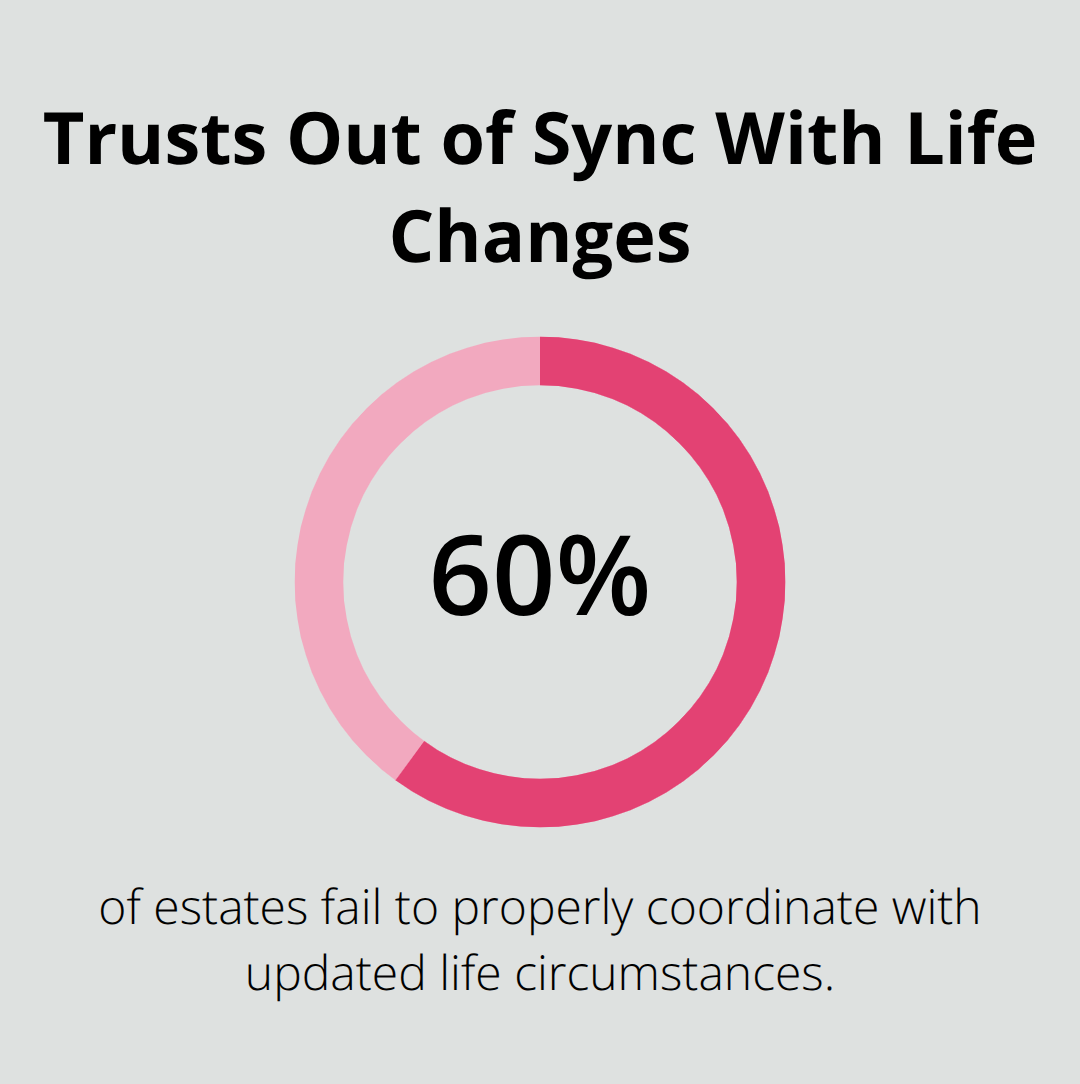
A revocable living trust created in 2009 doesn’t reflect the family that exists in 2026. Children marry, divorce, develop substance abuse issues, earn substantial income, or face creditor problems-yet the trust language remains frozen in time. We’ve encountered trusts that name a deceased spouse as successor trustee, trusts that distribute equally to three children when one now has a special needs child requiring protection, and trusts that were written before the client started a business worth $3 million. Approximately 60% of estates fail to properly coordinate with updated life circumstances, yet most families treat their trust as a document to file away rather than revisit. Tax law changes matter too: the federal estate tax exemption dropped from $12.92 million in 2023 to $13.61 million in 2024, then will fall to $7 million in 2026 unless Congress extends current law.
A trust designed without accounting for this cliff creates unnecessary exposure for estates above $7 million. Major life events should trigger an immediate trust review: a remarriage, the birth of grandchildren, a significant inheritance received by a child, a business sale, or relocation to a different state. We recommend reviewing your trust every three to five years minimum, more frequently if your assets or family structure changes. Families who skip these reviews end up amending or completely rewriting trusts later at double or triple the original cost, or worse, they discover after death that the trust no longer matches their actual intentions.
Successor Trustees Left in the Dark About Their Responsibilities
Naming a successor trustee without preparing them for the role is one of the most damaging gaps we encounter. A daughter inherits the trustee position only to discover the trust holds real estate in three states, a business interest, retirement accounts, and investment accounts spread across five institutions, with no consolidated list of where anything is located or what the trust documents actually require her to do. She faces immediate decisions about whether to continue operating the family business, how to value it for distribution purposes, and whether to sell the real estate or hold it as an investment. Meanwhile, siblings expect distributions within weeks, and she has no authority document, no investment policy, and no clarity on whether the trust requires her to preserve principal or can distribute growth. Trustee mistakes during this period can exceed $50,000 in unnecessary fees, lost investment returns, or litigation between beneficiaries. We recommend preparing successor trustees before death through a written trustee guide that lives with the trust documents themselves. This guide should identify every asset, every account number, every financial institution contact, passwords or access information stored securely, the location of the original trust documents, and specific instructions on how to handle each category of assets. Name a professional co-trustee or trust protector if the successor trustee lacks investment experience or feels uncomfortable making major decisions alone. The trust protector role, increasingly common in modern trust planning, gives an independent third party authority to modify trustee decisions, change investment strategies, or even replace the trustee if circumstances warrant-protecting the family from a trustee who becomes incapacitated, unavailable, or simply overwhelmed by complexity.
Unfunded Trusts and Tax Timing Oversights Derail Smooth Transfers
A revocable living trust sitting empty, with the family’s real assets still titled in the individual’s name, is worthless. Estates where the trust was created and signed but the house, investment accounts, and business interests were never retitled into the trust end up in probate anyway, defeating the entire purpose. Funding a trust means retitling property into the trust’s name: the deed for real estate, the beneficiary designation forms for retirement accounts, the account registration change for investment accounts. This step takes time and costs money-typically $500 to $2,000 depending on the number of assets-yet families skip it to save short-term costs and create long-term disaster. Overlooking how different asset types interact with trust distributions for tax purposes proves equally damaging. Life insurance proceeds held in an Irrevocable Life Insurance Trust avoid estate tax but require annual gifts that respect the annual gift tax exclusion of $18,000 per person in 2024. Retirement accounts held in a trust after the Secure Act now have compressed distribution timelines: non-spouse beneficiaries must empty inherited IRAs within ten years, and if the trust language doesn’t account for this, beneficiaries could face unexpected tax bills in years when they receive large distributions. A Grantor Retained Annuity Trust funding strategy requires precise timing: if the grantor dies during the annuity term, the full trust value reverts to the taxable estate, eliminating the tax benefit. Families regularly discover too late that the trust structure they chose creates tax consequences that exceed the tax savings they anticipated. We recommend having a tax professional review your trust funding plan before implementation, particularly if you hold concentrated stock, business interests, or substantial retirement assets. The cost of this review-typically $1,500 to $3,000-is recovered many times over when you avoid tax mistakes that cost tens of thousands.
Final Thoughts
Trust planning for families works only when you move from understanding to action. Signing documents and retitling property into your trust matters far more than reading about revocable living trusts or tax strategies. The families we at Family, Estate & Mediation Law see succeed are those who recognize that trust planning is not a one-time event but an ongoing process that adapts as your circumstances change.
Start with your core goals and commit to implementation immediately. Do you want to avoid probate, protect assets from creditors, support a charitable cause, or transfer a business smoothly to the next generation? Your answer shapes which trusts you need and how they coordinate together. Retitle property into your trust, update beneficiary designations on retirement accounts and life insurance, and ensure your successor trustee knows where everything is located and what you expect them to do (schedule a review every three to five years to catch changes in tax law, family circumstances, or asset values that might require adjustments).
Work with professionals who understand your full picture, as tax implications, family dynamics, business succession, and state-specific rules all intersect in ways that generic online templates cannot address. Contact Family, Estate & Mediation Law to discuss how a coordinated trust strategy can preserve your wealth and values across generations.