
A healthcare directive gives you control over your medical care when you can’t speak for yourself. Without one in place, hospitals and doctors make decisions based on state law rather than your actual wishes.
We at Family, Estate & Mediation Law help residents in St. Augustine and Palatka understand how to write sample healthcare directive language that truly reflects their values. This guide walks you through what belongs in your directive and how Florida law requires it to be structured.
What a Healthcare Directive Actually Does
The Legal Power Behind Your Healthcare Directive
A healthcare directive is a legal document that names someone to make medical decisions for you when you cannot make them yourself. It is not a suggestion or a guideline. It is a binding instruction that hospitals and doctors are required to follow. Many people confuse this document with a living will, which only addresses end-of-life treatment preferences. A healthcare directive goes further-it appoints a healthcare agent, someone with the legal authority to speak for you in real time across all medical settings. This agent can answer questions about treatments, request information, and make decisions that align with your actual values rather than what a hospital’s default protocol assumes you want.
Why Your Choice of Agent Matters More Than You Think
Without naming someone with this power, you leave your care in the hands of state succession laws, which typically default to family members in a rigid order: spouse, adult children, parents, and siblings. Those relatives might not know your wishes, and they may not agree with each other. The agent you choose can also advocate for you in ways family members cannot because they hold legal authority. In Florida, your healthcare directive must be signed in front of two witnesses or a notary public, and those witnesses cannot be your agent, your healthcare provider, or anyone with a financial interest in your care. This requirement protects you from coercion. You should store the document in multiple places: with your agent, your doctor’s office, and at home where emergency responders can find it quickly.
The Stark Reality of Missing Directives
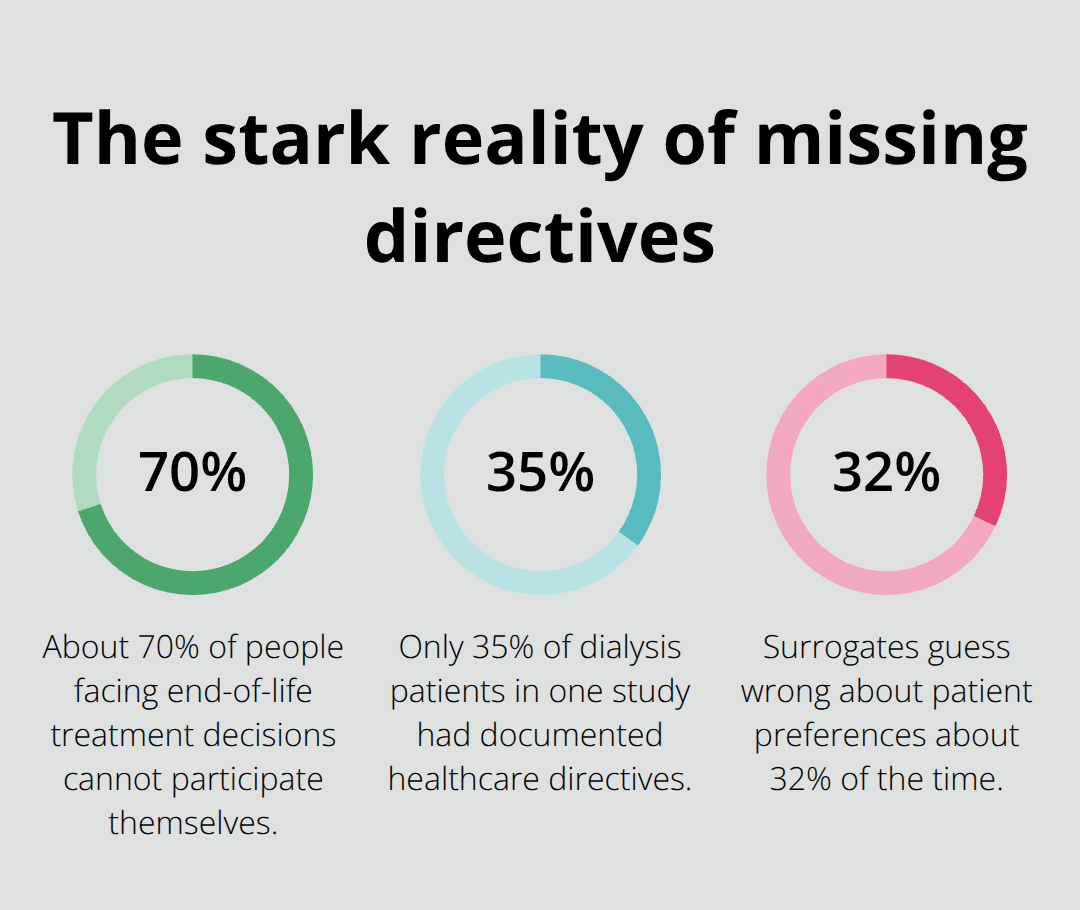
Statistics reveal how unprepared most people are. Only about 18 to 30 percent of the general population has a healthcare directive in place, according to a RAND Corporation literature review from 2007. Even among people with serious chronic illnesses (those who arguably need one most), completion rates hover around 32 to 35 percent. In one dialysis patient study, only 35 percent had documented directives. Among COPD patients, the figure was 32 percent. This gap matters because approximately 70 percent of people facing end-of-life treatment decisions cannot participate in those decisions themselves, based on research from Silveira and colleagues in 2010. That means surrogate decision-makers must step in, yet most surrogates guess wrong about patient preferences about 32 percent of the time.
How Directives Transform Outcomes
When directives do exist, outcomes improve dramatically. Research from Detering and colleagues in 2010 showed that people who engaged in advance care planning were more likely to have their preferences known and followed, enrolled in hospice earlier, and experienced reduced caregiver stress. In Oregon’s POLST program, which converts directive preferences into portable medical orders, patients with directives for comfort-focused care were substantially less likely to die in a hospital. Your healthcare directive should reflect your actual medical values, not what you think sounds good in the abstract. The next section walks you through the specific components that make a directive work-starting with how to name your healthcare agent and what language Florida law requires you to include.
Key Components of an Effective Healthcare Directive
Name Your Healthcare Agent With Clear Authority
Your healthcare directive only works if it contains three specific, actionable elements that Florida law recognizes and enforces. The first is naming someone with real legal power. A strong healthcare directive in Florida names your agent explicitly, gives that person clear decision-making authority for all medical matters, and states that authority applies immediately and continuously. Your agent should be someone you trust completely and who understands your values well enough to make decisions you would make yourself. That person must also be willing to serve, available to respond to hospital calls, and able to advocate firmly without backing down under pressure.
Research from 2010 by Shalowitz and colleagues found that surrogate decision-makers predict patient preferences with about 68 percent accuracy. That gap closes dramatically when the agent knows your specific wishes and has them in writing. Do not name multiple agents at the same level because hospitals will not make decisions when authority is unclear. You can name a successor agent (someone who steps in if your first choice cannot serve), but the primary agent must hold sole decision-making power during your incapacity. Your healthcare agent cannot act without legal authority, so this naming section carries the weight of your entire directive.
Specify Your Medical Treatment Preferences in Concrete Terms
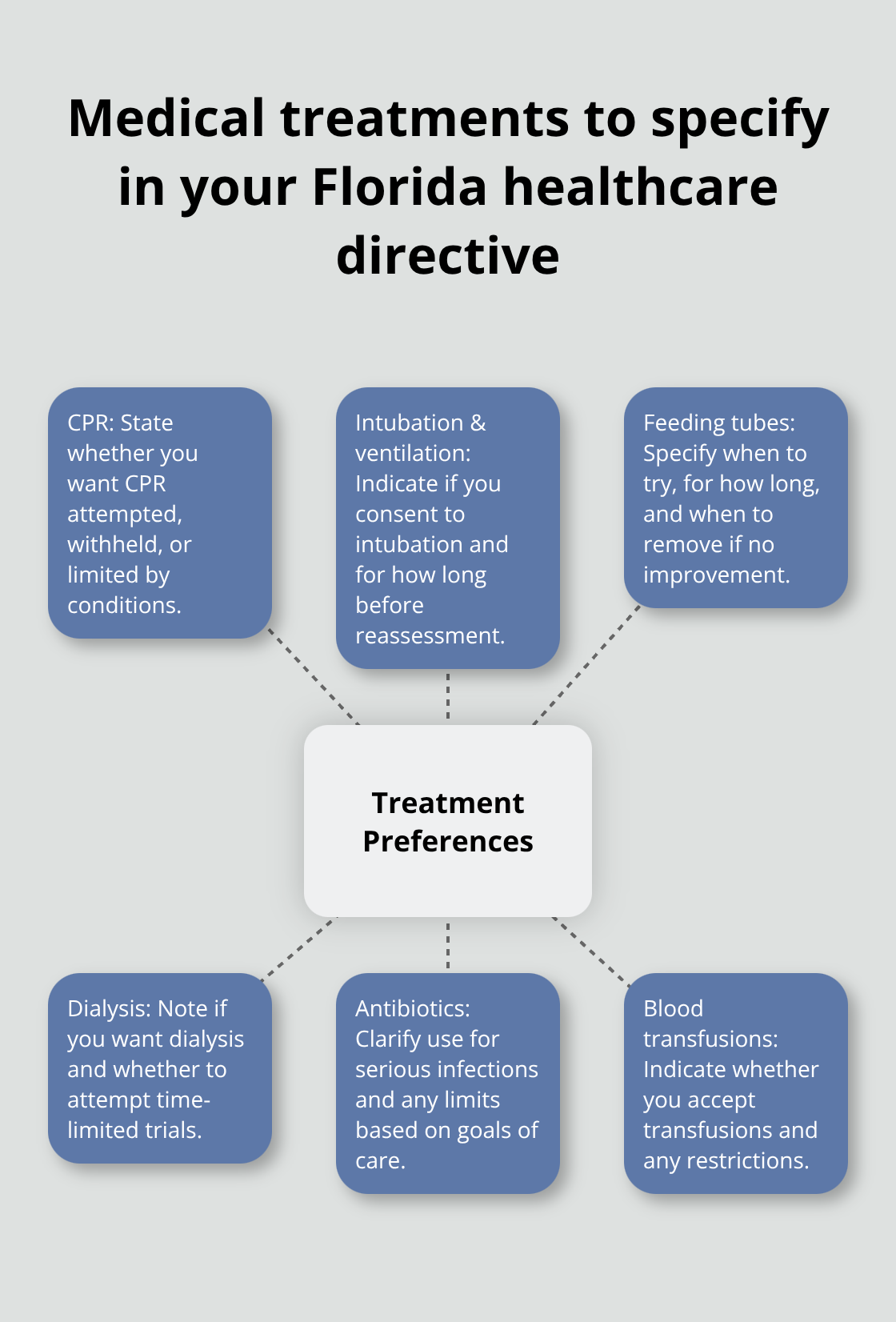
Your treatment preferences section must go beyond vague statements like “I want comfort care.” Florida law recognizes specific interventions: CPR (cardiopulmonary resuscitation), intubation and mechanical ventilation, feeding tubes, dialysis, antibiotics for serious infections, and blood transfusions. For each one, state whether you want it attempted, want it withheld, or want to try it for a limited time period before reassessing. Time-limited trials are powerful because they let doctors test whether a treatment is actually helping you reach your stated goals.
For example: “If I have a serious stroke and cannot swallow, I want a feeding tube placed for 30 days while rehabilitation is attempted. If I show no meaningful improvement after 30 days, I want the tube removed.” That language is far more useful than “I do not want a feeding tube” because it acknowledges that circumstances matter. Your treatment preferences cannot be applied if they are vague, so specificity transforms your directive from a general statement into a working medical order.
Address End-of-Life Scenarios With Condition-Specific Language
Your end-of-life language should address the conditions under which your preferences apply. Florida recognizes terminal illness and permanent unconsciousness as triggering conditions, but you can be more specific. If dementia is a concern for you, state it directly: “If I develop advanced dementia where I no longer recognize family members and cannot communicate my wishes, I want care focused on comfort and dignity, not life extension.” About 1 in 2 older adults die with a dementia diagnosis according to research from Compassion & Choices, which makes dementia-specific planning essential for many residents in St. Augustine and Palatka.
Your directive should also state where you want to die if possible and what quality of life matters most to you. Some people prioritize being at home. Others prioritize time with family regardless of setting. Some prioritize independence over length of life. These preferences guide your agent and your doctors when they must choose between options that extend life versus options that preserve comfort or independence. Your end-of-life wishes cannot guide care if they do not specify concrete conditions, so condition-specific language transforms vague intentions into actionable medical guidance that hospitals can follow.
The next section walks you through how Florida law requires you to execute and witness your directive, and what registration steps protect your document from being lost or ignored when you need it most.
Making Your Florida Healthcare Directive Legally Valid
Florida’s Statutory Requirements Transform Your Directive Into a Binding Order
Florida law imposes specific requirements that transform your healthcare directive from a personal preference into a binding medical order. Your directive must be in writing and signed by you in front of two witnesses or a notary public. The witnesses cannot be your healthcare agent, your doctor, a hospital employee, or anyone with a financial interest in your care or estate. This restriction prevents coercion and confirms that your choices reflect your actual values, not someone else’s agenda.
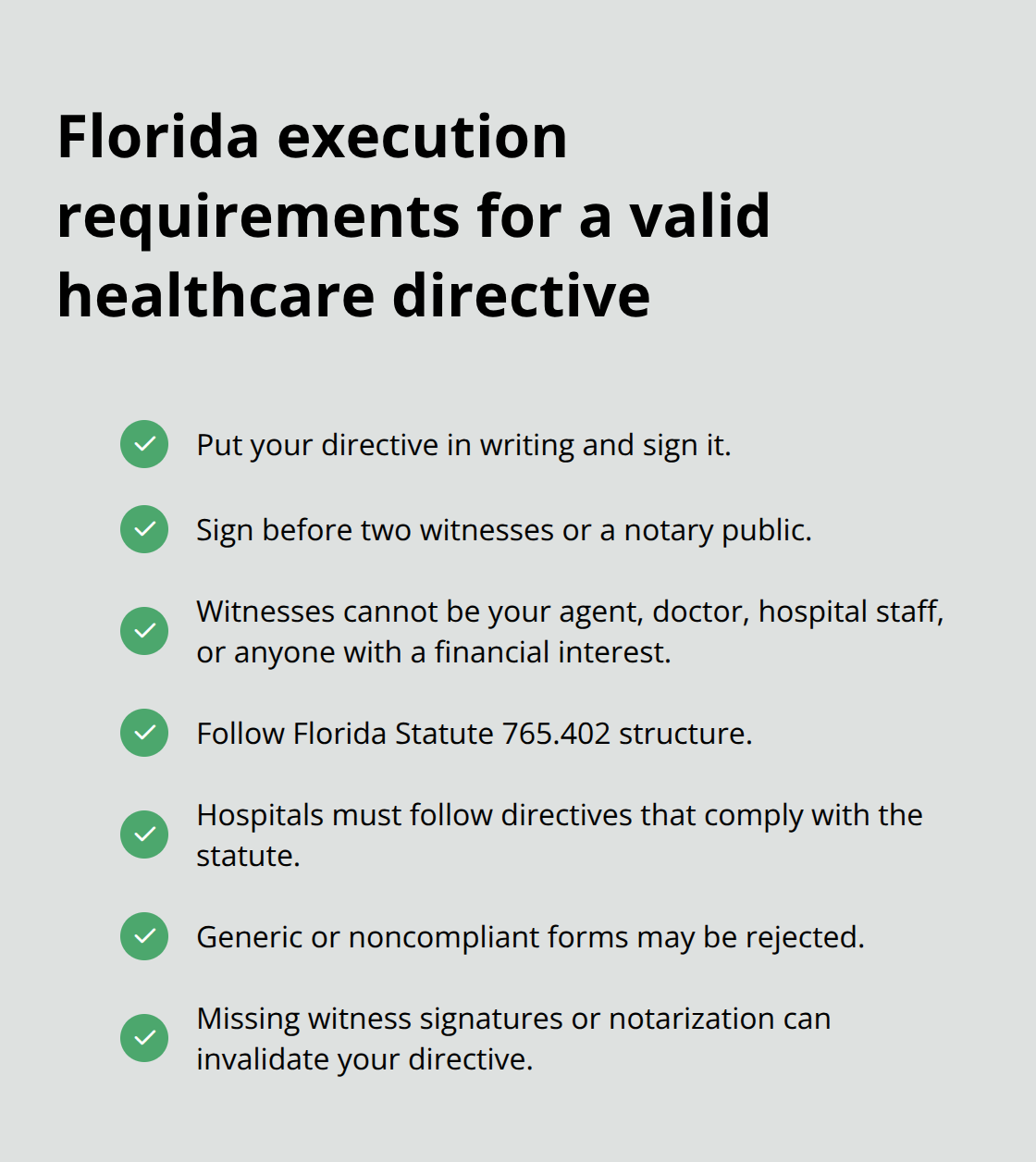
Florida Statute 765.402 governs how your directive must be structured, and hospitals in St. Augustine and Palatka are legally required to follow directives that comply with this statute. Many people assume a handwritten document or an online form will work, but Florida courts enforce only directives that meet the statutory format. If your directive fails to include the required witness signatures or notarization, hospitals can refuse to honor it, leaving your agent without legal authority to make decisions.
State-Specific Language Matters for Hospital Recognition
The state-specific language matters because other states’ forms do not automatically transfer to Florida. A healthcare directive from Georgia or South Carolina may not be recognized by Florida hospitals, even if it is legally valid in its home state. We at Family, Estate & Mediation Law recommend using Florida’s official statutory form or having an attorney review any custom language to confirm compliance. Your witnesses must sign the document in your presence and in the presence of each other, and they must understand that they are witnessing a healthcare directive. Verbal witnessing or signing separate pages does not satisfy Florida law. If you use a notary instead of witnesses, the notary must notarize your signature, and you must still sign the document yourself in the notary’s presence. Many people fail at this step because they ask someone to sign on their behalf, which invalidates the entire directive. Your signature must be your own, not a mark or initials.
Storage and Accessibility Determine Whether Your Directive Protects You
Storage and accessibility determine whether your directive actually protects you when you cannot speak. A directive locked in a safe deposit box does nothing for you in an emergency because emergency responders and hospital staff cannot access it quickly. Florida law does not require registration of healthcare directives like it does for DNR orders, but that does not mean your directive can sit unsigned and unshared. You must provide copies to your healthcare agent, your primary care physician, and any hospital or facility where you receive regular care. Your agent must keep a copy readily available and carry a wallet card stating that a directive exists and where it can be found. Electronic health record systems increasingly allow patients to upload advance directives, and major hospital systems in Northeast Florida now accept digital copies. Ask your doctor’s office specifically whether your directive has been scanned into their system and whether it will be accessible if you arrive unconscious. Many directives exist on paper that never reaches the medical record because no one asked. In 2007, RAND Corporation research found that advance directives were often not present in hospital medical records, and many clinicians were unaware a directive existed even when the patient had one.
Registration and Updates Protect Your Directive From Becoming Outdated
Your healthcare agent should also register your directive with the Florida Department of Health if you want additional protection, though this step is optional and not required by statute. The registry provides a backup location where hospitals can verify your directive exists if the original document is unavailable. Consider storing one copy with a trusted family member outside your home in case of fire or disaster, and update copies whenever your agent, preferences, or health status change significantly. Your directive is not a set-it-and-forget-it document. Outdated directives that name agents who are no longer available or reflect wishes that no longer match your values create confusion rather than clarity. Each time you update your directive, have the new version witnessed or notarized according to Florida law, and distribute copies to all relevant parties (your agent, your doctor, and your healthcare facilities).
Final Thoughts
Choose your healthcare agent first and talk directly with them about your medical values-do not assume they understand what you want without hearing it from you. Clarify your treatment preferences for CPR, intubation, feeding tubes, dialysis, and antibiotics, then write down which interventions you want attempted and under what conditions. Florida’s statutory form ensures hospitals will recognize your sample healthcare directive language without question, while generic online templates often fail to meet state requirements and leave your agent without legal authority when you need protection most.
St. Augustine and Palatka residents can access official directive forms through the Florida Department of Health and discuss preferences with their primary care physician. We at Family, Estate & Mediation Law help individuals and families across Northeast Florida with advance care planning, ensuring your directive complies with Florida law and actually protects your wishes. Schedule time this week to complete your directive while you are healthy and clear-headed, sign it properly in front of witnesses or a notary, and distribute copies to your agent and your doctor.