
Serving as an executor means handling significant responsibilities during an emotionally challenging time. We at Family, Estate & Mediation Law understand that executor duties explained clearly can make this process less overwhelming for those in St. Augustine and Palatka, FL.
This guide walks you through each step, from locating documents to distributing assets, so you know exactly what’s expected of you.
Starting Your Settlement: The First Critical Steps
Locate and File the Will or Trust Document
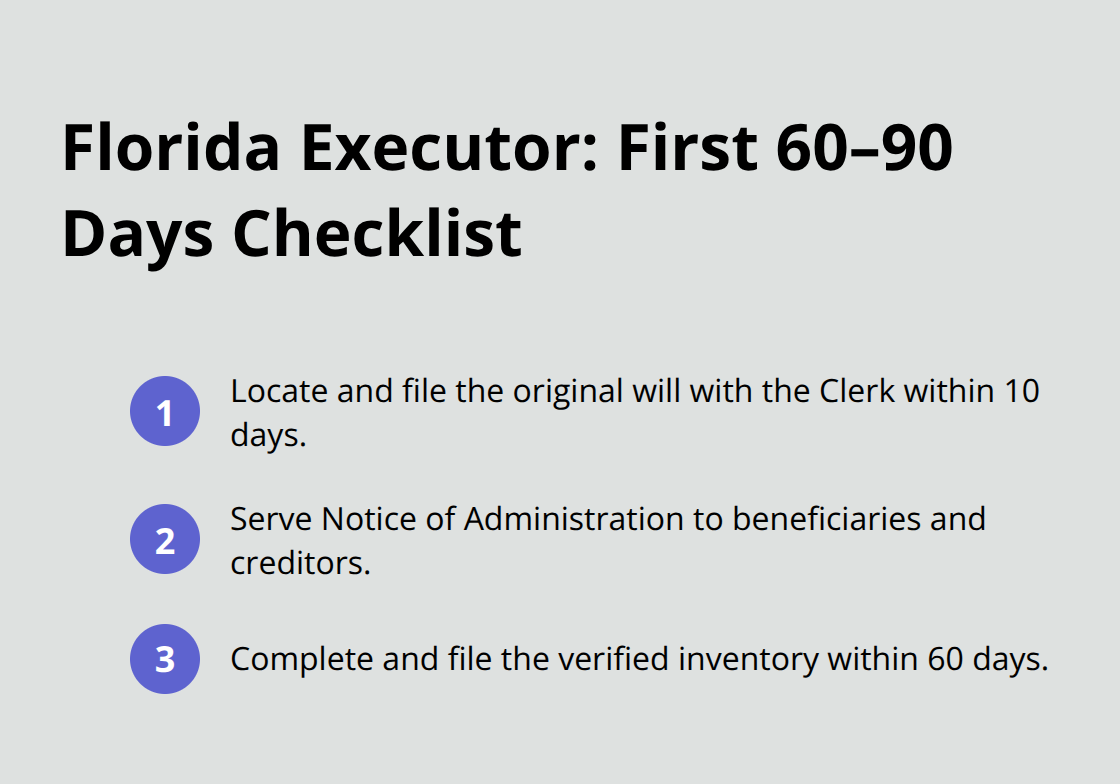
The moment you accept the executor role, your first action must be locating the original will or trust document. In Florida, the original Last Will and Testament must be deposited with the Clerk of the Circuit Court within 10 days of learning of the decedent’s death, according to Florida Statute 732.901. If the will hasn’t been filed yet, contact the decedent’s attorney, financial advisor, or search the safe deposit box at their bank. Read the entire document carefully-this is your roadmap for everything that follows.
Pay close attention to any special instructions, asset designations, and the powers granted to you. If the estate includes a trust, determine whether it’s revocable or irrevocable, as this affects which assets you control and how you manage them.
Notify Beneficiaries and Creditors Within the Required Timeline
Within three months of the decedent’s death, Florida law requires you to serve a Notice of Administration on all known beneficiaries and creditors. This notice triggers the 90-day creditor claim window, meaning creditors have exactly 90 days to file claims against the estate. Failing to serve this notice properly can extend your liability and delay the entire settlement.
You must also publish a Notice to Creditors in a newspaper of general circulation in the county where the decedent lived. For estates in Putnam County within the 7th Judicial Circuit, file these notices with the Clerk of the Circuit Court & Comptroller in Palatka at 410 St. Johns Avenue. Proper notification protects you legally and sets beneficiaries’ expectations early.
Complete the Inventory Within 60 Days
The inventory phase must be completed within 60 days of receiving your Letters of Administration. You’ll identify every probate asset: real estate, bank accounts, investment portfolios, vehicles, life insurance with no named beneficiary, and personal property. Separate probate assets from non-probate assets like jointly owned property, retirement accounts with named beneficiaries, and trust assets-these bypass probate entirely and aren’t your responsibility to administer.
For each probate asset, determine its fair market value as of the date of death; this is what goes in your verified inventory filing with the court. If the estate includes real property, you’ll likely need a professional appraisal (typically $300 to $800 depending on complexity). Bank accounts and investment statements are straightforward-use the statement dated closest to the death date. Personal property like jewelry, artwork, or vehicles often requires professional appraisal if the value is significant or disputed.
Maintain Meticulous Records From Day One
Document everything in writing and maintain meticulous records from the start. This inventory becomes your foundation for calculating taxes, paying debts, and eventually distributing assets to beneficiaries. Executors who skip detailed documentation often face beneficiary challenges later, so treat this step as non-negotiable. The records you create now will protect you throughout the settlement process and provide the transparency beneficiaries expect. With your inventory complete and filed, you’re ready to address the financial obligations that come next.
Settling Financial Obligations and Distributing Assets
Organize Financial Records and Open an Estate Account
With your inventory filed and beneficiaries notified, the financial work begins immediately. Gather every financial record tied to the decedent: bank statements, credit card statements, mortgage documents, investment account statements, and utility bills. Open a separate estate bank account in the decedent’s name as executor to keep probate funds isolated from your personal accounts-commingling funds violates Florida law and creates serious liability. Contact each financial institution directly; most require a certified death certificate and Letters of Administration before releasing account information.
Understand the Payment Priority Under Florida Law
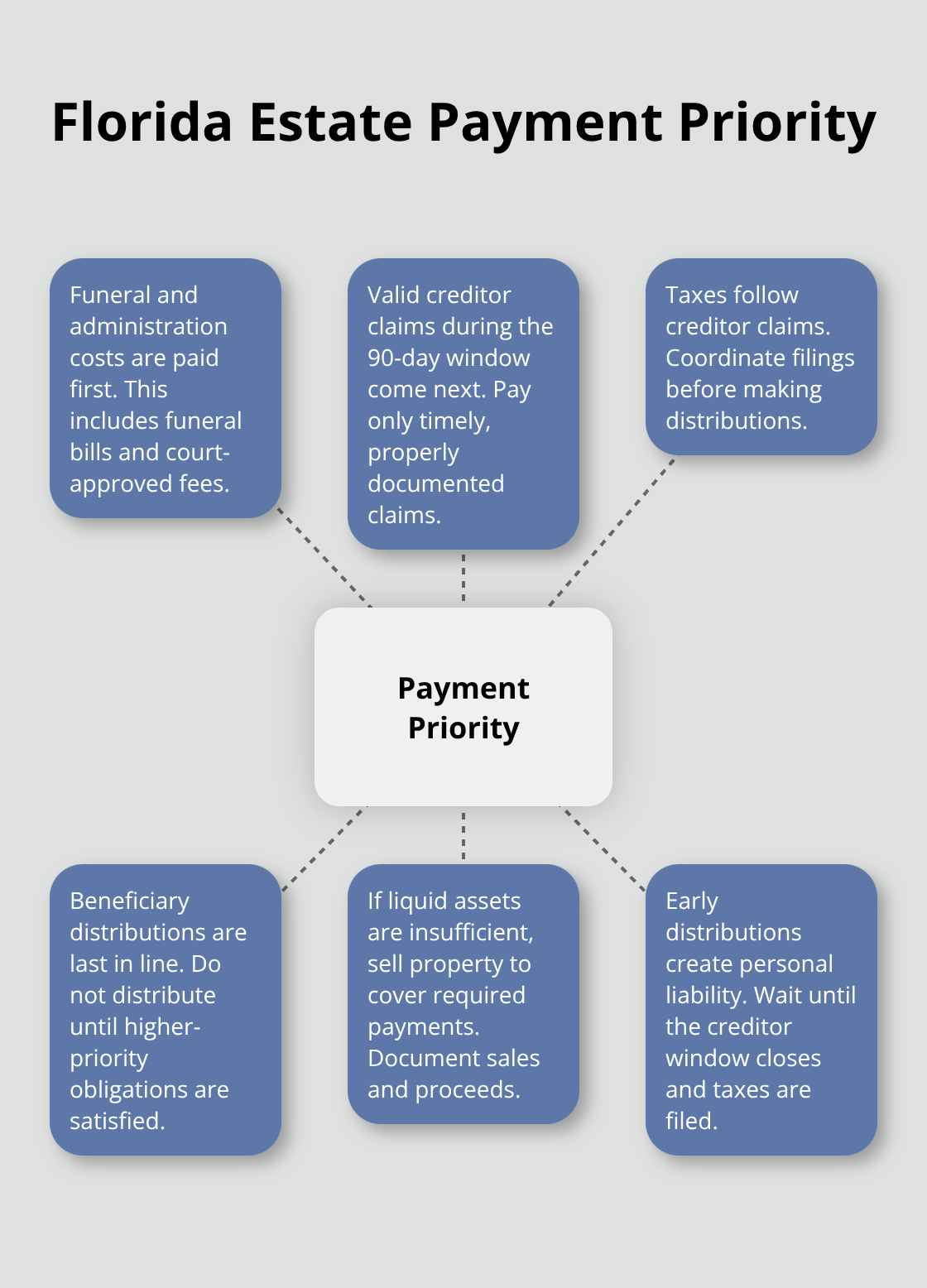
Florida Statute 733.617 establishes the order in which you must pay obligations: funeral expenses and estate administration costs come first, then valid creditor claims during the 90-day creditor period, then taxes, then distributions to beneficiaries. This priority matters because if the estate lacks sufficient liquid assets, you must sell property to cover debts before any beneficiary receives anything. Many executors distribute assets too early, only to discover unpaid debts or taxes later-this exposes you personally to liability.
File Tax Returns and Coordinate With Tax Professionals
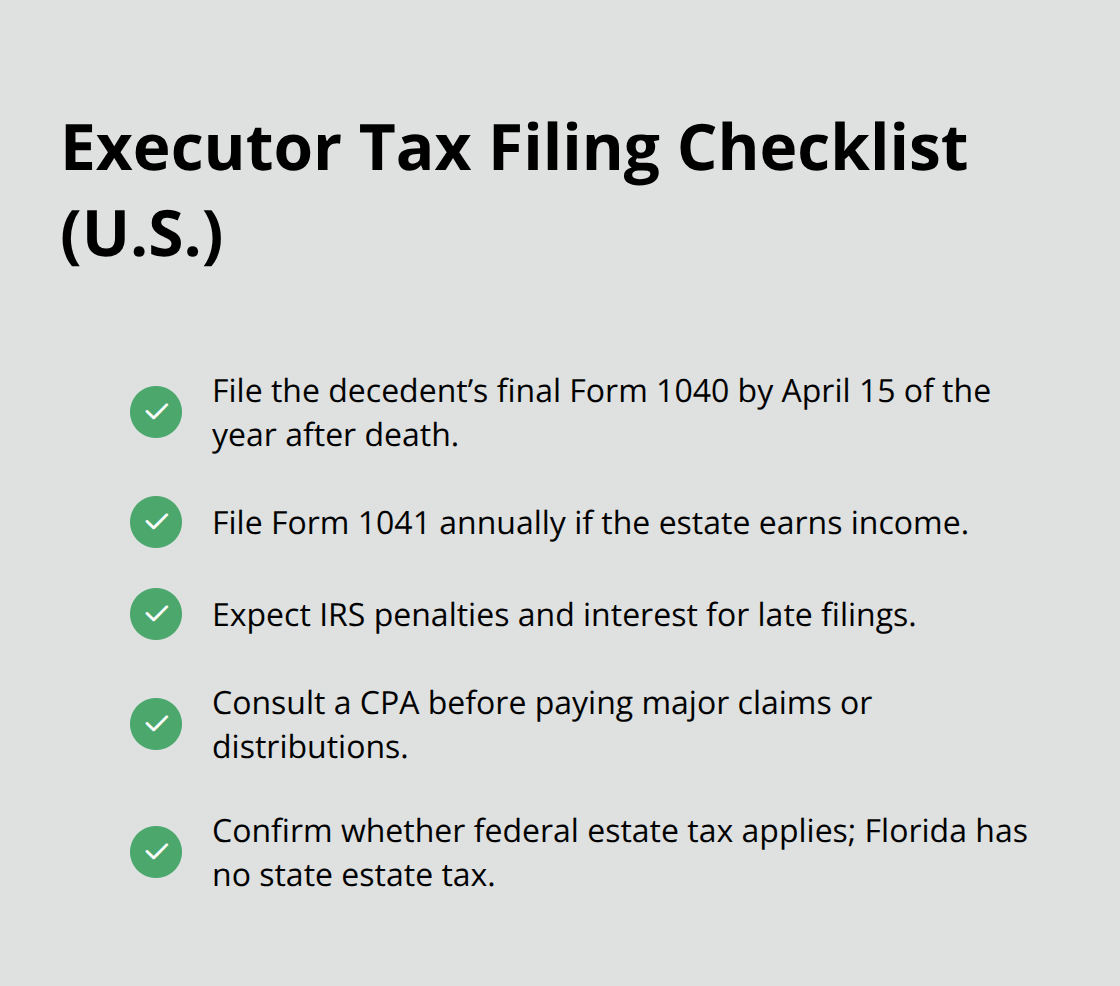
The decedent’s final Form 1040 income tax return is due by April 15 following the year of death, and if the estate generates income during administration, you must file Form 1041 for the estate itself. These tax returns are not optional, and the IRS takes late filing seriously. If the estate’s compensable value exceeds certain thresholds, you may owe federal estate taxes as well, though Florida has no state estate tax. Coordinate with a CPA or tax professional before paying anything; they identify which debts are legitimate, which are time-barred, and which can be challenged.
Review and Pay Creditor Claims
Creditor claims arrive in writing during the 90-day window, and you must review each one carefully. Invalid claims-those lacking proper documentation, those filed after the deadline, or those based on debts the decedent didn’t legally owe-can be rejected in writing. Valid claims must be paid from estate funds in the order prescribed by law. Once all debts, taxes, and administrative costs are settled, distribute the remaining assets according to the will or trust terms. If the will specifies exact dollar amounts to specific beneficiaries but the estate lacks sufficient funds, Florida law requires proportional reduction rather than paying some beneficiaries in full while others receive nothing.
Document Distributions and Obtain Court Approval
Document every payment and distribution with receipts and written acknowledgments from beneficiaries; these records protect you if disputes arise later. After distributions are complete, prepare a final accounting showing all receipts, expenses, and distributions, then file it with the court for approval. Only after the court approves your final accounting and you receive a discharge order are you legally protected from future liability for the estate’s debts or beneficiary claims. With your financial obligations settled and distributions complete, you’re now positioned to address the common mistakes that derail many executors-mistakes that can be prevented with awareness and careful attention to detail.
Common Executor Mistakes to Avoid
Poor Record-Keeping Exposes You to Liability
The first mistake that derails executors is treating record-keeping as optional rather than foundational. Every check written, every asset appraised, and every conversation with a beneficiary or creditor must be documented in writing with dates and amounts. Executors who maintain handwritten logs or rely on memory face devastating consequences when beneficiaries later question where money went or why distributions took months longer than expected. Courts in the 7th Judicial Circuit expect detailed documentation, and without it, you cannot obtain a discharge order that protects you from future liability. Your written records become the evidence that you acted properly and fulfilled your fiduciary duty.
Distributing Assets Too Early Creates Personal Liability
The second mistake-distributing assets before you settle all debts and taxes-happens because beneficiaries pressure you or because you underestimate hidden liabilities. Florida Statute 733.617 makes you personally liable if you distribute funds prematurely and then discover unpaid creditor claims or tax obligations. Courts have ordered executors to recover distributions from beneficiaries or pay shortfalls from their own pockets because they rushed the process. The 90-day creditor claim period is not a suggestion; it is a legal minimum, and taxes can surface months after that deadline passes. Wait until the creditor period closes and all taxes are filed before you make final distributions.
Neglecting Tax Returns Triggers IRS Penalties
The third mistake involves federal tax returns-either filing them late or not filing them at all. The decedent’s final Form 1040 is due April 15 following the year of death, and if the estate generates income during administration, Form 1041 must be filed annually. The IRS charges penalties and interest for late filings, and these costs come directly from estate funds that beneficiaries otherwise would receive. Coordinate with a CPA before you pay any significant claims or distributions; they identify which debts are legitimate and which are time-barred, and they prevent costly tax surprises.
A Systematic Approach Prevents All Three Mistakes
Maintain a written log of every transaction from day one. Wait until the 90-day creditor period closes and all taxes are filed before final distributions. Involve a tax professional from the start (not at the end). These three steps eliminate the vast majority of executor disputes and personal liability claims. The effort you invest in systematic documentation and professional coordination now protects you throughout the settlement process and shields you from liability long after the estate closes.
Final Thoughts
Executor duties explained clearly show that this role demands organization, attention to deadlines, and unwavering commitment to your fiduciary obligations. You must locate and file the will within ten days, notify beneficiaries and creditors on schedule, complete your inventory within sixty days, and maintain detailed records throughout the entire process. You cannot distribute assets until the ninety-day creditor period closes and all taxes are filed. You must pay debts in the correct legal order and document every transaction.
The complexity of Florida probate law means that mistakes happen quickly and carry serious consequences. Commingling funds, distributing prematurely, or neglecting tax returns can expose you to beneficiary lawsuits, court sanctions, or personal financial liability. The stakes are too high to navigate this alone, especially in St. Augustine and Palatka, FL, where local court procedures and judge expectations vary.
If you are serving as an executor or facing questions about your responsibilities, contact Family, Estate & Mediation Law today. We offer practical strategies tailored to your situation and local court requirements. Your next step is a conversation with our team about your specific circumstances and timeline.