
Estate settlement planning involves more than just distributing assets-it requires managing debts, taxes, and disputes while keeping the process moving forward. Many families in St. Augustine and Palatka face confusion about what happens after someone passes away and how to handle the final stages properly.
At Family, Estate & Mediation Law, we help families navigate these complex steps with clarity and confidence. This guide walks you through the essential phases of estate settlement so you understand what to expect.
What Happens During Estate Settlement
The Five Phases of Settlement
Estate settlement unfolds in five distinct phases, and understanding each one helps families in St. Augustine and Palatka prepare for what’s ahead. Phase 1 involves filing the will with the probate court and obtaining Letters Testamentary, which grant the executor legal authority to access accounts and manage assets. Without these letters, banks and financial institutions won’t communicate with the executor, so this step cannot be skipped. Phase 2 requires notifying heirs and creditors within a statutory window, typically lasting three to six months, during which creditors can file claims against the estate. Phase 3 focuses on creating a detailed inventory and appraising all assets-a process that takes two to four months and demands accuracy since these valuations determine tax liability and beneficiary distributions. Phase 4 involves validating creditor claims, paying debts in legal priority order, and filing the decedent’s final income tax return plus any estate tax returns if the estate exceeds federal thresholds. Phase 5 concludes with a final accounting presented to the court and the distribution of remaining assets to beneficiaries.
Timeline Expectations for Texas Estates
In Texas, estate settlement typically takes nine to twelve months, though complex estates with disputes, multiple properties, or business interests frequently extend beyond eighteen months. The 90-day window immediately following death is critical and often overlooked-families must locate the will, secure property, order six to ten certified death certificates, and begin the filing process within this timeframe.
What Causes Delays
Common delays stem from disputes over the will’s validity, difficulty locating hidden assets, complications with real estate sales, or disagreements among beneficiaries about asset distribution. Setting up a dedicated estate bank account early, maintaining meticulous records of all transactions, and communicating openly with beneficiaries about timelines and decisions significantly reduce friction and accelerate closure.
Accelerating the Settlement Process
Executors who proactively address potential issues-such as identifying and selling complex assets or engaging professionals for business valuations (rather than waiting for problems to surface)-move their estates through settlement faster than those who react passively. Families in St. Augustine and Palatka facing complex estates or significant disputes benefit from working with an attorney who can guide them through each phase and help prevent costly missteps.
Settling Debts and Taxes Before Distribution
Priority Order for Paying Estate Debts
Estate debts do not disappear after death-the estate must pay them before any beneficiary receives a single dollar. In Texas, the law establishes a clear priority: secured debts like mortgages and home equity lines of credit come first, followed by funeral expenses and administrative costs, then unsecured debts like credit cards and medical bills. Executors often make the mistake of using personal funds to cover estate obligations, which creates tax complications and personal liability. Instead, set up a dedicated estate bank account immediately after receiving Letters Testamentary and funnel all estate income into it.
This account becomes the single source for paying creditors, and a detailed transaction record protects you from future disputes. When creditors file claims, the executor validates each one against the decedent’s records-some claims are legitimate, others inflated or outdated. Publishing a creditor’s notice in the local newspaper, as Texas law requires, starts a statutory window (typically four months) during which creditors must file claims or lose the right to do so.
Negotiating and Reducing Creditor Claims
Many executors negotiate lower settlements with creditors, sometimes recovering 20 to 40 percent of claimed amounts, which preserves significant estate value for beneficiaries. This negotiation step requires documentation of the original claim and a written settlement agreement to protect the estate from future disputes. Families in St. Augustine and Palatka who face substantial creditor claims benefit from working with an attorney who understands debt negotiation and can ensure all settlements comply with Texas law.
Managing Tax Obligations
Tax obligations arrive in layers: the decedent’s final Form 1040 income tax return is due, an estate tax return (Form 706) if the estate exceeds the federal exemption (currently 13.61 million dollars for 2024), and ongoing fiduciary income tax returns (Form 1041) if the estate earns income during settlement. A qualified tax professional identifies opportunities like the stepped-up basis, which resets asset values at the date of death and can eliminate capital gains taxes for beneficiaries-a benefit worth tens of thousands in many estates.
Controlling Funeral and Administrative Expenses
Funeral and administrative costs deserve careful attention because they are deductible from the estate’s taxable value. Typical funeral expenses in Florida range from 7,000 to 12,000 dollars, but families often overspend without realizing the estate will ultimately bear the cost. Administrative expenses-attorney fees, accounting fees, executor compensation, appraisals, and court filings-typically consume 3 to 7 percent of the estate’s value. Executors who track these costs meticulously and obtain competitive bids for professional services keep expenses down and demonstrate fiscal responsibility to the court and beneficiaries.
Moving Forward to Asset Distribution
Once the executor validates all debts, negotiates settlements where possible, files required tax returns, and documents every expense, the estate transitions into its final phase. The remaining assets now flow toward the beneficiaries who have waited patiently through the settlement process, and the executor’s attention shifts to inventory, valuation, and the mechanics of transferring property to its rightful owners.
Turning Assets Into Distributions
The moment debts are paid and taxes filed, the executor faces the most tangible phase of settlement: converting the estate’s inventory into actual transfers to beneficiaries. This phase demands precision because mistakes in valuation, timing, or title transfer can trigger disputes years after distribution occurs. The executor must know exactly what the estate owns, what each asset is worth on the date of death, and which beneficiary receives which property-all documented in writing before a single transfer happens.
Valuing Estate Assets Accurately
Families in St. Augustine and Palatka often underestimate how long asset valuation takes, especially when real estate, business interests, or investment accounts are involved. A residential property requires a professional appraisal that typically costs 400 to 800 dollars and takes two to three weeks; a business valued at hundreds of thousands may demand a formal valuation report from an accountant, costing 2,000 to 5,000 dollars. These appraisals use the date-of-death value, which is critical because it determines the stepped-up basis that beneficiaries receive-a tax advantage that can save tens of thousands in capital gains taxes when beneficiaries later sell inherited assets.
Creating and Sharing the Distribution Plan
The executor creates a detailed distribution schedule listing each asset, its appraised value, and which beneficiary receives it, then shares this plan with all heirs before any transfers occur. This transparency prevents the feeling that decisions were made behind closed doors and reduces the likelihood of disputes. The executor never hands over assets without documentation-a signed release or receipt proves the beneficiary accepted the property and absolves the executor of future liability if disputes emerge later.
Resolving Disputes Over Personal Property
Disputes among beneficiaries arise most often when personal property is distributed, not when cash or titled assets change hands. A parent’s jewelry, artwork, or furniture may hold sentimental value far exceeding its market price, and multiple heirs may claim the same items. The structured approach works better than informal negotiation: the executor uses a round-robin selection method where heirs take turns choosing items in rotating order, or conducts a family auction where heirs bid against each other using estate cash, ensuring fair market allocation and preventing resentment.
Transferring Titles and Deeds
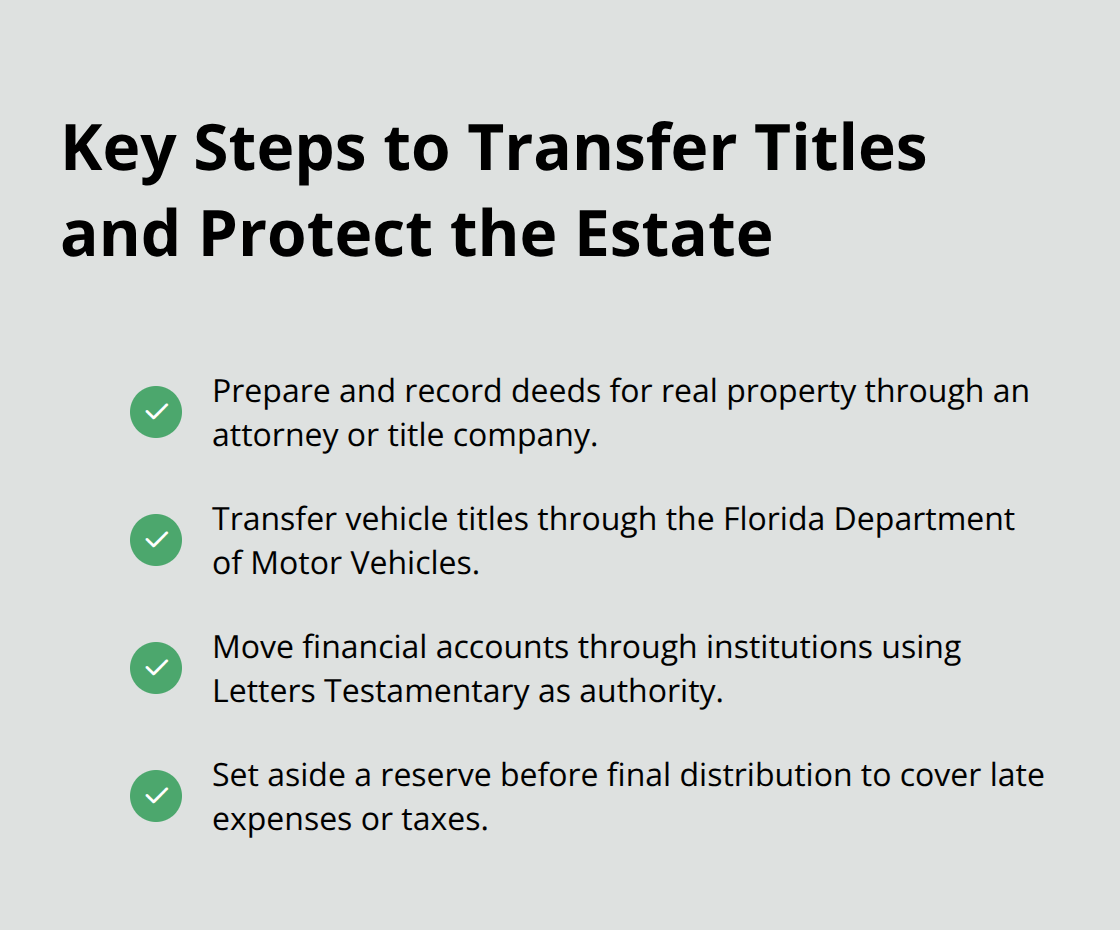
Once the distribution plan is finalized and all beneficiaries have signed receipts acknowledging what they received, the executor transfers titles and deeds through proper legal channels. Real estate transfers require a deed prepared by an attorney or title company; vehicles need title transfers through the Florida Department of Motor Vehicles; financial accounts move through the institutions holding them, using the Letters Testamentary as proof of authority. Setting aside a financial reserve before final distribution protects against last-minute expenses or undiscovered tax liabilities that could otherwise force the estate to claw back distributions.
Closing the Estate
Once all transfers are complete, documented, and approved by the court through a final accounting, the estate enters its closing phase and the executor’s fiduciary duties end. Families facing complex assets or beneficiary disagreements benefit from working with an attorney who can structure distributions fairly and ensure all title transfers comply with Florida law.
Final Thoughts
Estate settlement planning requires attention to detail across five distinct phases, from securing Letters Testamentary through final asset distribution. Families in St. Augustine and Palatka who move through settlement most smoothly act decisively in the first 90 days, maintain meticulous records of every transaction, and communicate openly with beneficiaries about timelines and decisions. Executors must validate debts carefully, negotiate creditor claims when possible, file tax returns on schedule, and document every expense to demonstrate fiscal responsibility.
Asset valuation demands professional appraisals for significant items, and distributions should never occur without signed receipts protecting the executor from future liability. Setting aside a financial reserve before final distribution prevents the estate from running short when unexpected expenses surface. The emotional weight of settling an estate often exceeds the administrative burden, and families benefit from professional guidance that addresses both the practical and relational dimensions of the process.
After settlement closes and the court issues its discharge order, your role as executor ends and your family can move forward. The relationships you preserve during settlement matter far more than the time saved by cutting corners. If you face estate settlement in St. Augustine or Palatka, contact Family, Estate & Mediation Law Group to discuss how we can help your family navigate this final chapter with confidence and care.