
A medical directive Florida allows you to communicate your healthcare preferences before you’re unable to do so yourself. Without one, your family members may face difficult decisions about your treatment with no clear guidance.
At Family, Estate & Mediation Law, we help Florida residents create directives that reflect their true wishes and protect their autonomy. This guide walks you through what you need to know to get started.
What Medical Directives Actually Do in Florida
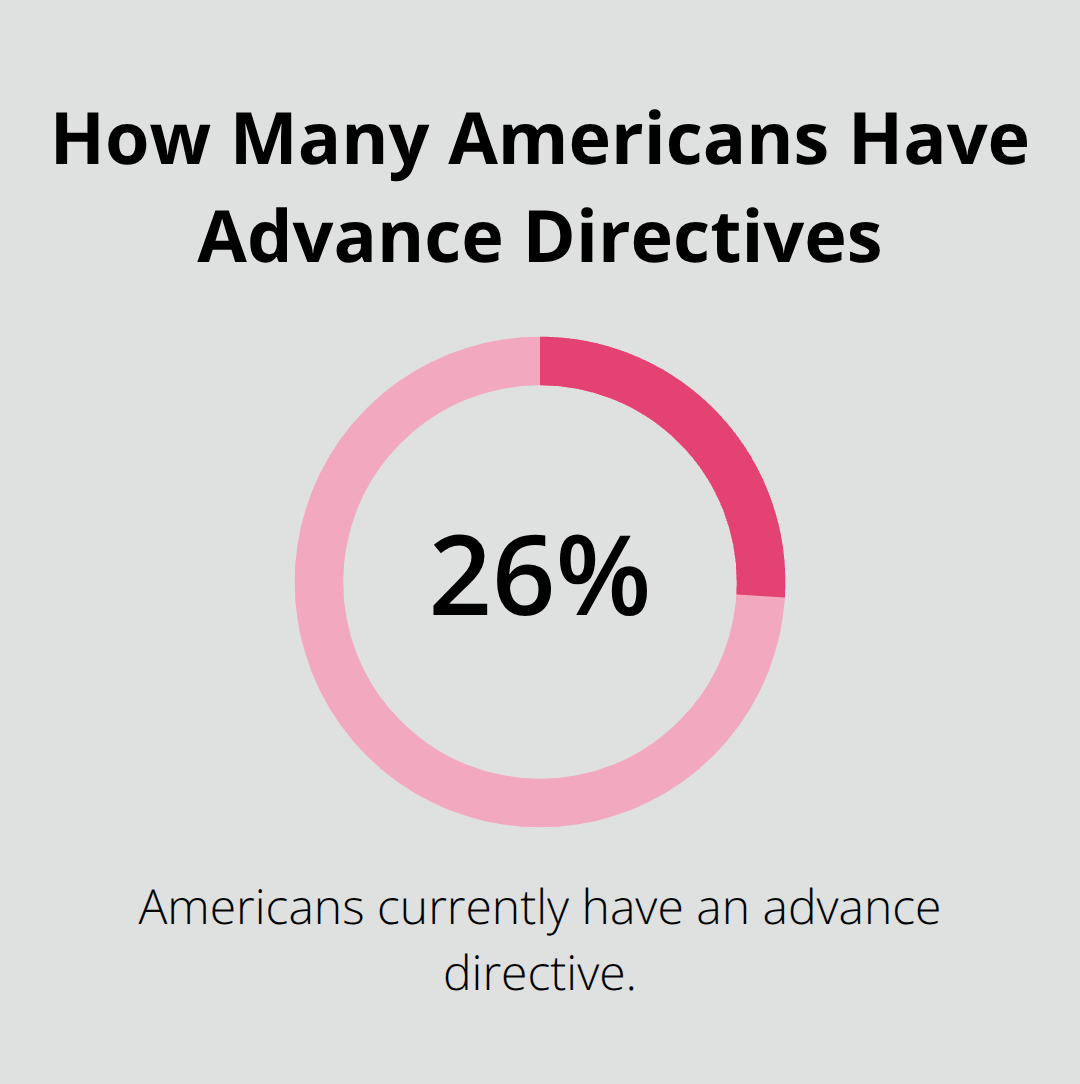
In Florida, a medical directive is a legally binding document that tells healthcare providers exactly what you want if you can’t communicate your wishes yourself. Under Florida Statutes Chapter 765, this document takes effect while you’re still living and guides decisions about life-prolonging procedures when you face a terminal condition, end-stage condition, or persistent vegetative state. The directive isn’t theoretical-it’s a practical tool that prevents your family from making assumptions about your care and stops hospitals from applying aggressive treatment decisions you’d never approve. Florida law recognizes three main advance directive options: a living will that states your medical preferences, a health care surrogate designation that names someone to make decisions on your behalf, and anatomical donation wishes. You can complete one or all three. About 26 percent of Americans currently have an advance directive according to national data, which means most people leave their families without clear guidance about their care preferences. That gap matters because hospitals and nursing homes operate on legal protocols that default to aggressive life-sustaining treatment unless you’ve explicitly said otherwise.
How Medical Directives Differ from Other Advance Documents
A living will specifically addresses life-prolonging procedures and applies only when you’re incapacitated and terminally ill. A health care surrogate designation, by contrast, can take effect immediately or upon incapacity and gives your chosen person authority to make any healthcare decision, not just end-of-life choices. A durable power of attorney for healthcare addresses an even broader range of decisions and works as an alternative or supplement to a surrogate designation. Florida law presumes you’re capable of making health decisions until proven otherwise, so physicians assess capacity before your surrogate’s authority takes effect. The key difference is scope: a living will is narrow and specific to dying, while surrogate designations and healthcare powers of attorney are wider and cover ongoing medical decisions throughout your illness or incapacity. This matters because if you only have a living will and you become unable to decide about a surgery or medication while you’re not yet terminally ill, no one has legal authority to act for you without a court order.
Florida’s Default Decision-Making Chain Creates Problems
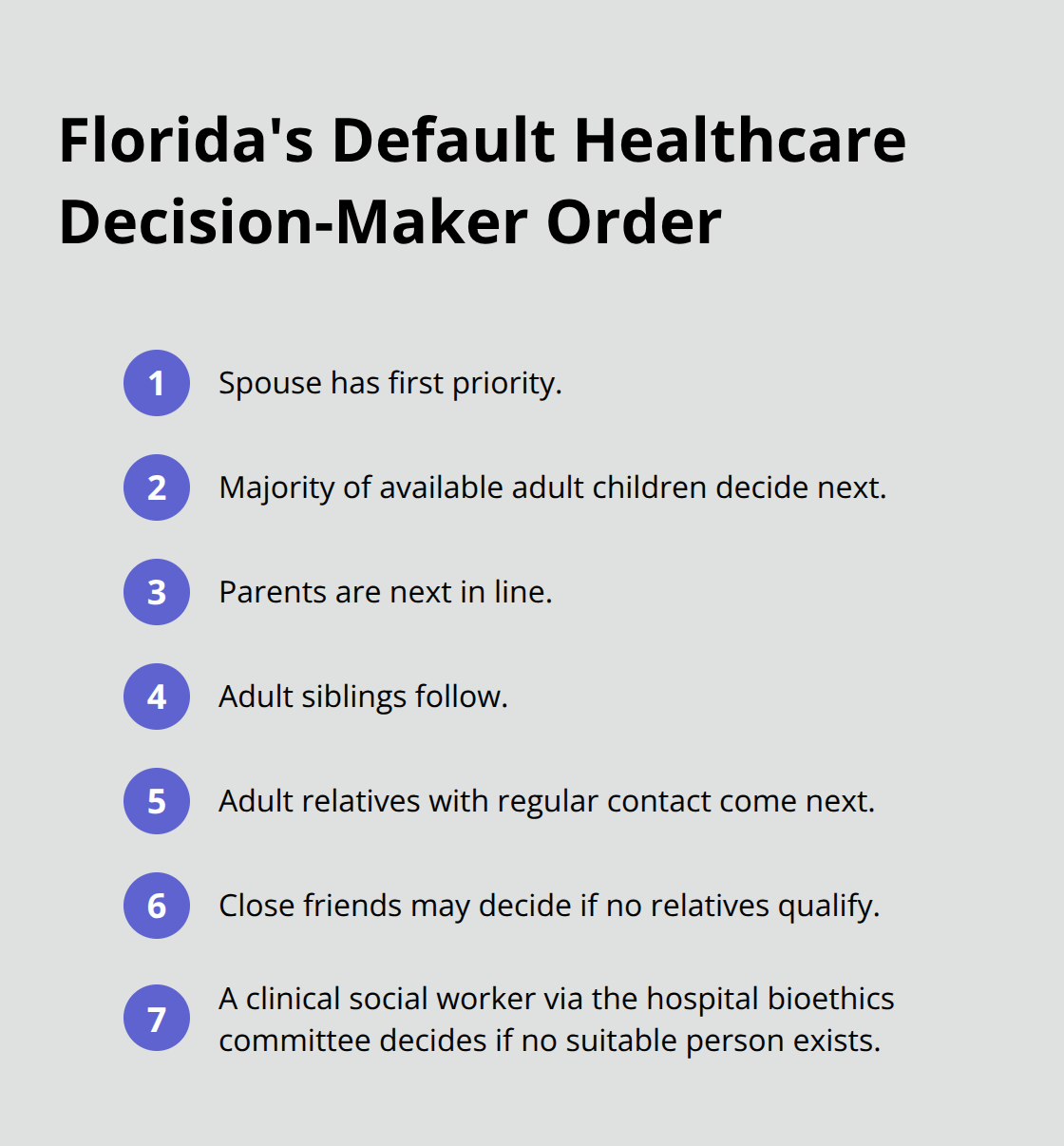
Florida’s population includes snowbirds, retirees, multigenerational families spread across states, and blended families with complicated relationships. When you can’t speak for yourself, that complexity turns into conflict. Without a medical directive naming your surrogate, Florida law follows a priority order: spouse first, then a majority of available adult children, then parents, then adult siblings, then adult relatives with regular contact, then close friends. If none of those people exist or are suitable, a clinical social worker selected by the hospital’s bioethics committee makes decisions for you. That default chain often produces the wrong person in charge.
Taking Control Through Explicit Designation
A directive fixes the problem of default decision-makers by removing assumptions and giving your chosen person explicit authority. You also keep control-you can specify immediate authority for receiving health information, for making decisions, or both, depending on how you write the designation. Florida allows you to amend or revoke a directive at any time, and revocation takes effect when you communicate it to your surrogate, healthcare provider, or facility. That flexibility matters because your preferences change as your health and life circumstances shift. Your surrogate needs to understand your wishes before they face a decision, so conversations with your chosen agent matter more than the document itself. Once you’ve named your surrogate and specified your preferences, you’re ready to address the specific components that make a directive legally effective and actually useful when hospitals and families need it most.
Key Components of a Florida Medical Directive
Your medical directive needs three working pieces to be legally valid and actually useful when hospitals need it. The first is naming someone with authority to act when you cannot. The second is spelling out your actual medical preferences, not vague wishes. The third is giving that person legal access to your health information.
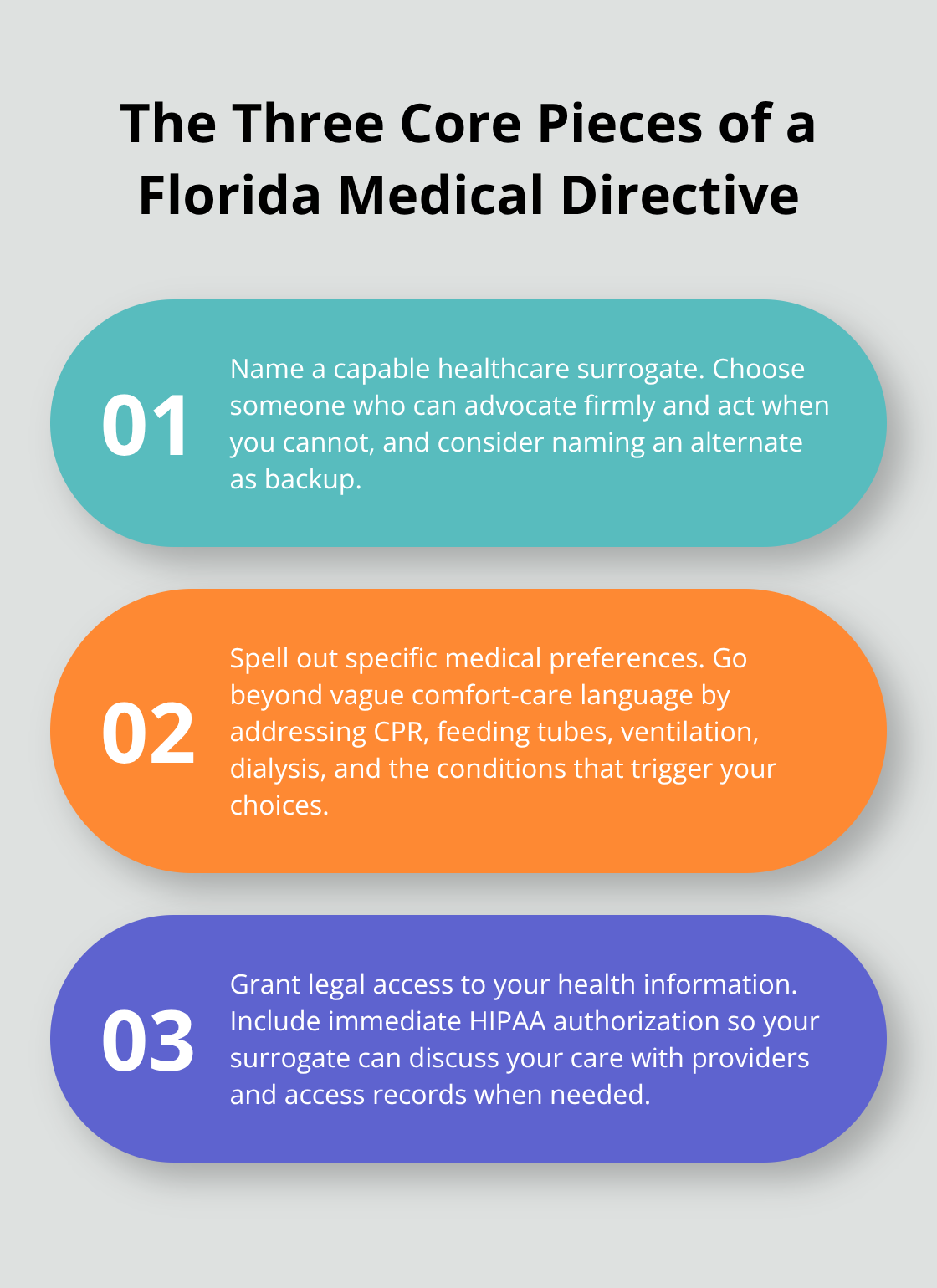
Without all three, your directive sits in a file and fails when it matters most.
Naming Your Healthcare Surrogate with Precision
Florida Statutes Chapter 765 requires your surrogate designation to be in writing with two adult witnesses, and at least one witness cannot be your spouse or blood relative. That witness requirement exists because courts have seen too many cases where family members claim they never knew what the patient wanted. Your surrogate should be someone willing to advocate for your preferences even under pressure from other family members or medical staff who disagree.
Many people name their spouse automatically, but that’s not always the right choice. If your spouse tends to avoid conflict or defers to doctors, they may struggle to enforce your wishes. If your adult child lives nearby and has already shown they can make tough decisions, that person might be stronger in the role. You can name an alternate surrogate to step in if your first choice becomes unavailable or unwilling, which matters because people move, relationships change, and capacity issues arise unexpectedly.
Authorizing Information Access Immediately
Florida law allows your surrogate’s authority to take effect immediately for receiving health information, which means they can access your medical records and discuss your care with providers before any incapacity occurs. That early access prevents the common problem where hospitals refuse to talk to family members until a formal capacity determination happens. Your surrogate cannot effectively advocate for your wishes if they do not understand what your wishes actually are, and that understanding comes from direct discussion about scenarios you might face.
Specifying Your Medical Preferences with Concrete Detail
Your medical preferences should address specific situations, not general statements. Instead of writing that you want comfort care, specify whether you want CPR if your heart stops, feeding tubes if you cannot eat, mechanical ventilation if you cannot breathe, or dialysis if your kidneys fail. The 2025 Florida Statutes suggest form language that applies when you face a terminal condition, end-stage condition, or persistent vegetative state with no reasonable probability of recovery.
If life-prolonging procedures would only prolong the dying process, you direct that they be withheld or withdrawn. This matters because hospitals interpret vague language conservatively, meaning they continue aggressive treatment when you would have refused it. Many Florida residents complete a directive and never discuss it with their chosen agent, which defeats the entire purpose.
Building HIPAA Authorization into Your Directive
HIPAA authorization deserves its own attention because many directives fail here. Federal privacy law restricts who can access your medical information, and your healthcare surrogate needs explicit written permission to receive it. Without that authorization built into your directive, providers can legally refuse to discuss your condition with your surrogate until a court order forces compliance.
Florida allows you to authorize your surrogate immediately, which means they can gather information about your diagnosis, treatment options, and prognosis while you’re still able to discuss these decisions together. That conversation matters more than the document itself. After you’ve named your surrogate, specified your preferences, and authorized information sharing, you must distribute copies strategically. Give copies to your surrogate, your primary care physician, any specialists you see regularly, and your family members who should know your wishes. Keep a copy in your wallet, another at home, and consider storing it digitally on your phone so it’s accessible in emergencies. Once your directive is complete and distributed, the real work begins-making sure the people who matter most understand not just what the document says, but why you made these choices and what they mean for your care.
Common Mistakes People Make When Creating Medical Directives
The moment you sign a medical directive, most people believe the hard work is finished. That assumption costs lives. A directive sitting in a drawer while your family members have never heard of it, or worse, disagree with what it says, becomes worthless the instant you need it. Hospitals and emergency rooms operate under time pressure, and they default to aggressive treatment unless someone present can immediately explain your wishes and show legal authority to enforce them. If your spouse arrives at the ER without a copy of your directive and your adult children start arguing about whether you’d want CPR, the medical team will resuscitate you regardless of what your unsigned directive says at home.
Failing to Communicate Wishes to Family Members
This happens constantly because people complete directives in isolation, treating them as paperwork rather than as communication tools that require active conversation with the people who matter most. The National Alliance for Care at Home found that even with written directives in place, hospitals and families fail to follow them unless healthcare providers understand them, family members know they exist, and someone present can advocate for them with authority and clarity. Your surrogate cannot effectively enforce your wishes if they have never discussed what those wishes actually mean in real situations. A thirty-minute conversation with your chosen agent about whether you’d accept a feeding tube if you had advanced dementia, or CPR if you had terminal cancer, prevents months of family conflict later.
Using Outdated or Incomplete Forms
The second critical failure happens when people use outdated forms or incomplete templates that do not match Florida’s current law. Directives signed before October 1, 1999, remain valid under Florida Statutes Chapter 765, but forms created decades ago may lack the HIPAA authorization language that modern healthcare systems require. They often fail to specify concrete medical preferences instead of vague comfort-care language that hospitals interpret conservatively. Many people download free forms from generic websites designed for multiple states, missing Florida-specific requirements like the two-witness rule with specific restrictions on who can witness, or they complete forms without naming an alternate surrogate, leaving no backup if their primary choice becomes unavailable.
Not Reviewing and Updating Directives Regularly
Your directive also needs updating whenever your health changes, your family situation shifts, or your preferences evolve, yet most people never review theirs after signing. If you designated your spouse as surrogate fifteen years ago and you have since divorced, that designation is automatically revoked under Florida law, but you will not know that unless you have actually read the statute or discussed it with someone familiar with Florida’s requirements. Static documents fail when life keeps moving. We at Family, Estate & Mediation Law recommend annual review of your directive, triggered by major health events, medication changes, or relationship changes (such as marriage, divorce, or estrangement from a family member). After you complete your directive, schedule a conversation with your surrogate within days of signing. Walk through specific scenarios and explain why you made these choices. That conversation transforms your directive from a legal document into an actual communication tool that your family understands and will enforce when hospitals need it most.
Final Thoughts
A medical directive Florida protects your autonomy when you cannot speak for yourself, and it prevents your family from making impossible decisions under pressure. Without one, hospitals default to aggressive treatment, and your loved ones face conflict at the worst possible moment while they guess what you would have wanted. That uncertainty creates guilt and regret that lasts long after the crisis passes.
The real power of a medical directive comes from the conversations you have before crisis hits. When you sit down with your chosen surrogate and discuss whether you would accept a feeding tube or mechanical ventilation, you transform paperwork into actual communication that your family understands and will enforce. That conversation gives your family permission to enforce your wishes instead of fighting about what they think you would have wanted.
We at Family, Estate & Mediation Law help Northeast Florida residents create directives that reflect their true values and hold up when hospitals need them most. Contact our St. Augustine or Palatka offices to schedule a conversation about your current directive or to create one if you don’t have one yet.