
Estate disputes tear families apart. When assets are at stake, siblings stop talking, spouses clash, and relationships fracture in ways that money can’t repair.
At Family, Estate & Mediation Law, we’ve seen how a family mediation estate plan stops this damage before it starts. Mediation gives families a structured path to resolve disagreements without courtroom battles that drain savings and leave lasting resentment.
How Mediation Stops Estate Disputes From Destroying Families
Mediation works because it stops disputes before they reach the courtroom, where costs spiral and relationships die. When a mediator sits down with beneficiaries, executors, and trustees, the conversation shifts from who wins to what actually needs to happen. A neutral third party removes ego from the room and keeps focus on solving the problem rather than proving someone wrong. Research from the Love & Sterk study on mediation clauses in estate planning shows that mediation costs significantly less than probate litigation because attorney fees drop and court costs vanish entirely. The average probate litigation case drains tens of thousands of dollars from an estate, while mediation typically costs a fraction of that amount.
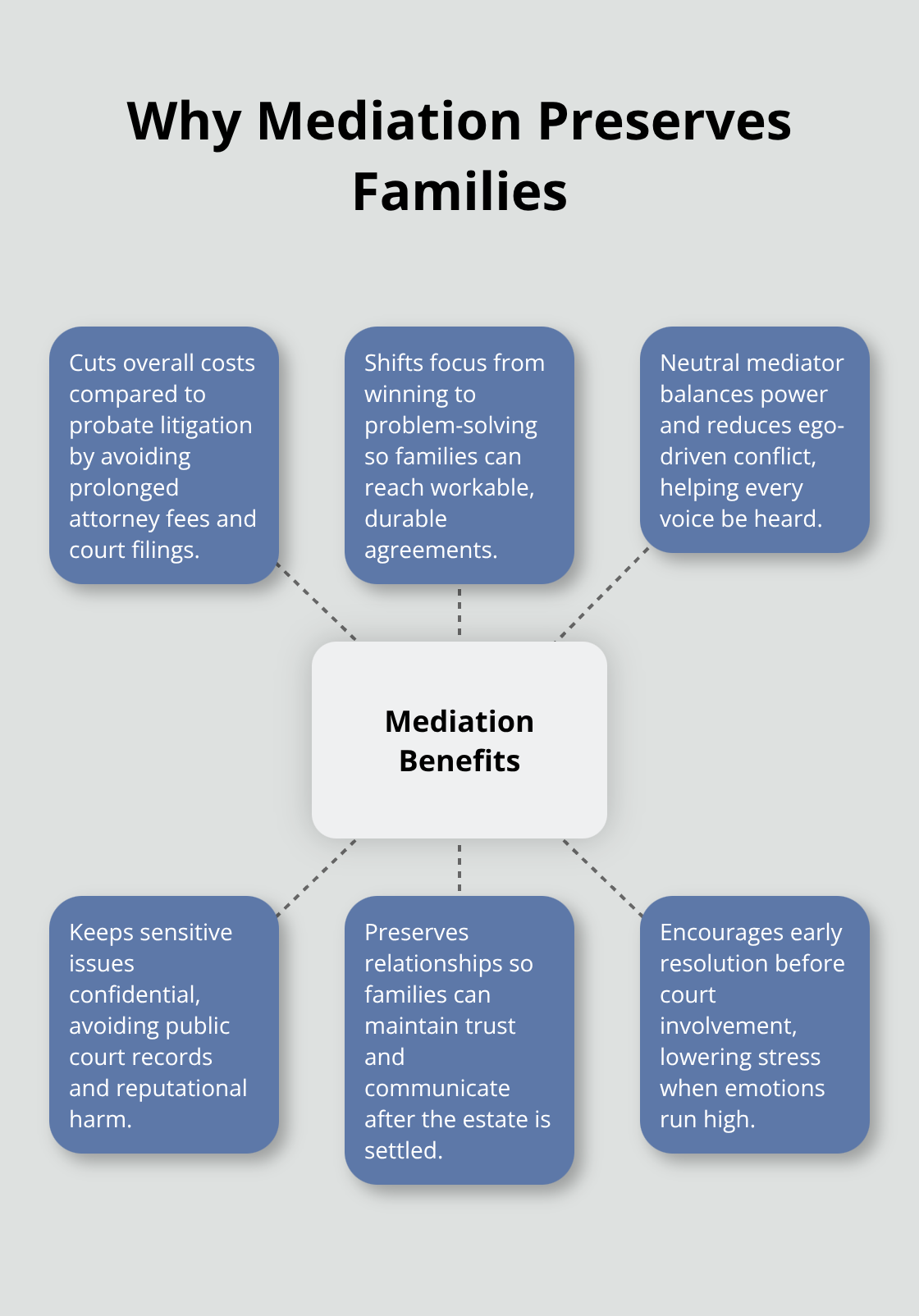
Beyond money, mediation preserves what money cannot buy back: the ability for siblings to sit at the same dinner table, for adult children to respect their parents’ wishes without resentment, and for families to move forward without years of courtroom battles poisoning every relationship.
The Real Role of a Mediator in Estate Conversations
A mediator in estate disputes is often a retired probate judge or someone trained specifically in family dynamics and property law. This person does not make decisions for the family. Instead, they create a safe space where each person can speak without interruption, and they help translate what family members actually want beneath the anger and fear. When one sibling claims they deserve more because they provided caregiving, and another claims the will was written unfairly, the mediator unpacks those claims to find what matters most: recognition, fairness, or security. The mediator also addresses power imbalances directly. If one family member dominates conversations or one person has access to financial information while others do not, the mediator levels the playing field so everyone’s voice actually counts. Sessions stay confidential, shielding sensitive family information from public court records where anyone can read about family secrets, medical details, or financial struggles.
When Disputes Surface During Administration
Estate conflicts often surface when the executor or trustee begins distributing assets. A beneficiary questions whether the executor paid themselves too much in fees. A child discovers the parent had a second will. Someone claims the will is invalid or the parent lacked mental capacity when signing. Without a mediation structure already in place, these disputes escalate immediately to litigation. With a mediation clause built into the estate plan before problems arise, families have a mandatory first step that forces communication before legal action. This early intervention matters because emotions run highest immediately after death, and families often make litigation decisions in grief rather than clarity. Mediation gives time for anger to settle and for facts to emerge without court involvement. If mediation does not resolve the issue, litigation remains available, but the act of sitting together often shifts what people actually need from the process-and that shift opens the door to solutions that courtrooms cannot provide.
Common Family Conflicts Over Estates and Assets
Will Validity Challenges and Interpretation Disputes
Will validity challenges and interpretation fights represent the most dangerous conflicts families face because they strike at legitimacy itself. When one beneficiary claims the parent lacked mental capacity when signing, or another insists the will was forged or improperly executed, the entire estate plan collapses into accusation. These disputes do not settle easily because they are not really about money-they are about whether the parent’s final wishes actually reflect what the parent wanted. A child who felt excluded from caregiving might suddenly question whether the will is valid, weaponizing doubt to rewrite the outcome.
Asset Distribution and Fairness Disputes
Asset distribution disputes follow a different pattern but cause equal damage. One sibling provided years of unpaid caregiving while another lived across the country and contributed nothing, yet the will divides assets equally. Another scenario involves a blended family where the surviving spouse receives everything while adult children from the first marriage receive nothing, triggering rage and litigation. Real estate creates specific friction because properties cannot be easily split-someone must buy out the others, or the family home gets sold to strangers, erasing the last physical connection to shared history.
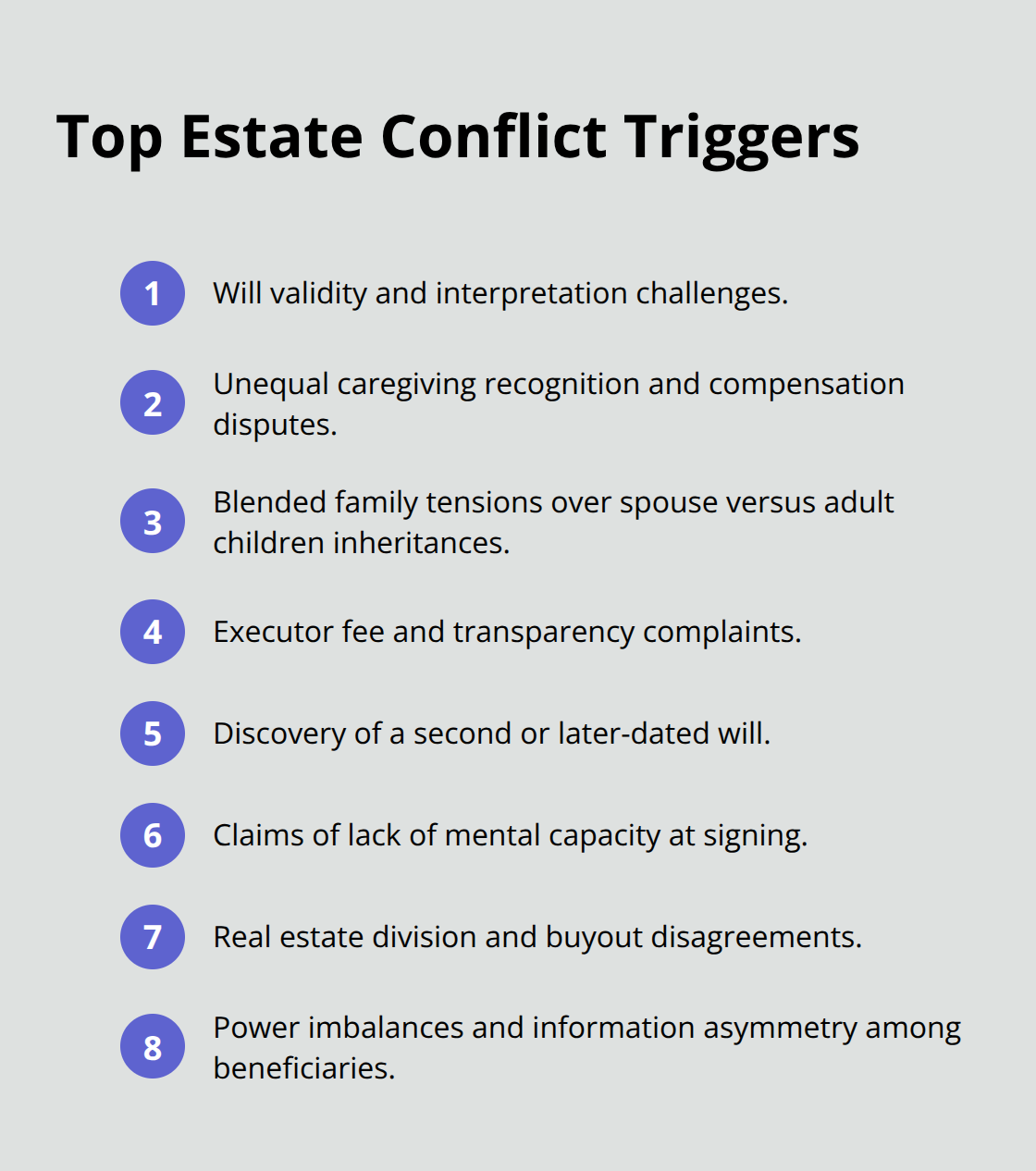
Mediation addresses these disputes by separating the emotional claim from the financial claim. A mediator helps the caregiving child articulate what they actually need: acknowledgment of sacrifice, or compensation for years of unpaid work, or a larger share. Often the answer is not more money but recognition that the will itself should have reflected their contribution. In blended family situations, mediation clarifies what the deceased parent actually intended versus what family members assumed, and it creates space for the surviving spouse and adult children to negotiate a division that feels fair to both groups rather than forcing one side to accept a judge’s decision.
Blended Families and Competing Interests
Conflicts between blended families and competing interests represent the fastest-growing estate dispute category because remarriage is increasingly common but planning rarely addresses it. A parent remarries late in life and creates a new will favoring the new spouse, leaving adult children with nothing or minimal amounts. The adult children feel betrayed and question whether the new spouse manipulated or coerced the parent into the new will. The surviving spouse feels entitled to security and views the adult children as threats to their inheritance. Without mediation, these disputes become scorched-earth litigation where each side hires attorneys and both sides lose.
Mediation in blended family situations works because it forces conversation about what the deceased parent actually wanted for both groups. Did the parent want the surviving spouse secure for life but also want to pass wealth to adult children eventually? A mediator helps construct solutions like a trust that provides income to the surviving spouse during their lifetime but distributes remaining assets to adult children at the spouse’s death. This arrangement satisfies both the surviving spouse’s security need and the adult children’s inheritance expectation.
The key is addressing these conflicts before death, not after. A family mediation estate plan built during the parent’s lifetime, with all parties present, prevents these disputes entirely. The parent states their wishes directly, beneficiaries voice concerns in real time, and the estate plan gets adjusted to reflect actual family dynamics rather than assumptions or resentment. This proactive approach sets the stage for the practical steps families must take to resolve conflicts when they do arise.
Practical Steps to Resolve Estate Conflicts Through Mediation
Start Mediation Before Conflict Takes Hold
The worst time to start mediation is after the will is read and fighting erupts. Families caught in reactive mediation face entrenched positions, hardened resentments, and people already committed to litigation. The difference between proactive and reactive approaches matters enormously: proactive mediation prevents disputes entirely, while reactive mediation salvages relationships after damage occurs. Timing shapes everything because emotions stay lowest and clarity stays highest when the parent is alive and involved. Starting mediation before death means the person whose wishes matter most-the testator-can speak directly about what they want, why they want it, and how they expect beneficiaries to treat each other afterward.
This conversation, facilitated by a trained mediator, becomes the foundation for an estate plan that reflects actual family dynamics rather than assumptions or resentment. Many families resist this step because they assume mediation is only for conflict resolution after disputes arise. That assumption costs them tens of thousands of dollars and years of fractured relationships.
Select the Right Mediator and Schedule Sessions
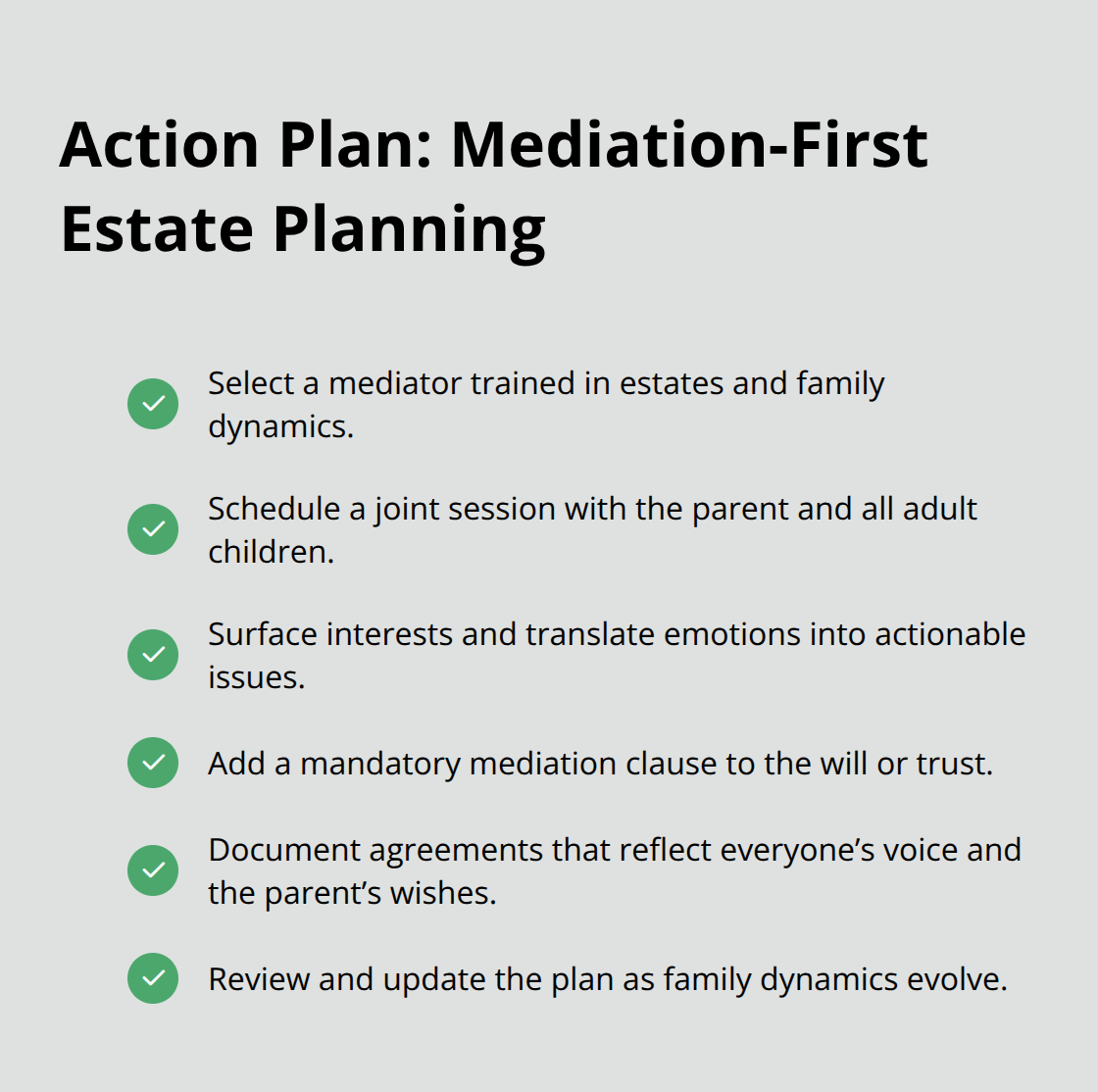
The practical process starts with identifying a mediator trained in estate and family dynamics, not just general mediation. Retired probate judges bring familiarity with estate administration and understand the legal framework that governs distributions and trustee duties. Once a mediator is selected, schedule a session with the parent and adult children present-all stakeholders in one room. The mediator opens by explaining that the goal is not to make decisions but to surface what matters most to each person: security, fairness, recognition, or control.
Facilitate Direct Conversation About Wishes and Concerns
The parent states their wishes clearly, addressing specific concerns like the caregiving child who expects acknowledgment or the blended family situation where competing interests exist. Adult children voice concerns without accusation. The mediator translates emotional language into actionable issues. If one child says the will is unfair because another received help with a home down payment, the mediator helps clarify whether the issue is unequal treatment, lack of transparency, or something else entirely.
Draft or Revise the Estate Plan Based on Mediation Outcomes
Once conversations surface actual needs, the estate plan gets drafted or revised to address them. A mediator clause gets added to the will or trust, requiring mediation as a mandatory first step if disputes arise after the parent’s death. This clause does not prevent litigation but forces communication before court involvement. Research from Love & Sterk’s study on mediation clauses in estate planning documents shows that mandatory mediation reduces litigation rates significantly compared to estates without such provisions.
The cost of this proactive mediation typically ranges from a few hundred to a few thousand dollars, depending on the number of sessions needed. Compare that to probate litigation, which routinely costs tens of thousands of dollars in attorney fees alone, and the financial case becomes obvious. The family gains something litigation cannot provide: a documented agreement that reflects everyone’s voice and the parent’s actual wishes, not a judge’s interpretation of a contested will.
Final Thoughts
Mediation protects family relationships because it keeps disputes out of the courtroom and keeps conversations within the family. When siblings sit together with a mediator rather than facing each other across a courtroom, the goal shifts from winning to understanding. The parent’s wishes stay at the center of the discussion instead of getting buried under legal arguments and procedural delays. A family mediation estate plan built before death means beneficiaries already know what to expect and why the parent made specific choices.
Planning ahead prevents years of conflict because it addresses family dynamics when emotions are stable and communication is possible. A parent who sits down with adult children and a mediator to discuss the estate plan removes the guesswork that destroys families after death. Adult children stop wondering whether they were loved equally or whether the parent favored a sibling. Blended families clarify competing interests before resentment hardens into litigation, and caregiving children receive acknowledgment for their sacrifice.
We at Family, Estate & Mediation Law help families across Northeast Florida build proactive estate plans that prevent disputes before they start. The choice is clear: invest in mediation now or pay far more in litigation later. Families that plan ahead move forward with unity intact.