
Probate disputes tear families apart. When a loved one passes, disagreements over the estate can transform grief into anger, drain savings through litigation costs, and leave lasting damage to family bonds.
At Family, Estate & Mediation Law, we’ve seen how probate mediation services offer a different path. Instead of courtroom battles that entrench positions and escalate conflict, mediation brings families together with a neutral third party to find solutions that work for everyone.
What Actually Breaks Families Apart During Probate
Unresolved Tensions Surface When Money Enters the Picture
Probate conflicts rarely start with the will itself. They start with unresolved family dynamics, unmet expectations, and money decisions that force uncomfortable conversations at the worst possible time. A parent dies, the will gets read, and suddenly siblings who haven’t spoken in years must make decisions together about assets, property, and who controls what. Disputes over executor or trustee selection account for a significant portion of probate disagreements because family members often question whether the chosen person has the right judgment or loyalties.
When Distributions Feel Unfair
Perceived unfairness in distributions triggers deep resentment, especially when one beneficiary receives substantially more or when some family members feel excluded entirely. Claims of undue influence-where one person allegedly manipulated the deceased into changing the will-create suspicion that poisons every conversation afterward. Medical bills, debts, and claims against the estate force painful financial realities into the open. These conflicts intensify when multiple generations hold different values about money, family obligations, and what the deceased would have wanted.
How Litigation Transforms Conflict Into Warfare
Traditional probate litigation transforms these emotional wounds into legal warfare. Court proceedings cost $5,000 to $30,000 or more depending on complexity, with some contested estates exceeding $100,000 in attorney fees alone. The process takes months or years-Florida probate cases often drag through the system for 12 to 24 months-during which family members remain locked in opposition, unable to move forward or heal.
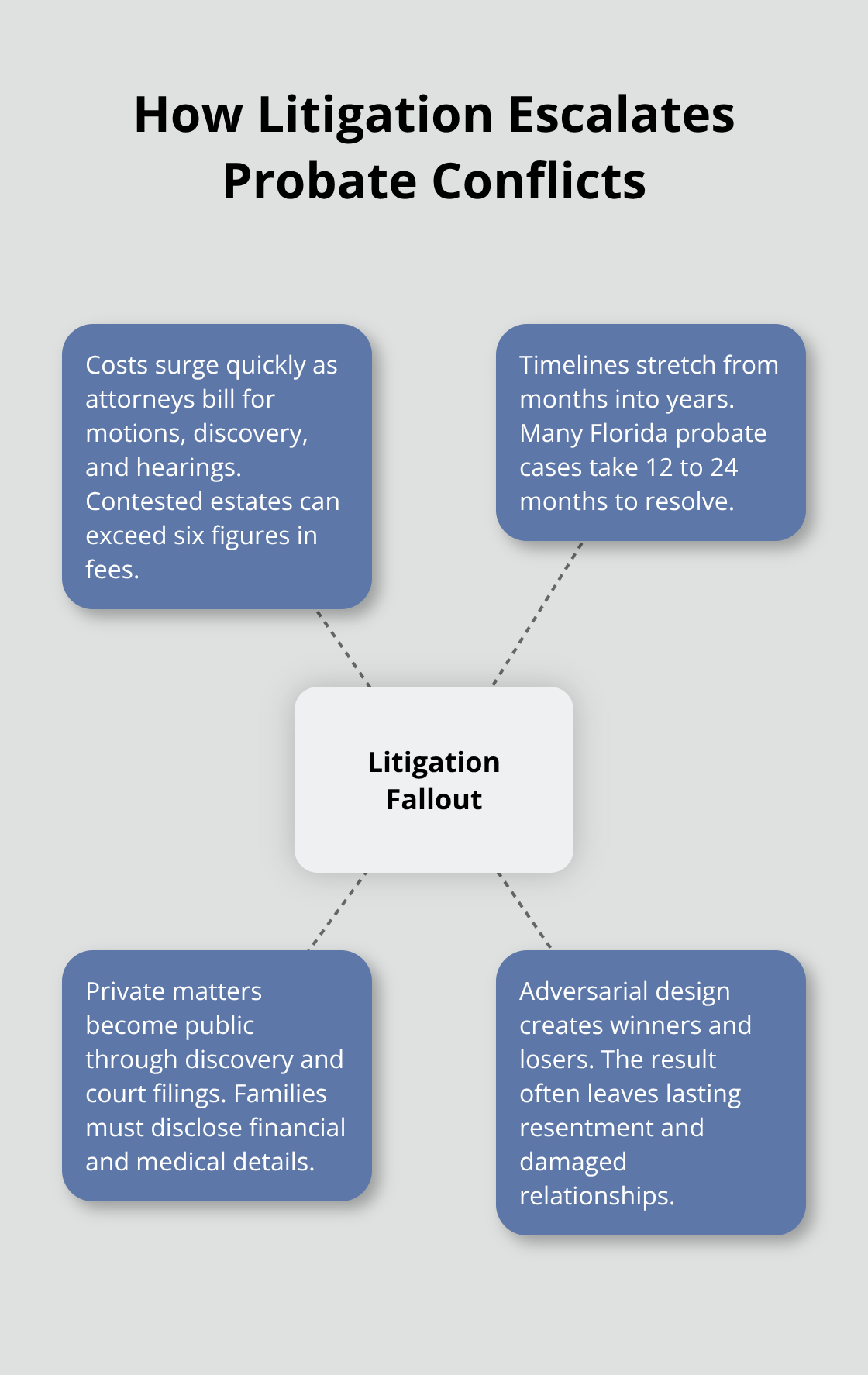
Discovery processes force families to expose private financial information, medical records, and personal communications in public court documents. Depositions and cross-examinations turn family members into witnesses against each other, creating permanent records of accusations and distrust. The adversarial structure means one side wins and one side loses, leaving lasting resentment among people who must coexist at future family events.
The Real Cost of Courtroom Battles
Litigation also delays estate distribution, leaving beneficiaries without access to their inheritance while legal fees accumulate. Court outcomes are rigid-judges impose solutions rather than allowing families to craft arrangements that reflect their actual needs and relationships. Once litigation starts, settlement becomes harder because both sides have invested emotionally and financially in their positions, making compromise feel like defeat. This is where mediation offers a fundamentally different approach to resolving what the courtroom cannot fix.
A Better Way to Resolve Estate Disputes
Control Over Your Settlement
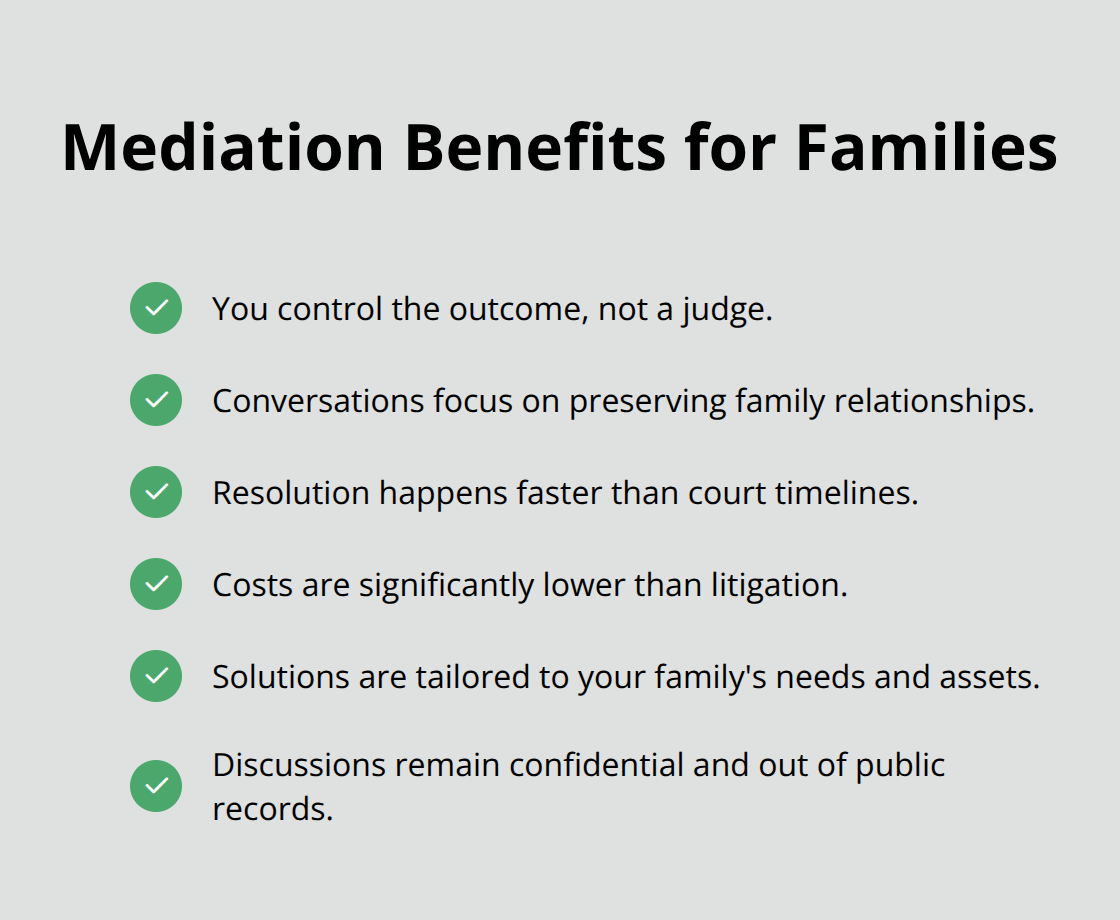
Mediation operates on a principle that court cannot replicate: both sides control the outcome. In litigation, a judge decides who wins and who loses based on legal arguments and evidence. In mediation, you and your family members work with a neutral mediator to craft a solution that addresses what actually matters to you-whether that’s preserving relationships, accessing your inheritance quickly, or protecting your role in family decisions.
A neutral mediator does not impose answers. Instead, they facilitate structured conversations, help identify common ground beneath competing positions, and guide you toward settlements that reflect your family’s real needs rather than legal technicalities. This shift from adversarial to collaborative changes everything.
Cost and Speed Advantages
Mediation sessions typically cost between $500 and $2,500 per party, compared to litigation expenses that routinely exceed $15,000 to $30,000 per person. Resolution often happens in one to three sessions rather than the 12 to 24 months typical for contested probate cases in Florida.
You remain in control of settlement terms, which means distributions can be tailored to your family’s circumstances-perhaps one sibling receives property while another receives cash equivalent, or the executor role shifts to someone both sides trust. Court cannot offer this flexibility because judges apply law, not family logic.
How Mediators Reframe Estate Conflicts
The mediator’s role in estate disputes centers on reframing conflict as a problem to solve together rather than a battle to win. Mediators bring probate-specific knowledge that allows them to identify settlement pathways invisible to family members locked in their positions. They conduct separate conversations with each side to understand underlying concerns-maybe a beneficiary’s real worry isn’t about money but about whether the deceased’s final wishes are honored, or whether they’ll be excluded from decisions about inherited property.
These confidential conversations, called caucuses, allow the mediator to find creative solutions without exposing sensitive information in joint sessions. One family might agree that distributions happen monthly rather than in one lump sum, reducing financial strain. Another might designate a neutral third party to oversee property decisions, removing the burden from feuding siblings.
Creating Binding Agreements and Protecting Privacy
The mediator helps draft settlement agreements that become legally binding once signed, giving your resolution the same force as a court order without the litigation scars. Mediation also preserves confidentiality-nothing discussed in sessions becomes part of public court records, protecting your family’s privacy and your estate details from public view. This privacy protection matters especially when estates involve sensitive financial information or family dynamics you prefer to keep private.
When mediation produces a settlement, the agreement reflects actual family circumstances rather than a judge’s interpretation of law. This practical approach to resolution sets the stage for understanding when mediation makes sense for your specific situation and what outcomes you can realistically expect.
Probate Mediation in St. Augustine and Palatka, FL
When Mediation Solves What Court Cannot
Mediation works best when family members want to move forward but cannot agree on how. If beneficiaries dispute the executor’s actions, siblings disagree over asset distribution, or questions about undue influence threaten to derail the entire probate process, mediation stops the bleeding before litigation costs explode. The timing matters significantly. Early mediation, initiated before formal litigation starts, costs substantially less because the facts remain undisputed and parties have not yet invested thousands in attorney fees defending entrenched positions. A family dealing with a will contest claim in St. Augustine or Palatka should pursue mediation within the first 30 to 60 days after the dispute surfaces, not after months of hostile letters and legal threats have poisoned the relationship.
Complex Assets and Creative Solutions
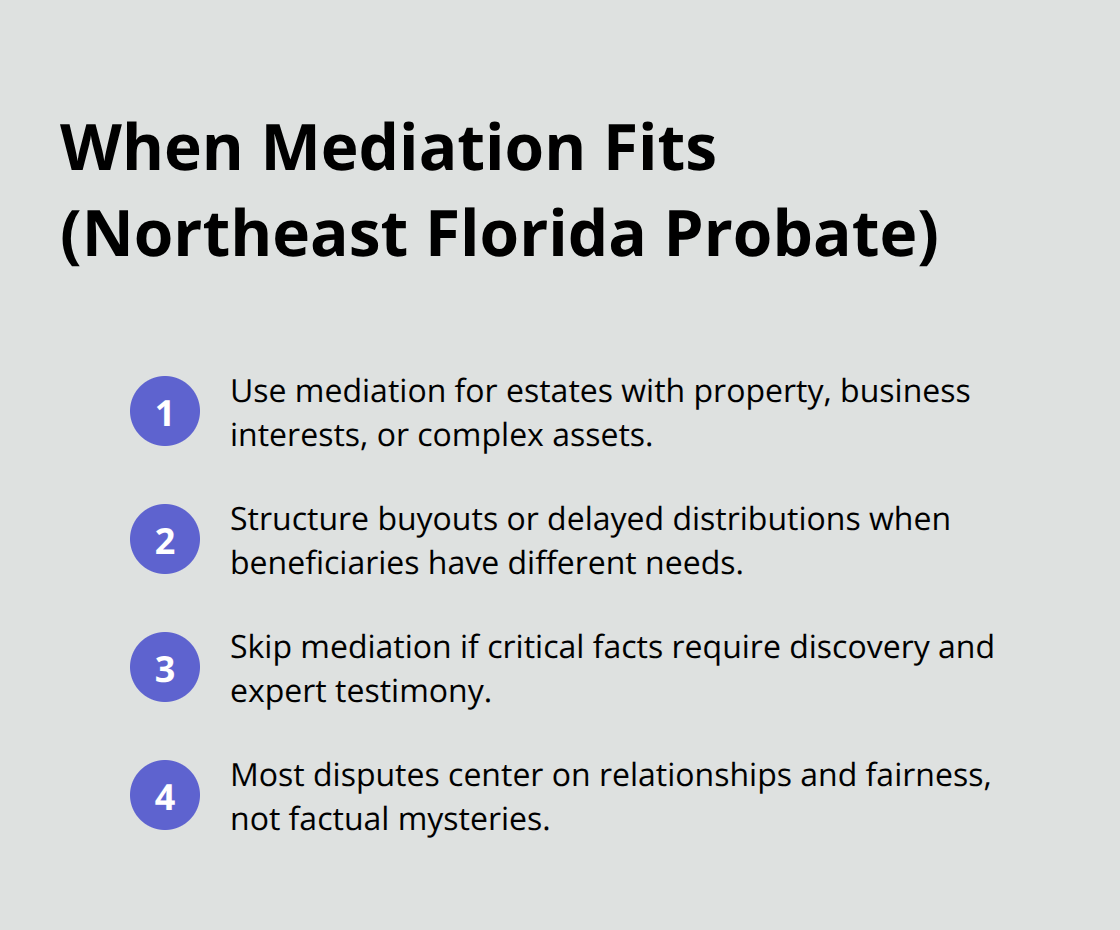
Mediation also makes sense when the estate includes property, business interests, or complex assets that benefit from creative solutions rather than a judge’s binary decision. If one beneficiary wants to keep inherited real estate while another needs immediate cash, mediation allows them to structure a buyout or delayed distribution that court cannot easily impose. You should skip mediation only when critical facts require discovery and expert testimony-for example, if you must prove the deceased lacked capacity through medical records and neurological evidence, litigation may be unavoidable. However, most probate disputes involve relationship breakdowns and competing interpretations of fairness, not factual mysteries that require court intervention.
Speed and Cost Reality
Mediation in Northeast Florida typically resolves in one to three sessions spanning two to eight weeks, compared to contested probate cases that consume 12 to 24 months in Florida courts. Total mediation costs range from $1,500 to $7,500 per family depending on session length and mediator rates, whereas litigation routinely exceeds $15,000 to $30,000 per person once discovery, depositions, and trial preparation commence.
How Mediators Identify Settlement Pathways
Mediators with probate-specific knowledge help families identify settlement pathways through confidential conversations with each side, then facilitate joint sessions where creative solutions emerge. One family resolved a fiduciary duty dispute in two sessions by restructuring how the executor managed distributions and created a neutral oversight mechanism both sides trusted. Another mediated a will contest claim by establishing a payment plan that satisfied the challenging beneficiary’s financial concerns without requiring the estate to prove the original will’s validity. These outcomes avoid the public record exposure, relationship destruction, and unpredictability of trial, leaving families able to move forward without permanent scars from courtroom warfare.
Final Thoughts
Families across Northeast Florida move away from probate litigation and toward mediation because the math is simple: mediation costs less, resolves faster, and leaves relationships intact. When a St. Augustine or Palatka family faces a probate dispute, the choice between court and mediation determines whether they spend the next two years in legal warfare or two months finding solutions that work for everyone. Probate mediation services address what litigation cannot fix because court imposes outcomes while mediation creates them.
Your legacy extends beyond the assets in your estate and includes how your family moves forward after you’re gone. Litigation leaves scars that persist through holidays, family gatherings, and future generations, whereas mediation allows your family to grieve, resolve disagreements, and honor your memory without permanent damage. The shift toward mediation reflects a growing recognition that probate disputes are fundamentally about relationships and fairness, not legal technicalities that require a judge to decide.
If you face a probate conflict in St. Augustine or Palatka, the time to act is now because early mediation stops disputes from escalating into expensive litigation. Contact us at femlg.com to discuss whether mediation makes sense for your situation and how we can help guide your family toward solutions that protect your relationships and legacies.