Most Florida residents don’t realize that wills and trusts serve completely different purposes in your estate plan. A will handles what happens after you die, while a trust manages your assets during your lifetime and beyond.
At Family, Estate & Mediation Law, we’ve seen countless families struggle with these decisions because they didn’t understand the real differences. This guide breaks down Florida wills and trusts in plain language so you can make the right choice for your situation.
Wills and Trusts: How They Work Differently in Florida
What a Will Actually Does
A will is a set of instructions that take effect only after you die. Under Florida law, your will must be in writing, signed by you in front of two witnesses, and those witnesses must sign in front of each other. Once filed in probate court, your will becomes public record-anyone can see who inherits what and the full value of your estate. Probate in Northeast Florida typically costs 3-7% of your estate’s value and takes 6-12 months to complete.
Your will controls only assets titled in your name alone. Life insurance with a named beneficiary, retirement accounts, and jointly owned property bypass your will entirely and pass directly to those beneficiaries. This limitation catches most people off guard. If you own real estate, bank accounts, and investment portfolios but name beneficiaries on only some of them, those accounts skip probate while everything else gets dragged through the court system.
The Will’s Incapacity Problem
A will also fails to protect your family if you become incapacitated. If you suffer a car accident and cannot make decisions, your will sits useless in a drawer while your family fights in court to gain authority to pay your bills. Your will addresses only what happens after death, not what happens while you’re alive but unable to act.
How Trusts Operate Differently
A trust holds the title to your assets during your lifetime and transfers them privately after you die, meaning zero probate for funded property and complete privacy. Your trust terms never become public record. A trust also gives you control over distributions to your beneficiaries. Instead of leaving money outright, you can specify that funds go toward health, education, maintenance, and support, protecting spendthrift beneficiaries from themselves.
Trusts Solve Blended Family Problems
For blended families, a trust prevents a surviving spouse from disinheriting your adult children. In Florida, a spouse has rights to claim up to 30% of your elective estate under state law, but a properly drafted trust can override those defaults and ensure your wishes control the outcome. Trusts also cost less than probate in the long run. While a revocable living trust costs more upfront to create and fund than a simple will, it eliminates probate expenses entirely and avoids the 6-12 month delay.
Advanced Trust Benefits
Special needs trusts preserve eligibility for SSI and Medicaid while providing for a disabled child’s care. Irrevocable trusts can remove assets from your taxable estate and reduce federal estate taxes-something a will cannot do. If you own a business, a trust transfers ownership without forcing a sale to cover probate costs or taxes.
The real choice isn’t will versus trust. It’s whether you want your family navigating probate court or stepping into their inheritance privately and quickly. Understanding which tool fits your situation requires looking at your specific assets, family structure, and long-term goals.
Florida-Specific Requirements for Wills and Trusts
Will Execution Rules Under Florida Law
Florida Statute 732.502 sets strict execution rules that most people overlook until it’s too late. Your will must be in writing, signed by you at the end, and witnessed by two people who sign in front of you and each other. Skip even one of these steps and Florida probate courts will reject your will as invalid, forcing your estate into intestacy laws that ignore your wishes entirely. Florida Statute 732.102 then dictates who inherits based on a rigid hierarchy: your spouse gets a percentage, your children split the rest, and if you have no spouse or children, your parents or siblings inherit instead. This default path rarely matches what families actually want.
Why Trusts Avoid Signature Formalities
Trusts bypass these signature formalities because they take effect during your lifetime, not after death, which is why they avoid the two-witness requirement altogether. However, trusts must still meet Florida Statute Chapter 736 requirements: you must have legal capacity (age 18 and sound mind), the document must be in writing with clear intent to create a trust, you must name at least one ascertainable beneficiary, and you must actually fund the trust by retitling assets into the trust’s name. Most people create a trust document and then leave their real estate deed, bank accounts, and investment portfolios titled in their individual names, which means those assets still go through probate anyway, defeating the entire purpose.
Homestead Protection Complications
Florida homestead protection adds another layer of complexity that wills and trusts handle very differently. Under Florida Constitution Article X Section 4, your primary residence receives special protection from creditors and forced sale, but this protection creates strict rules about who can inherit it. If you place homestead property into a trust, Florida law requires specific language and sometimes spousal joinder (your spouse’s signature) to keep the homestead protection intact after your death. Get this wrong and your surviving spouse might lose homestead rights entirely.
Federal Tax Planning and Exemptions
Federal estate tax exemptions apply in Florida even though the state has no state estate tax itself. In 2026, you can transfer approximately 13.61 million dollars to heirs tax-free during your lifetime or at death, but this exemption shrinks to 7 million dollars in 2027 unless Congress acts. Irrevocable trusts let you lock in today’s higher exemption by transferring assets now, while a will cannot freeze exemptions at all. Married couples should use credit shelter trusts to preserve each spouse’s separate exemption, preventing one spouse’s exemption from going unused after death, which wastes hundreds of thousands in potential tax savings.
The Real Cost Difference
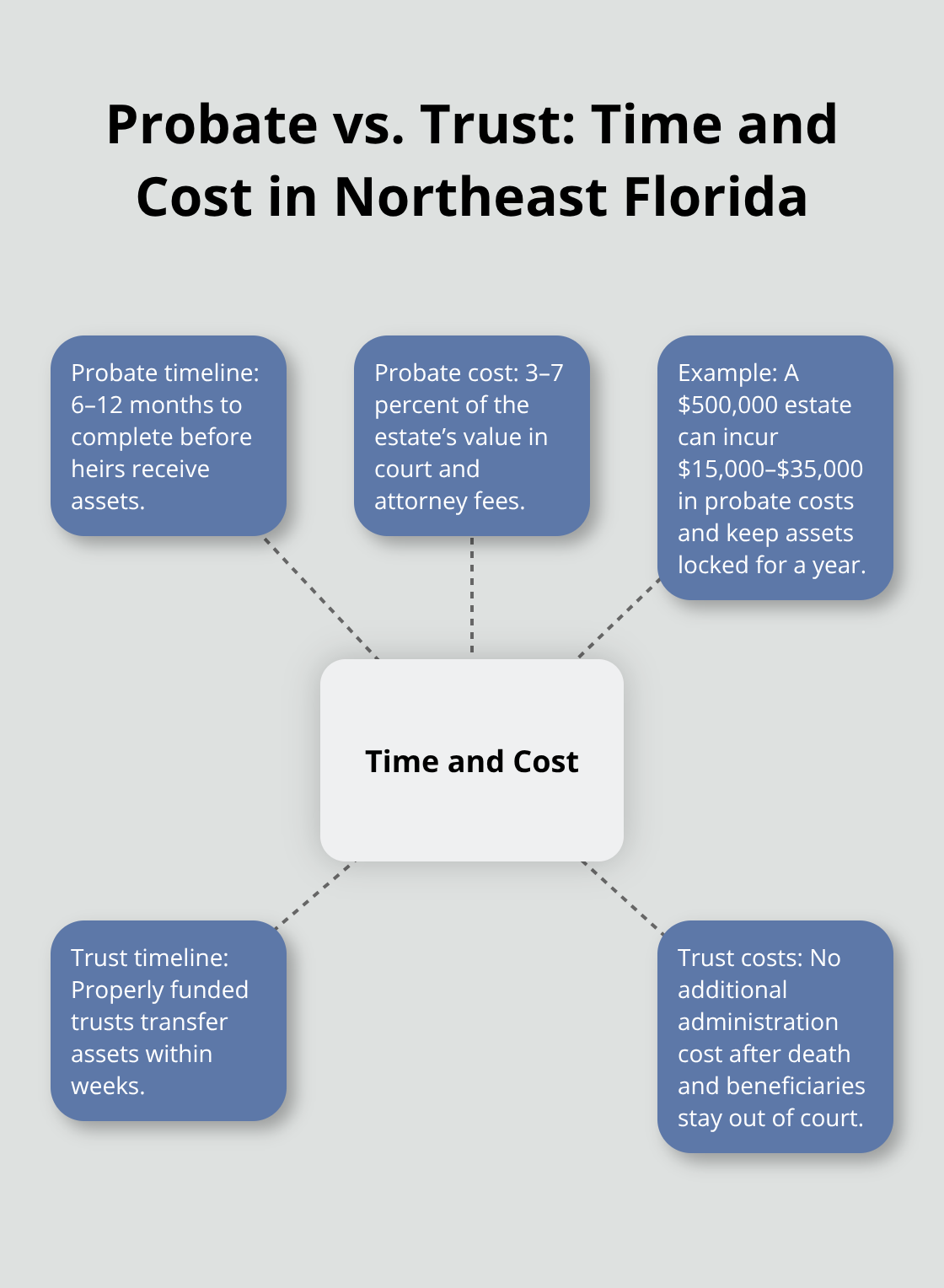
Northeast Florida probate takes 6-12 months and costs 3-7 percent of your estate’s value in court fees and attorney expenses, whereas a properly funded trust costs nothing to administer after death and transfers assets within weeks. The math is straightforward: a 500,000 dollar estate in probate costs 15,000 to 35,000 dollars and locks up assets for a year, while a trust costs nothing extra once funded and keeps beneficiaries out of court entirely. Understanding these requirements and costs shapes your next decision about which mistakes to avoid in your planning.
Common Mistakes People Make With Estate Planning
Estate Plans That Drift Out of Date
Most people create a will or trust and then never touch it again. Life changes constantly-marriages, divorces, births, job changes, relocations-but estate documents sit in a drawer gathering dust. Florida Statute 732.507 allows you to update a will through a codicil (a formal amendment), but many people simply scribble changes on the existing document or create a new will without properly revoking the old one, which creates conflicting instructions that confuse probate courts. A woman in her fifties remarries and creates a trust naming her new spouse, but never updates the beneficiary designations on her 401(k) from her first marriage, meaning her ex-spouse still receives the retirement account despite her wishes. A father adds a newborn to his will but forgets to fund his trust with the family business, so the business still passes through probate on his death, triggering a forced sale to pay estate taxes.
Several specific triggers demand immediate updates to your documents. Marriage, divorce, birth of children or grandchildren, significant changes in asset value, and moves to a different state all require attention. Acquiring real estate in another state, changes in tax law (like the federal exemption drop from 13.61 million dollars to 7 million dollars in 2027), and changes in beneficiary circumstances (a child’s addiction or financial irresponsibility, a beneficiary’s disability affecting government benefits, a beneficiary’s divorce) also necessitate document reviews. Deaths of named fiduciaries create urgent needs for updates. Without regular reviews-ideally every three to five years or immediately after major life events-your documents become obsolete and fail to protect your family.
Selecting the Wrong Executor or Trustee
Selecting the wrong executor or trustee ranks equally high among costly mistakes. An executor in Florida must be a resident or a close relative and have no felony conviction, but many people name their oldest child, best friend, or spouse without considering whether that person has the financial skills, emotional maturity, or willingness to manage a complex estate. A trustee owes fiduciary duties under Florida law to manage assets prudently, maintain detailed records, file accountings with beneficiaries, and treat all beneficiaries with impartiality-duties that require competence and attention. Naming a grieving spouse as trustee immediately after your death, when they’re emotionally devastated and unfamiliar with investment management, often leads to poor decisions and family conflict.
Overlooking Digital Assets and Online Accounts
Digital assets-cryptocurrency, social media accounts, email, cloud storage, online banking-present another blind spot almost universally overlooked. Most people fail to create an inventory of digital assets with access instructions, leaving their family locked out of accounts, unable to access photos, documents, or funds. Your digital fiduciary (the person authorized to manage these accounts) needs explicit designation in your estate documents and a separate inventory listing usernames, passwords stored securely, and specific instructions for each account. Without this, your family may spend months or years battling companies like Google or Meta to gain access, and some accounts simply disappear after prolonged inactivity, taking valuable information or funds with them.
Final Thoughts
The decisions you make about Florida wills and trusts today directly shape your family’s financial security and peace of mind for decades. Without proper planning, your family faces probate delays, public exposure of your assets, and court battles over who controls your estate. The mistakes outlined in this guide-outdated documents, poor fiduciary choices, and forgotten digital assets-are entirely preventable with professional guidance tailored to your specific situation.
We at Family, Estate & Mediation Law understand that estate planning feels overwhelming when you’re juggling work, family, and daily responsibilities. Our team has helped Northeast Florida families protect their legacies through wills, trusts, probate administration, and comprehensive estate planning across St. Johns, Duval, Flagler, Clay, and Putnam counties from our offices in St. Augustine and Palatka. We offer in-person, phone, and virtual consultations to fit your schedule.
Gather a list of your assets-real estate, bank accounts, investments, retirement plans, life insurance, and digital accounts-and write down your family structure and any special circumstances like blended families or dependents with special needs. Contact us at 904-819-6959 or schedule a free consultation to review your situation and determine which approach makes sense for you. We’ll outline the exact steps to implement your plan and protect your family’s future today.