
A financial power of attorney in Florida gives someone you trust the legal authority to manage your finances if you become unable to do so yourself. Without this document in place, your family may face costly court proceedings to handle your accounts, investments, and property.
We at Family, Estate & Mediation Law help Florida residents protect their financial futures by creating clear, legally sound powers of attorney tailored to their specific needs.
What a Financial Power of Attorney Means in Florida
A financial power of attorney in Florida is a legal document that grants someone you select the authority to act on your behalf in financial and property matters. Under Florida Statutes Chapters 709 and 765, this document becomes effective the moment you sign it-you do not have to wait for incapacity. The person you appoint, called your agent or attorney-in-fact, can manage your bank accounts, handle investments, pay bills, and conduct real estate transactions within the scope you define.
Execution Requirements That Protect You
Florida law requires your signature, two witnesses, and notarization for the document to be valid, a requirement strengthened in 2011 to protect residents from financial exploitation. These safeguards matter: they create a clear record of your intent and make it harder for someone to forge or misuse your authority. When you sign, you establish a legally binding relationship between yourself, your agent, and any third parties (banks, brokers, title companies) who will rely on the document.
Why Durable Powers Dominate in Florida
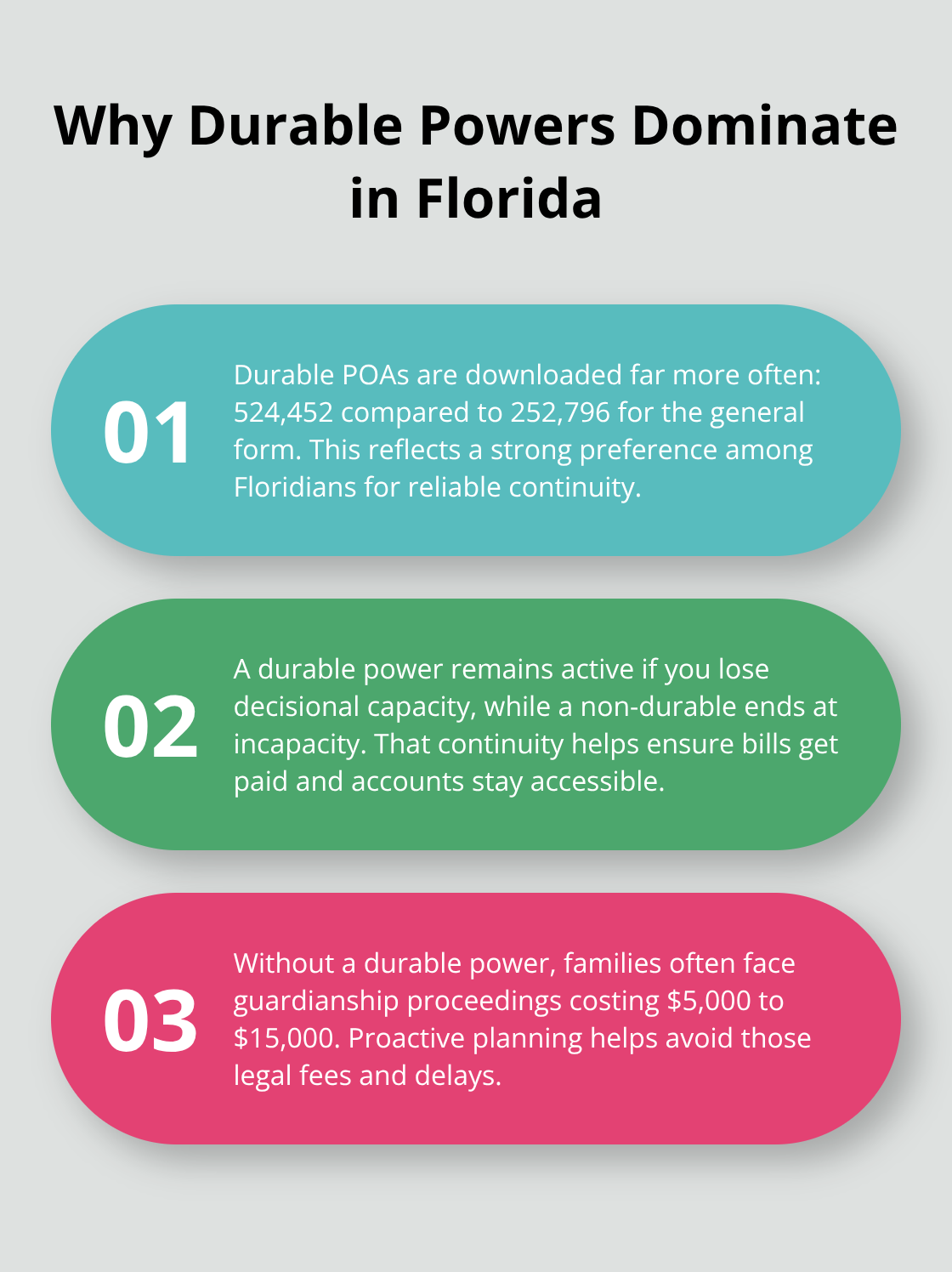
The durable financial power of attorney is the most downloaded Florida POA form with 524,452 downloads, far exceeding the general power of attorney at 252,796 downloads. This preference reflects a practical reality: a durable power remains active even if you lose decisional capacity, whereas a non-durable power terminates immediately upon incapacity. Without a durable power in place, your family faces expensive guardianship proceedings that can cost $5,000 to $15,000 in legal fees alone.
How a Financial Power of Attorney Differs From Wills and Trusts
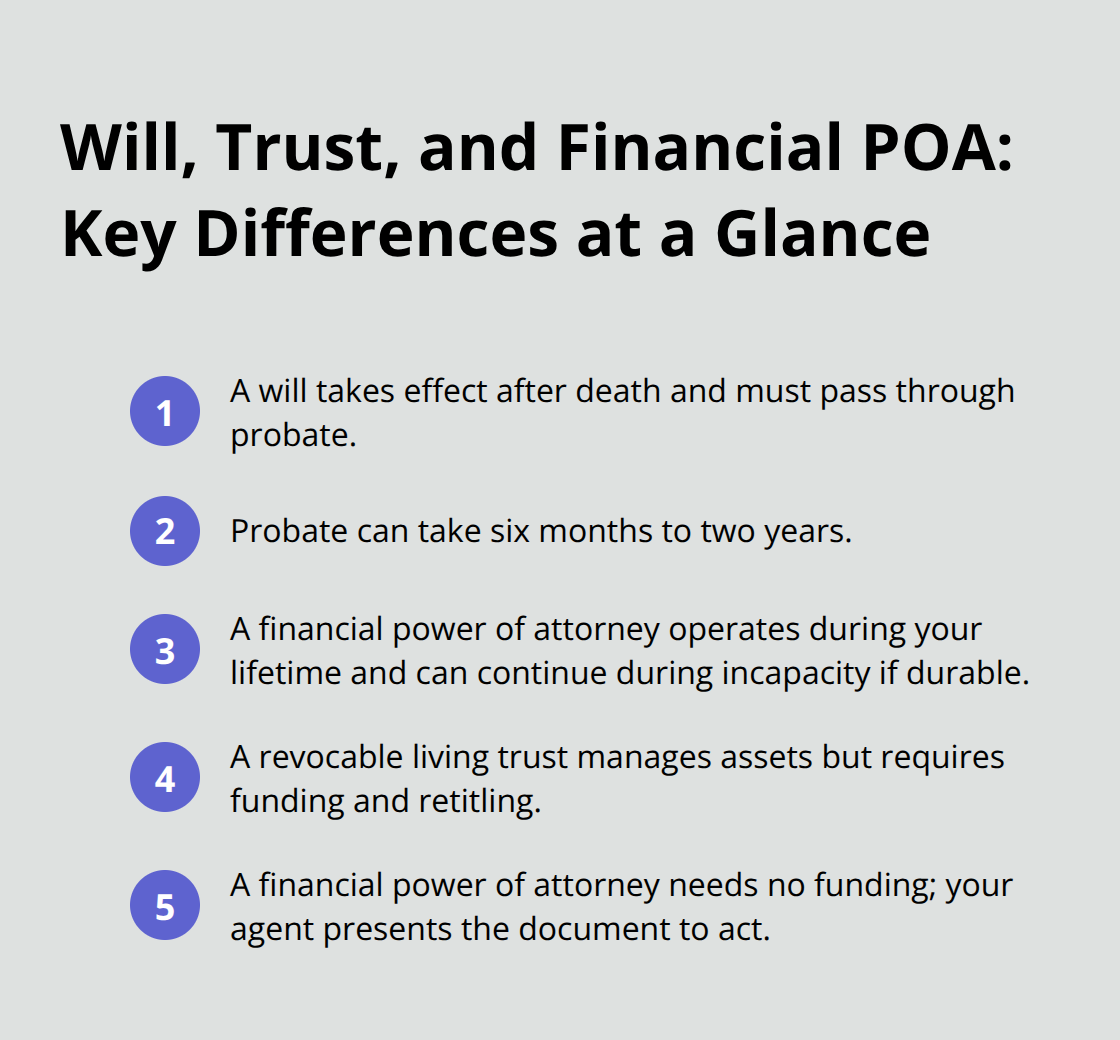
A will only takes effect after you die and must pass through probate, a court-supervised process that can take six months to two years and expose your estate to public scrutiny. A financial power of attorney operates during your lifetime while you are still living-and if it is durable, it continues operating if you become incapacitated. A revocable living trust handles property transfer and management but requires you to fund it with assets and retitle property in the trust’s name, an ongoing administrative task many people neglect.
Your financial power of attorney requires no funding, no property retitling, and no trust administration; your agent simply presents the document to banks and other institutions to access accounts and conduct transactions. Florida residents often combine all three documents: a will for property outside the trust, a revocable living trust for major assets, and a durable financial power of attorney to manage day-to-day finances and handle unexpected transactions during incapacity. Understanding these distinctions helps you recognize which tools address your specific planning goals-and which powers you actually need to grant your agent.
What Authority Does Your Agent Actually Receive
Your financial power of attorney grants your agent specific powers that depend entirely on what you authorize in the document. Florida law distinguishes between general authority, which covers broad financial acts, and enumerated powers, which must be explicitly listed and initialed by you to take effect. This distinction matters because a bank or title company may refuse to honor a power that appears too vague or lacks your initials next to the specific authorization.
Banking and Investment Powers Under Florida Law
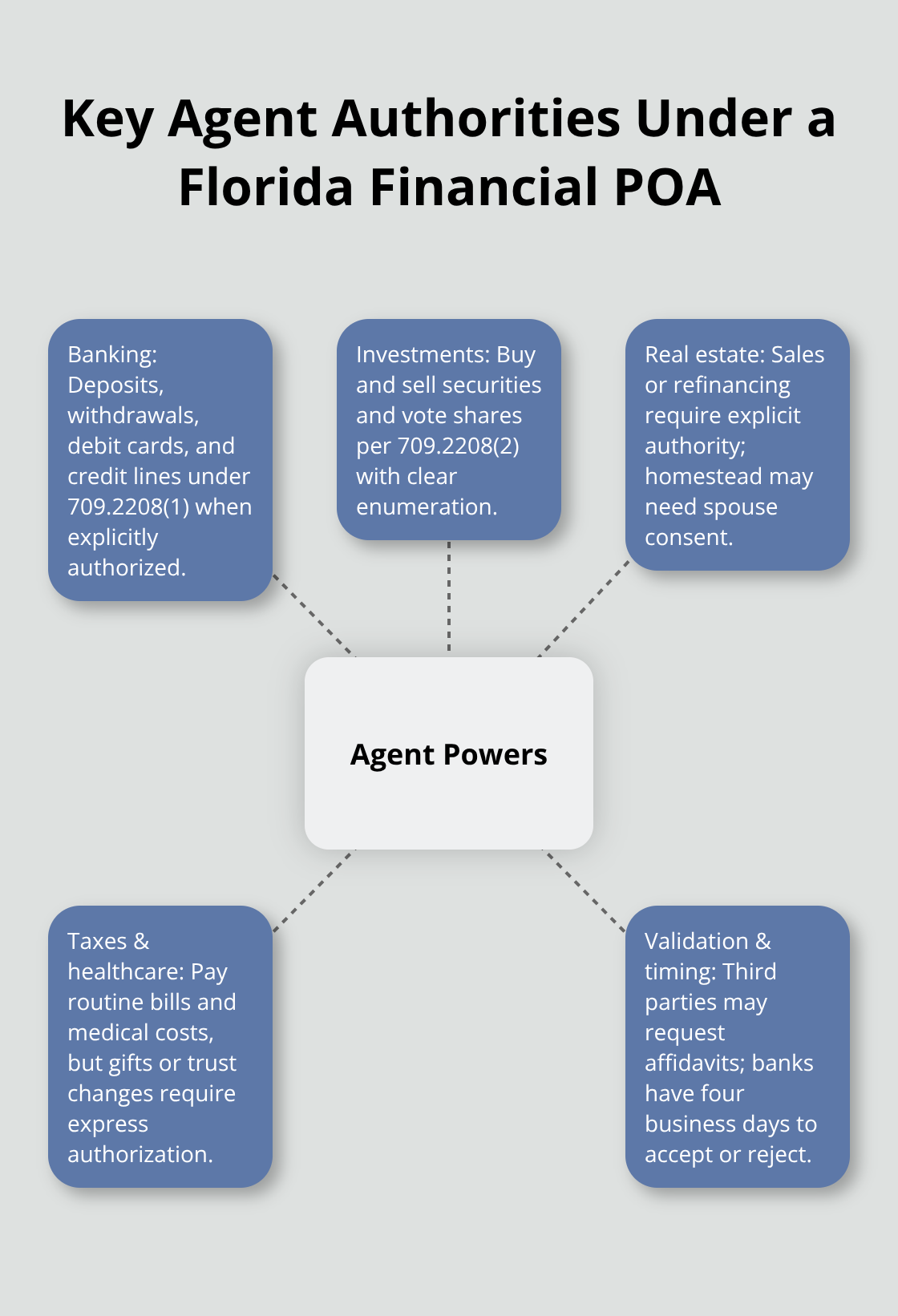
Under Florida Statutes 709.2208, banking and investment authorities carry particular weight. Section 709.2208(1) covers banking transactions including deposits, withdrawals, debit cards, and lines of credit, while 709.2208(2) covers investment actions such as buying or selling securities and voting shares. If your document does not specifically reference these statutory sections or does not explicitly enumerate these powers with your signature or initials nearby, a financial institution can legally reject your agent’s requests. Many Florida residents discover this problem too late, when their agent cannot access funds during a crisis because the power of attorney lacks proper language or documentation.
Real Estate and Property Transactions
Real estate transactions require particular attention because selling your home or refinancing a mortgage involves significant financial consequences. Your agent can sell your property only if you grant this authority explicitly, and if you are married, your spouse’s consent may be required for homestead property under Florida law. The scope you define in the document controls what your agent can and cannot do with your real property.
Tax and Healthcare Expense Authority
Tax payments and healthcare expense decisions operate differently than banking or investment authority. Your agent can pay routine bills and medical expenses within the scope you define, but cannot make large gifts or trust modifications without explicit authorization. The tax power of attorney, Form DR-835, operates under separate rules and does not require witnesses or notarization, making it simpler for agents to file Florida state taxes on your behalf.
Validation and Third-Party Requirements
Third parties frequently request affidavits or legal opinions to validate older or out-of-state documents, and banks have four business days to accept or reject a properly presented power of attorney for banking or investment actions. Vague language creates delays and expense; clear enumeration prevents disputes. A Florida attorney can review your current power of attorney document line by line to confirm that the powers match your actual intentions, especially if your document predates 2011 or originated in another state.
Understanding what your agent can actually do sets the stage for recognizing what happens when that authority gets tested-and what mistakes most Florida residents make when they first create these documents.
Common Mistakes When Creating a Financial Power of Attorney
Florida residents make three critical errors when establishing financial powers of attorney, and each one creates real problems down the line. The first mistake is appointing the wrong person as your agent. Many people select a family member out of obligation rather than competence-an adult child who has never managed money, a sibling with a history of poor financial decisions, or a spouse who lacks investment knowledge. Your agent must understand banking, investments, and real estate transactions well enough to act independently without constant guidance. If your agent cannot navigate a bank’s requirements or misunderstands the scope of authority you have granted, your accounts remain frozen during a medical crisis. Florida law allows any competent adult 18 and older to serve as your agent, but competence in this context means financial literacy and trustworthiness.
Selecting an Agent With Real Financial Experience
Choose someone with demonstrated financial responsibility, someone who has managed their own investments or property successfully, and ideally someone who lives nearby or can respond quickly to urgent matters. A second agent or co-agent adds oversight and ensures continuity if your primary agent becomes unavailable. This dual-agent structure protects your interests and prevents a single person from making unilateral decisions about your finances during incapacity.
Updating Your Document After Life Changes
The second major mistake is failing to update your power of attorney document after significant life changes. Divorce, remarriage, relocation to Florida from another state, major asset acquisition, or changes in your agent’s circumstances all trigger the need for document review. An outdated power of attorney that names a deceased spouse, an estranged ex-partner, or an agent who has moved to another country creates delays and legal disputes at precisely the moment you need swift action. Florida residents who move from out-of-state often discover that their existing power of attorney lacks the two witnesses and notarization now required under Florida law, making it invalid or subject to challenge by banks.
Understanding What Authority You Actually Grant
The third mistake is misunderstanding the scope of authority you actually grant. Many people sign a general power of attorney believing it covers everything, only to learn that their agent cannot make gifts, modify trusts, or execute specific real estate transactions without explicit enumeration and your initials next to those powers. Banks and title companies regularly reject powers of attorney that lack clear language referencing Florida Statutes 709.2208 or that fail to specifically authorize the transaction at hand. The consequence is not merely inconvenience; it is financial paralysis when your agent cannot access funds to pay your medical bills or maintain your property during incapacity.
Final Thoughts
A financial power of attorney in Florida protects your family from costly guardianship proceedings and keeps your finances accessible during incapacity. The document itself is straightforward to create, but the details matter enormously-choosing the right agent, understanding what authority you grant, and updating your document as your life changes determine whether your power of attorney works when you need it most. We at Family, Estate & Mediation Law recognize that many Florida residents approach estate planning reactively, waiting until a health crisis forces the issue.
Contact Family, Estate & Mediation Law to schedule a consultation about your financial power of attorney in Florida. We serve clients in St. Augustine and Palatka and can review your current documents, identify gaps or outdated language, and create a power of attorney tailored to your specific circumstances. Whether you need a new document, an update to an existing power of attorney, or validation of an out-of-state document you brought to Florida, our attorneys provide practical guidance without unnecessary complexity.
Your financial security during incapacity depends on decisions you make today. We help you make them correctly.