
A power of attorney document is one of the most overlooked tools in business planning. Many owners focus on day-to-day operations while leaving their succession vulnerable to gaps and legal complications.
At Family, Estate & Mediation Law, we see business owners struggle with POA options for businesses because they don’t understand how different types protect their assets and family interests. This guide walks you through the main POA structures, critical decisions you’ll face, and mistakes that could derail your planning.
Which POA Type Fits Your Business
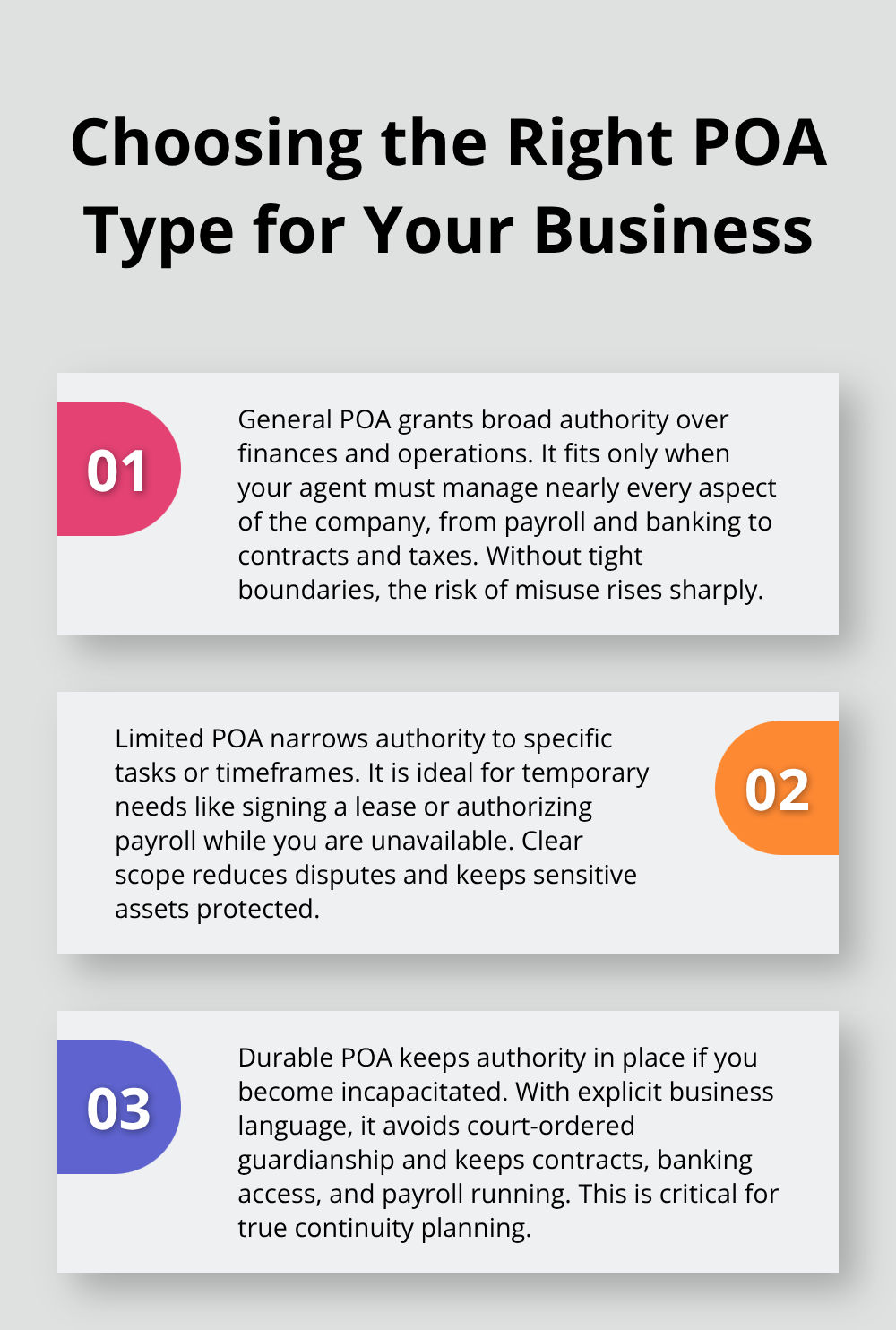
A general power of attorney hands your agent sweeping authority over financial and business decisions, but most business owners don’t need that level of access. We recommend a general POA only if your agent must handle nearly every aspect of your company-payroll, contracts, vendor relationships, bank accounts, and tax filings. The risk is real: giving someone this much power without clear boundaries invites mismanagement or abuse. If your agent acts carelessly with your business accounts or makes poor contract decisions, you bear the responsibility. Most business owners benefit more from tailored approaches that match their actual operational needs.
When Limited Authority Makes Sense
A limited POA restricts your agent to specific transactions or a defined time period, making it practical for situations where you need temporary help. You’re traveling abroad for three months and need someone to sign a commercial lease or authorize payroll while you’re unreachable-a limited POA handles exactly that without granting access to your investment accounts or intellectual property. The clarity matters: your agent knows precisely what they can and cannot do, and third parties (banks, vendors, government agencies) understand the boundaries. Texas law allows you to specify the exact powers granted, and the agent cannot exceed those limits without voiding their authority. This structure reduces disputes and keeps your company’s sensitive operations protected.
Long-Term Protection Through Durability
A durable POA remains valid if you become incapacitated, which is the real protection business owners need. Without durability language, your POA becomes worthless the moment you cannot act-precisely when your company needs leadership most. Oklahoma banks and vendors frequently refuse to honor personal durable powers of attorney for business transactions unless the document explicitly includes business authority. This gap forces families into costly court-ordered guardianship proceedings that paralyze operations for weeks or months. A durable POA with clear business language prevents that crisis. It keeps your accounts accessible, allows contract signing to continue, and maintains payroll without interruption.
Strengthening Enforceability With Third Parties
The Texas Estates Code Section 752.051 provides a statutory form that includes durability language, though customization for your specific business structure strengthens enforceability with third parties. You should pair your durable POA with a healthcare POA and living will to create a complete protection plan that addresses both business continuity and family decision-making when you cannot communicate your wishes. The next step involves selecting the right person to act as your agent-a decision that determines whether your plan actually works when crisis strikes.
Who Should Hold Power Over Your Business
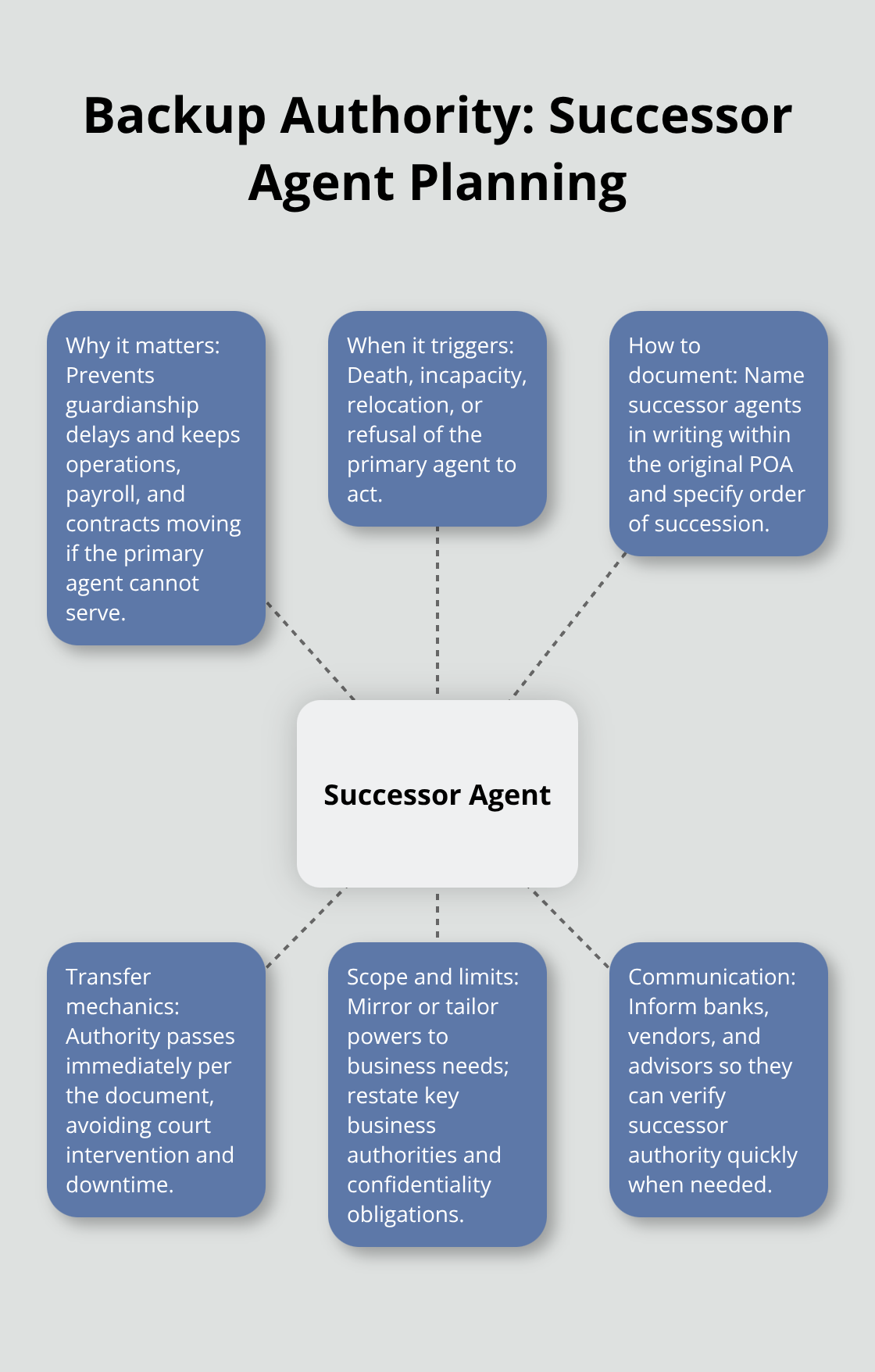
The agent you select determines whether your POA actually protects your company or becomes a liability. Business owners often appoint spouses, adult children, or trusted employees without considering whether those individuals possess the financial discipline, business experience, or fiduciary mindset to make decisions under pressure. Your agent needs more than good intentions-they need the ability to understand contracts, manage cash flow, communicate with vendors and lenders, and act decisively when you cannot. If your agent freezes during a crisis or lacks the knowledge to authorize payroll or renew critical licenses, your business suffers operational paralysis. Try selecting someone with a track record of sound financial decisions and ideally someone who understands your industry. Designate a successor agent in writing so that if your first choice becomes unavailable or unwilling to serve, authority transfers smoothly without requiring court intervention. Many business owners overlook this step and create a vacuum when their primary agent dies or becomes incapacitated themselves.
Controlling What Your Agent Can Actually Do
Vague language in your POA invites disputes and gives third parties a reason to reject your agent’s authority. Instead of granting broad access to all financial matters, specify exactly which business accounts your agent can access, which contracts they can sign, whether they can sell company assets, and whether they can make employment decisions. Texas Estates Code allows you to restrict your agent’s powers to particular transactions or business functions, and this specificity actually strengthens your agent’s credibility with banks and vendors. When your agent presents a POA that clearly states they can sign contracts under $50,000 or manage payroll but cannot sell real property, third parties recognize legitimate boundaries and honor the document faster. Without these limits, a bank may demand a legal opinion or refuse to act altogether, delaying critical operations.
Business-Specific Powers and Confidentiality
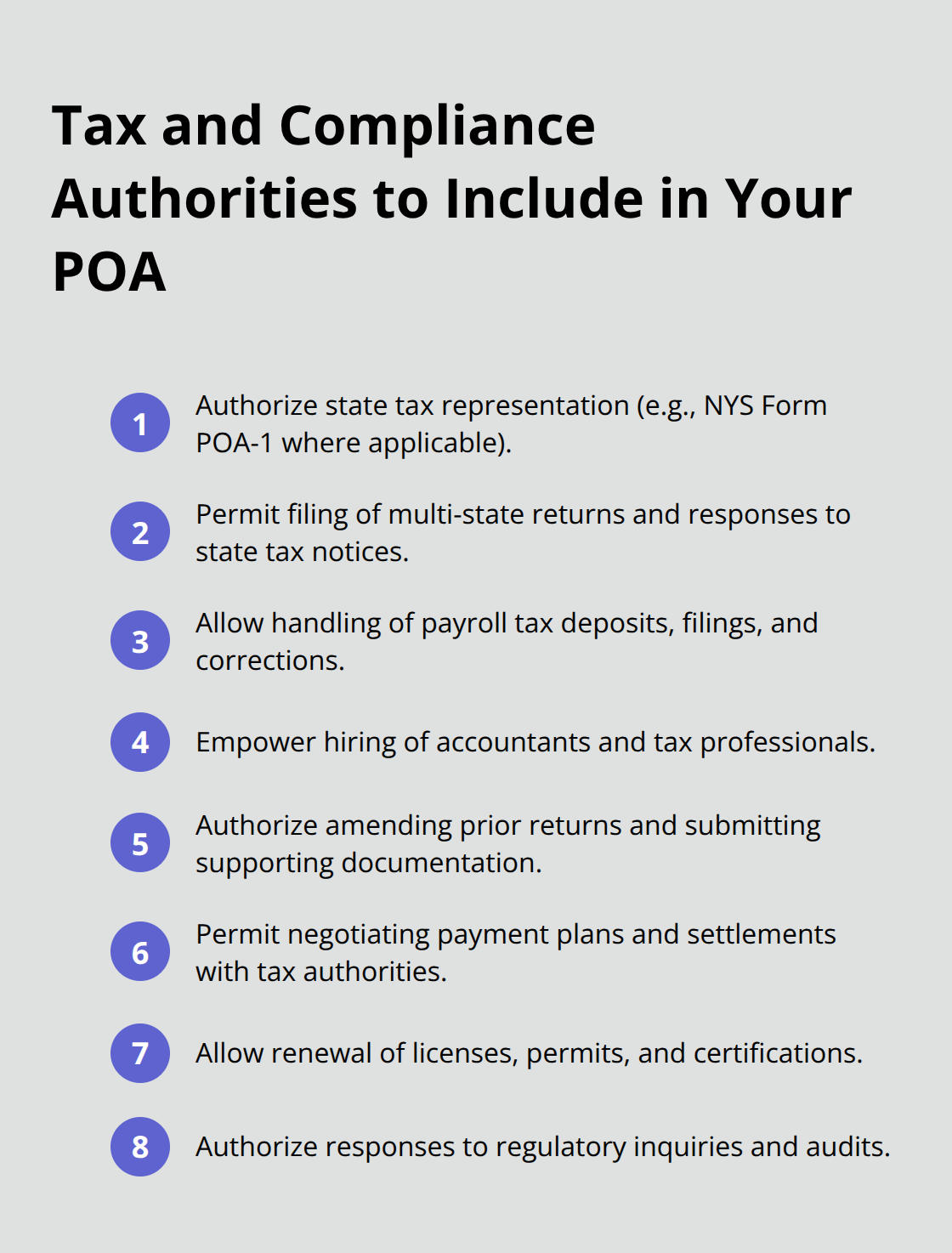
Include language about business-specific decisions like accessing business bank accounts, authorizing inventory purchases, negotiating vendor contracts, and handling tax filings. If your agent will manage intellectual property or trade secrets, address that explicitly so they understand their confidentiality obligations. State-specific requirements matter significantly-Oklahoma, Texas, and Florida each have different standards for what constitutes valid business authority in a power of attorney. Your agent becomes responsible for filing taxes and maintaining compliance on your behalf, so the POA should address these duties directly.
Tax Representation and Regulatory Compliance
The New York State Department of Taxation and Finance accepts Form POA-1 for tax representation, allowing your agent to handle audits, conciliation conferences, and settlements with the tax department. If your business operates across multiple states, your agent needs explicit authority to file state returns, handle payroll tax obligations, and respond to regulatory inquiries. Many business owners assume a general POA covers tax matters, but some jurisdictions treat tax representation separately. Your POA should state whether your agent can hire accountants or tax professionals, amend prior returns, and negotiate payment plans with tax authorities. Processing times matter operationally-the NYS Tax Department processes online POA filings within one business day, while mail submissions take seven to ten business days, so your agent should know which filing method to use. If your business holds licenses, permits, or certifications, clarify whether your agent can renew these or handle regulatory compliance without additional documentation. Without explicit authority, your agent may face rejection from government agencies even with a valid POA in hand.
The decisions you make about agent authority directly affect how smoothly your business operates during your absence or incapacity. What remains equally important is understanding the common pitfalls that derail POA planning altogether-mistakes that can undermine even the most carefully drafted documents.
POA Documents That Fail When Life Changes
Business owners draft a POA and assume it remains valid indefinitely, but life events force critical updates that many miss entirely. A divorce changes everything-if your spouse is your designated agent and you split, that POA may still grant them authority over your business accounts and contracts depending on your state’s laws. Texas Estates Code addresses this directly: a POA ends at divorce unless you explicitly state otherwise, but only if the document includes that language. Many owners never add it, creating a situation where an ex-spouse retains access to company finances months or years after the marriage ends.
When Your Agent Can No Longer Serve
If your designated agent dies, becomes incapacitated, or moves out of state, your POA becomes inert without a successor agent in writing. The absence of a backup agent forces your family into emergency court proceedings to establish guardianship, which freezes your business operations during the crisis you were trying to prevent. Designate successor agents explicitly in your original document so authority transfers smoothly if your first choice cannot serve. This single step prevents operational paralysis when your primary agent becomes unavailable.
Life Events That Demand POA Updates
Review your POA annually and immediately after major life events-remarriage, business expansion, acquisition of real estate, significant tax changes, or relocation to another state. Each transition potentially invalidates key provisions or exposes gaps in your authority structure. If you acquire real property through your business, your existing POA may not include sufficient language to authorize its sale or use as collateral, requiring a formal amendment rather than a simple update. Texas requires real estate transactions to include a legal property description and recording in county deed records, so a POA drafted before you owned property lacks this specificity.
State-Specific Requirements That Trip Up Business Owners
State-specific requirements compound the problem when business owners rely on generic online templates or forms from other jurisdictions. Oklahoma banks frequently reject personal durable powers of attorney that lack explicit business authority language, even if the document is technically valid under another state’s law. The New York State Department of Taxation and Finance accepts Form POA-1 for tax representation but rejects IRS Form 2848 and many other agency forms, meaning your agent cannot handle state tax matters without the correct document. Florida, Texas, and Oklahoma each define valid business authority differently, and a POA drafted for one state may fail enforcement in another if your business operates across state lines.
Processing Delays and Third-Party Rejection
Processing delays amplify the damage-the NYS Tax Department processes online POA filings within one business day, but mail submissions take seven to ten business days, so your agent needs to know which filing method applies to your situation. Without state-specific language addressing business transactions, vendor contracts, and regulatory compliance, third parties demand additional documentation or legal opinions before honoring your agent’s authority, which delays payroll, contract renewals, and license maintenance. The cost of amending a POA varies by location and complexity, but addressing these gaps upfront costs far less than emergency litigation or operational paralysis during incapacity. Ensure your POA includes durability language that survives incapacity while addressing the specific business powers your company requires.
Final Thoughts
A power of attorney is not a document you draft once and forget. We at Family, Estate & Mediation Law recognize that business owners who treat POA planning as a one-time task expose themselves to operational collapse when incapacity strikes. The POA options for businesses we’ve outlined-general, limited, and durable structures-each serve different protection goals, but only if you select the right type, designate a capable agent, and update the document when your circumstances change.
Your business continuity depends on having a clear succession plan in place before crisis arrives. Without explicit business authority language, your agent cannot access company accounts, sign contracts, or maintain payroll when you cannot act. Without a successor agent named in writing, your family faces emergency court proceedings that freeze operations for weeks, and without state-specific language addressing tax representation and regulatory compliance, third parties reject your agent’s authority and delay critical decisions.
We at Family, Estate & Mediation Law help business owners across Northeast Florida integrate POA planning into comprehensive estate and succession strategies that protect both company operations and family interests. Your next step is scheduling a consultation to review your current POA or draft one tailored to your business structure and state requirements.