
Family disputes don’t have to destroy your relationships. When conflict arises, family mediation in Northeast Florida offers a path forward that keeps communication open and families intact.
At Family, Estate & Mediation Law, we’ve helped countless families in St. Augustine and Palatka resolve disagreements without the damage that courtroom battles cause. This guide walks you through how mediation works and why it’s often the smarter choice.
Why Family Mediation Works Better Than Court
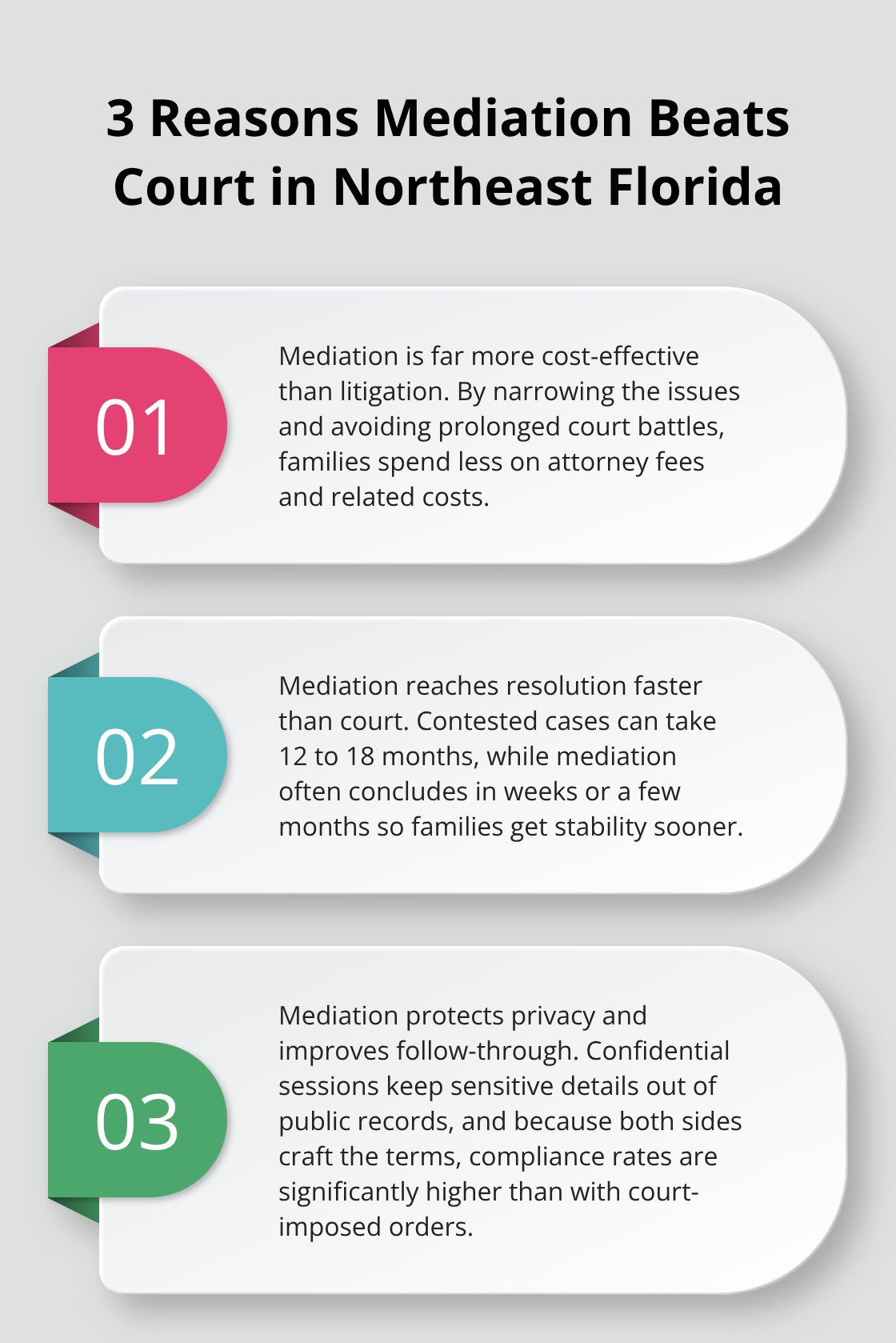
Court battles over family matters drain finances, stretch timelines, and poison relationships that must survive for years. Litigation in Northeast Florida family courts costs substantially more than mediation, with attorney fees alone often reaching $15,000 to $50,000 depending on case complexity. Mediation typically resolves disputes in weeks or a few months, whereas contested court cases average 12 to 18 months from filing to final judgment. Court forces a winner-and-loser outcome that leaves both sides resentful, particularly damaging when children are involved and parents must continue parenting together for years afterward. Mediation produces agreements both parties helped create, so compliance rates run significantly higher than court-ordered solutions. When parents craft their own parenting plan through mediation rather than having a judge impose one, they feel ownership over the arrangement and follow it more consistently.
Mediation Keeps Your Private Life Private
Divorce records filed in Northeast Florida courts become public documents anyone can access, including employers, extended family, and neighbors. Mediation remains confidential; no court filings expose your financial details, health issues, or parenting disagreements to public scrutiny. This privacy matters enormously for business owners, professionals, and anyone concerned about reputation. Court testimony and depositions create a permanent written record that can resurface years later. Mediation sessions stay between the parties and mediator, protected by confidentiality agreements that prevent disclosure even if disputes later intensify. The settlement agreement itself can remain private or file only minimally with courts, limiting who sees sensitive information about your assets, income, or family dynamics.
Speed Matters When Children Are Waiting
Every month a custody dispute drags through court adds stress to children caught between parents. Mediation resolves custody and parenting time questions in weeks rather than the year-plus timeline typical for contested court cases. Parents can implement new parenting schedules quickly, giving children certainty and stability faster. Court calendars in Northeast Florida fill months ahead, with continuances extending cases further. Mediation sessions schedule around your availability, not judicial calendars, compressing resolution timelines dramatically. Faster agreement also means lower cumulative attorney costs and reduced emotional toll on the entire family.
Higher Compliance Through Shared Ownership
Parties who negotiate their own solutions (rather than accept imposed court orders) follow agreements at significantly higher rates. When you help shape the terms, you invest in the outcome and commit to honoring it. Court-imposed orders often breed resentment that leads to violations, enforcement motions, and additional litigation costs. Mediation shifts control back to you and your family, replacing judicial mandates with mutually acceptable terms you both understand and support.
Understanding how mediation preserves relationships and accelerates resolution sets the stage for learning what the actual mediation process looks like in Northeast Florida.
How the Mediation Process Works in Northeast Florida
Initial Consultation and Assessment
Mediation starts with a detailed initial consultation where we assess your specific situation, identify the core issues dividing your family, and explain exactly how the process will unfold. During this first meeting, we listen to your priorities, concerns, and what outcomes matter most to you. We ask about children, property, income, debts, and any existing agreements or court orders affecting your case. This consultation clarifies whether mediation fits your circumstances or if litigation becomes necessary.
We’re direct about this: mediation works best when both parties genuinely want to resolve matters cooperatively. If one side is purely adversarial and refuses to negotiate, court may be your only path forward. Most families in Northeast Florida can benefit from mediation, but we won’t waste your time pursuing it if the dynamics make settlement unrealistic.
Structured Negotiation Sessions
Once we confirm mediation makes sense, we schedule structured negotiation sessions, typically lasting two to four hours each, spaced one to three weeks apart depending on complexity. These sessions follow a defined framework: each party presents their position, the mediator identifies common ground and legitimate interests, and both sides brainstorm options that address underlying needs rather than just stated demands.
A Florida Supreme Court Certified Family Mediator doesn’t take sides or impose solutions. Instead, we ask tough questions that help both parties see beyond initial positions toward practical compromises. In custody disputes, we focus relentlessly on what arrangement truly serves the child’s stability and both parents’ realistic involvement.
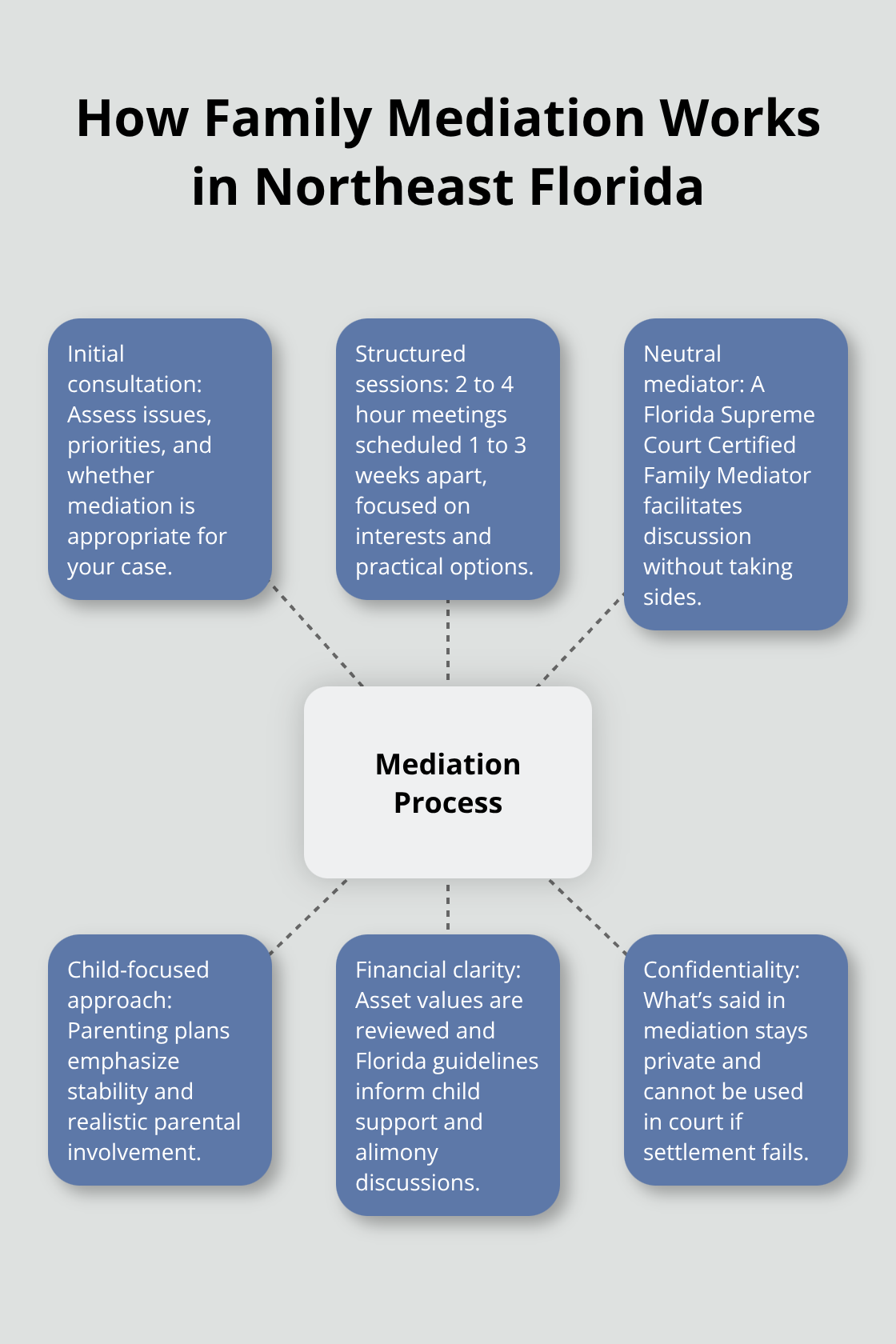
For property division, we gather financial documents, review asset values, and help parties understand equitable distribution under Florida law. Child support and alimony discussions anchor to Florida’s statutory guidelines, eliminating guesswork about what’s reasonable.
Sessions remain confidential; nothing said in mediation can be used against you in court if settlement fails.
Agreement Development and Documentation
Once parties reach agreement on all issues, we draft a comprehensive Mediated Settlement Agreement that covers parenting time, custody, support obligations, property division, and any other contested matters. This agreement gets reviewed by attorneys if you choose, then signed and filed with the court. Most families resolve disputes within four to eight weeks through mediation, compared to 12 to 18 months for contested litigation.
The agreement becomes enforceable and binding, giving both parties certainty about their rights and obligations moving forward. With your mediated settlement in place, attention shifts to what happens next and how we support your family’s long-term stability.
Common Family Disputes We Help Resolve
Divorce and Separation Agreements
Divorce and separation agreements sit at the heart of what mediation resolves in Northeast Florida. When a marriage ends, mediation addresses everything a court would handle: division of marital property, allocation of debts, spousal support (alimony), and the terms under which you’ll separate your financial lives. Florida law presumes equal distribution of marital assets, but mediation lets you customize that split based on your actual circumstances rather than accepting a judge’s standard formula.
One spouse might keep the family home while the other receives retirement accounts of equivalent value, or you might sell property and divide proceeds. Mediation creates flexibility courts cannot offer. The same applies to debts accumulated during marriage; you negotiate who pays what rather than having a judge assign obligations without understanding your income capacity or future plans. Separation agreements drafted through mediation include clear language about what happens to joint bank accounts, investments, business interests, and personal property, eliminating ambiguity that breeds future disputes.
For unmarried couples, mediation resolves similar financial entanglements without the formality of divorce, addressing shared property, shared debts, and any agreements about support or asset division you’ve made together.
Custody and Parenting Plans
Custody and parenting plans represent the most emotionally charged disputes mediation handles, and mediation’s strength shines brightest here. Florida law strongly presumes that equal time-sharing between both parents serves children’s best interests, but what equal time-sharing looks like varies dramatically across families. One family might use a 50-50 week-on-week-off schedule while another alternates every few days, and a third uses a 5-2-2-5 pattern that minimizes transitions.
Mediation lets you design a schedule matching your work hours, school calendars, and your child’s actual needs rather than forcing your family into a generic court template. You’ll address holiday time-sharing, vacation periods, transportation responsibilities, and how you’ll handle school decisions, medical choices, and religious upbringing. The parenting plan also specifies whether one parent has final decision-making authority on major issues or whether you share that responsibility. Mediation helps you honestly assess whether you can genuinely co-parent cooperatively.
Property Division and Financial Matters
Property division and financial matters extend beyond the marital home and retirement accounts into intricate territory that demands expertise. If you own a business, mediation helps determine whether one spouse buys out the other’s interest, whether you sell and split proceeds, or whether you continue co-owning post-divorce. We gather financial documents showing income, assets, and debts, then apply Florida’s child support guidelines to calculate fair monthly support based on combined parental income and time-sharing percentages.
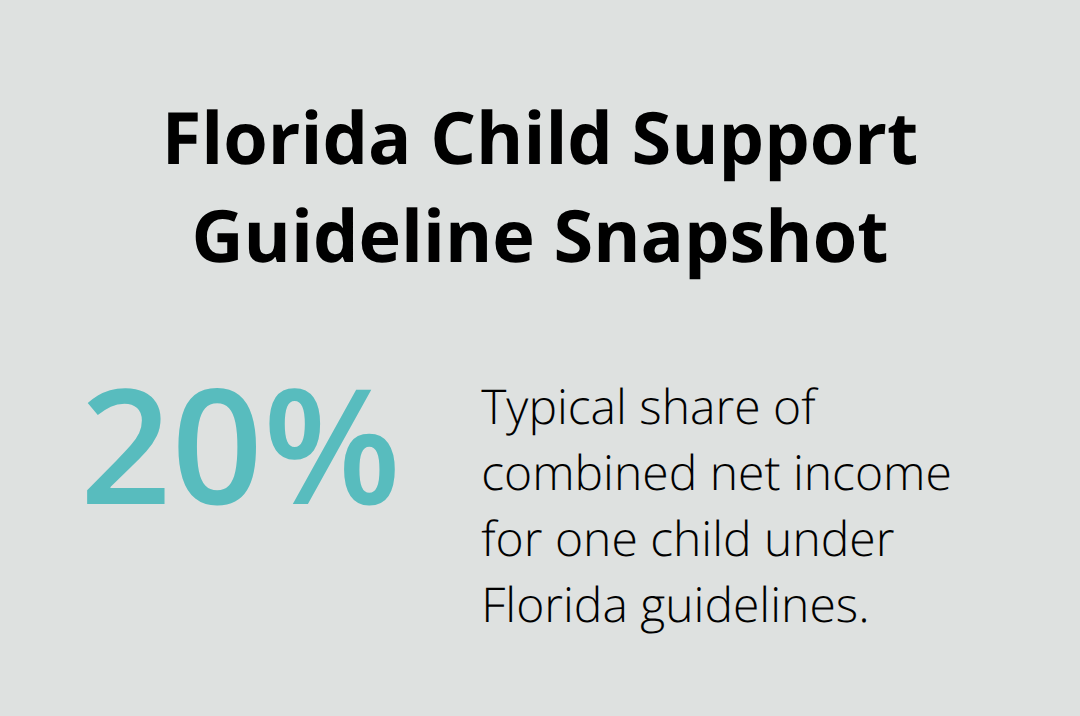
Child support in Florida typically runs 20 percent of combined net income for one child, increasing incrementally for additional children, but mediation allows deviation from these guidelines when circumstances genuinely warrant it. Alimony calculations consider marriage duration, standard of living during marriage, each party’s earning capacity, and whether one spouse sacrificed career development to support the family. Mediation keeps these financial discussions grounded in actual numbers and realistic future income rather than theoretical positions.
Final Thoughts
Your mediated settlement agreement marks a beginning, not an ending. Once both parties sign and the court approves your agreement, the real work of moving forward starts. At Family, Estate & Mediation Law, we support you as life shifts-a job relocation, a child’s changing needs, or a significant income change may require adjustments to your parenting plan or support obligations. Florida law allows modification of custody, time-sharing, and child support when circumstances change substantially, and family mediation in Northeast Florida offers a cooperative path to adjust terms without returning to court.
We also support enforcement when the other party fails to honor your agreement. If someone misses parenting time, skips support payments, or violates terms you negotiated, we help you address violations without escalating to full litigation (sometimes a simple conversation clarifies misunderstandings; other times, formal enforcement becomes necessary). For families in St. Augustine and Palatka, our offices provide ongoing access to guidance on parenting plan adjustments, support modifications, and enforcement questions. We maintain detailed records of your mediation and agreement, making future adjustments straightforward.
Family mediation works because it puts control back in your hands. You negotiated terms that reflect your actual priorities and your family’s real circumstances, and that ownership carries forward as you implement your agreement and adapt it over time. Contact Family, Estate & Mediation Law to discuss how we support your family’s long-term stability and success.