
A power of attorney in Florida gives someone legal authority to act on your behalf when you can’t or don’t want to handle matters yourself. This document is one of the most important estate planning tools available to Florida residents.
At Family, Estate & Mediation Law, we help clients understand which type of power of attorney fits their situation best. The right choice depends on your specific needs, timeline, and who you trust to represent you.
What Is a Power of Attorney in Florida
A power of attorney is a legal document governed by Florida Statutes Chapter 709 that grants one person the authority to act on another person’s behalf for financial and property matters. Under Florida law, the person granting authority is called the principal, and the person receiving it is the agent. The agent’s power extends only to what the document explicitly authorizes-no more, no less.
Execution Requirements and Immediate Effect
Florida requires that a power of attorney be signed by the principal in front of two witnesses and a notary public to be valid. This execution requirement exists specifically to prevent fraud and confirm the principal truly intended to grant the authority. If the principal cannot physically sign, a notary may sign the principal’s name on their behalf, provided two witnesses are present. The document becomes effective immediately upon signing unless the principal specifies otherwise, though some older forms used springing powers that only activated upon proof of incapacity.
Durable Powers of Attorney Protect Your Future
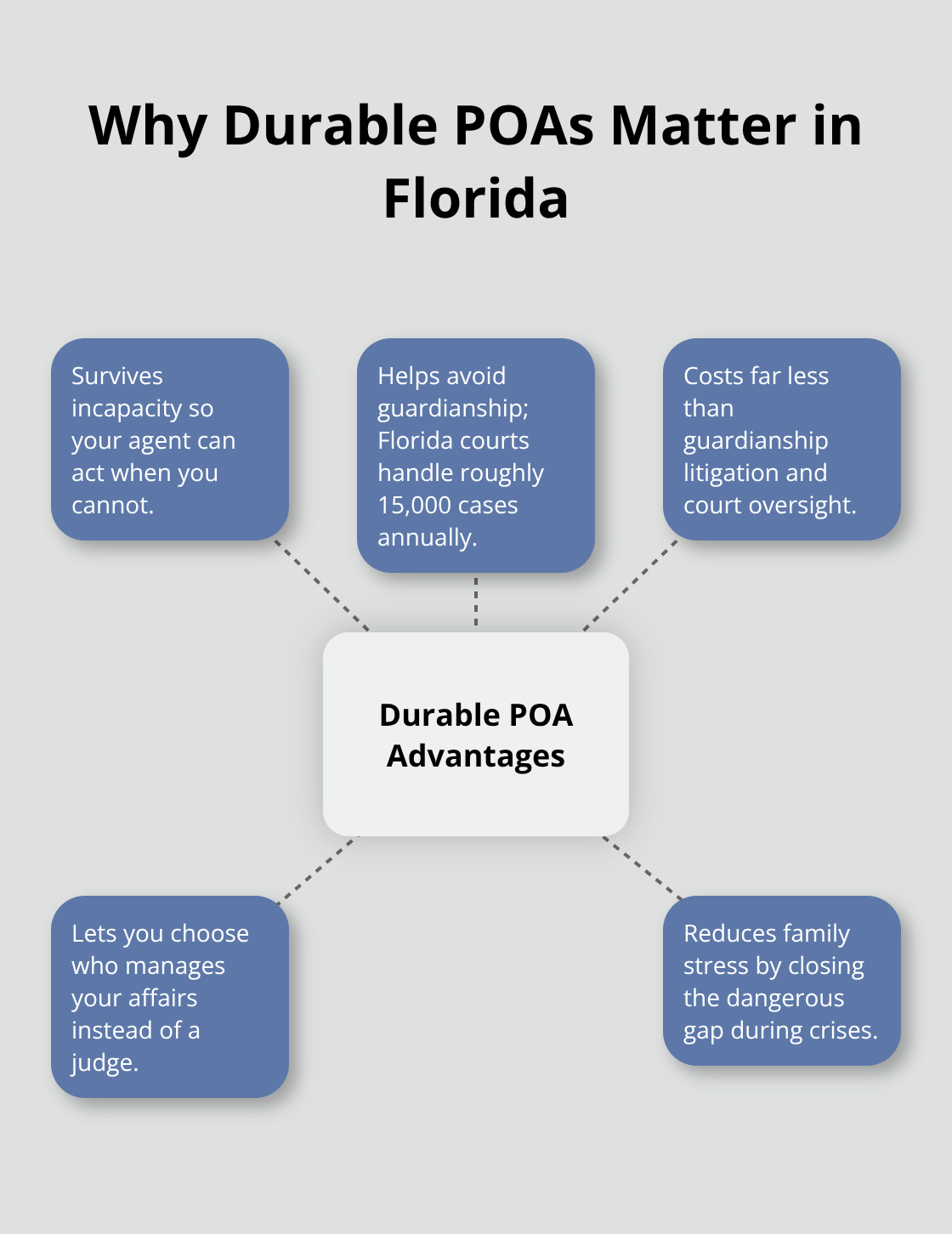
Modern durable powers of attorney in Florida remain effective even if the principal becomes incapacitated, but only if the document explicitly states this durability. Without that language, the power automatically terminates if the principal loses mental capacity. A durable power of attorney is the practical choice for most Florida residents because it survives incapacity. If you become unable to manage your affairs due to illness or cognitive decline, a non-durable power of attorney becomes worthless at that exact moment when you need it most.
This creates a dangerous gap that often forces families into expensive guardianship proceedings. Florida courts handle roughly 15,000 guardianship cases annually across the state, many of which could have been prevented with proper planning. A durable power of attorney costs far less than guardianship litigation and gives you control over who manages your affairs instead of letting a judge decide.
General Authority Versus Limited Scope
A general power of attorney grants broad authority across all financial matters, from bank accounts to real estate transactions. A limited power of attorney restricts the agent to specific tasks, such as selling one property or managing a single investment account. Limited powers work best when you need temporary help with a specific task, like someone handling a real estate closing while you’re out of state. General powers suit long-term planning and situations where you want one trusted person managing multiple aspects of your finances.
Hot Powers Require Explicit Authorization
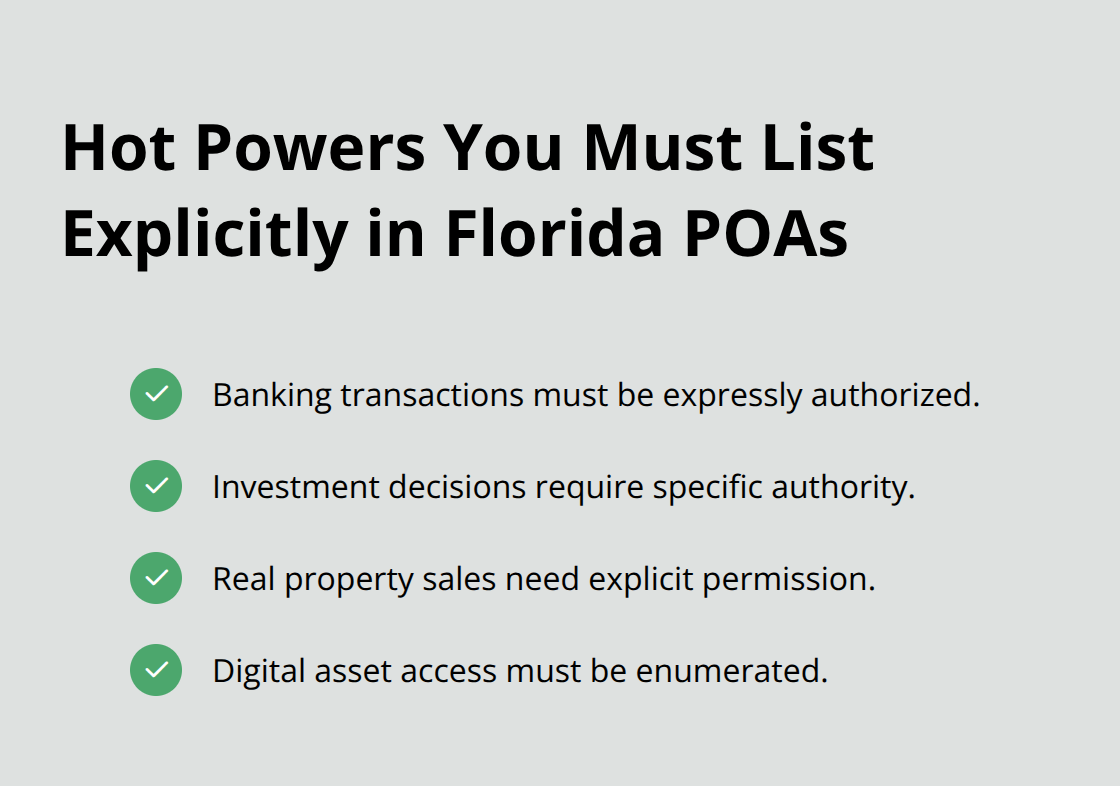
Florida law recognizes what attorneys call hot powers-specific authorities that must be explicitly stated in the document to be valid. These include banking transactions, investment decisions, real property sales, and digital asset access. Simply granting general authority does not automatically include these powers; the principal must sign or initial next to each enumerated authority to activate them. Understanding which powers matter most to your situation sets the stage for selecting the right agent to exercise them.
Which Power of Attorney Type Fits Your Situation
Durable powers of attorney work best for most Florida residents because they survive incapacity, but the choice between durable and non-durable depends entirely on your timeline and circumstances. A non-durable power of attorney terminates the moment you lose mental capacity, making it useful only for temporary situations where you know exactly when the authority ends. If you’re traveling out of state for three months and need someone to handle a specific transaction, a non-durable power suffices. The moment you anticipate any possibility of long-term incapacity-whether from aging, illness, or accident-a durable power becomes essential. Without durability language, your agent’s authority vanishes when you need it most, potentially forcing your family into guardianship court. Florida courts process approximately 15,000 new guardianship cases annually, and many involve families who delayed proper planning. A durable power avoids this entirely and costs a fraction of guardianship litigation.
Scope Matters More Than You Think
General powers of attorney grant broad authority over all your financial affairs, while limited powers restrict the agent to specific tasks. The distinction determines how much control you retain and how much flexibility your agent needs. A general power works when you want one trusted person managing your bank accounts, investments, real estate, and business interests simultaneously. A limited power suits situations where you need help with one specific matter-selling a vacation home, managing an investment account, or handling banking while you recover from surgery. Most people assume general powers are always better, but this creates unnecessary risk. If you grant general authority to someone who later makes poor decisions, you’ve handed them control over everything. Limited powers let you compartmentalize risk and maintain tighter oversight.
Springing Powers Create Dangerous Delays
Springing powers activate only when you become incapacitated, requiring a physician’s affidavit to prove incapacity before the agent can act. This sounds appealing because you maintain full control until incapacity occurs, but springing powers create dangerous delays when you need action fastest. A doctor must certify incapacity, paperwork must be prepared and notarized, and financial institutions may request additional documentation before accepting the springing power. This process typically takes weeks or months while your bills pile up, investments languish, and medical decisions wait.
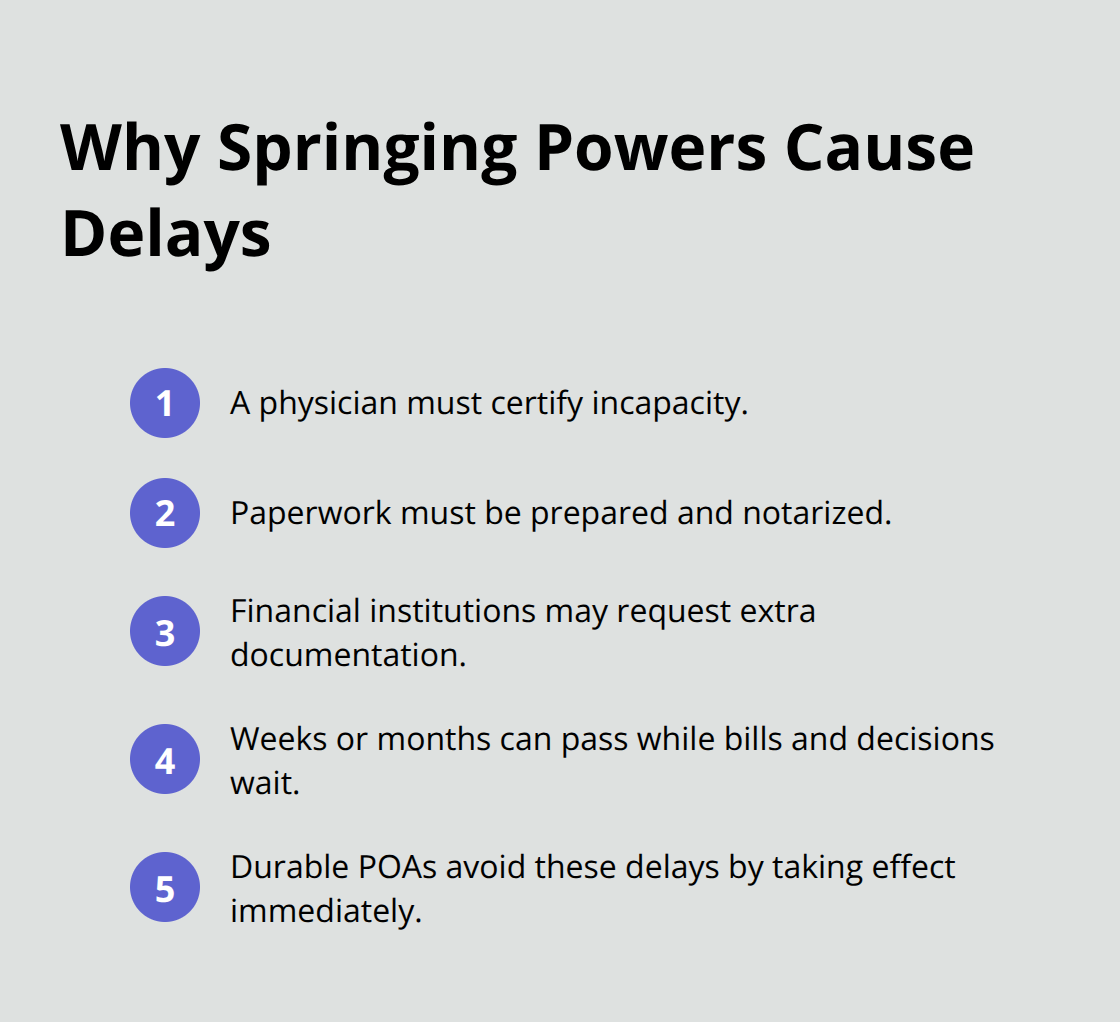
Modern durable powers avoid this entirely because they activate immediately upon signing. You can give the document to a trusted person with instructions to use it only if you become incapacitated, achieving the same protection without delays. Florida law permits this arrangement, giving you immediate effectiveness with practical timing controls. The incapacity certification requirement for springing powers made sense decades ago when estate planning was less sophisticated, but today’s durable powers with conditional use instructions accomplish the same goal without procedural delays.
Selecting the Right Agent Determines Everything
Your choice of agent matters far more than the type of power you select. An untrustworthy agent can transfer assets to themselves, ignore your wishes, or mismanage your finances regardless of how well you draft the document. A reliable agent must be responsible, organized, and financially capable of effectively managing your affairs. Poor record-keeping by an agent can obscure how money is managed and lead to family conflicts later. You can appoint multiple agents as co-agents or designate backup successors to step in if your primary agent becomes incapacitated or unwilling to serve. Whether multiple agents work for your situation depends on coordination, potential conflicts, and reliability. You retain the power to change or update your POA agents later if relationships or circumstances shift, preventing control by someone you wouldn’t want in charge.
Understanding which power of attorney type matches your needs sets the foundation for the next critical decision: identifying and selecting the right person to serve as your agent.
Choosing Your Agent and Structuring Authority That Works
Assess Trustworthiness Before Naming an Agent
Start with a brutal assessment of who you actually trust with money and decisions. Most people name a spouse or adult child out of habit rather than honest evaluation of that person’s financial responsibility, organizational skills, and willingness to keep meticulous records. An untrustworthy or disorganized agent can drain your accounts, ignore your specific wishes, or create family chaos through poor record-keeping that obscures how money moved.
Ask yourself whether this person has successfully managed their own finances, whether they document transactions carefully, and whether they’ve demonstrated the ability to prioritize your interests over their own. If you hesitate on any of these points, they’re not the right agent.
Structure Multiple Agents Strategically
Consider appointing co-agents only if both people communicate well and can coordinate decisions without conflict, since independent co-agents can each act alone unless your document requires joint approval. Successor agents matter equally-name a backup person who can step in if your primary agent becomes incapacitated, dies, or refuses to serve. This prevents authority gaps that force your family into guardianship court.
Multiple agents work best when you’ve thought through potential conflicts and communication patterns. If coordination seems unlikely, a single agent with a clear successor provides better protection than co-agents who disagree.
Grant Specific Powers, Not Blanket Authority
Think through the specific powers your agent actually needs rather than granting broad general authority. If you own real estate, explicitly authorize real property transactions. If you have investment accounts, specify investment authority. If digital assets matter to your finances, enumerate digital asset access. This compartmentalized approach limits damage if your agent makes poor decisions in one area while maintaining their necessary authority elsewhere.
Hot powers (banking, investments, real property, digital assets) require explicit enumeration under Florida law. Vague language leaves financial institutions confused about what your agent can actually do, creating delays when you need immediate action.
Work with an Attorney to Draft Properly
An attorney reviews your asset structure, identifies which hot powers genuinely matter to your situation, and drafts language that financial institutions will actually accept without requesting additional documentation or affidavits. Florida banks and brokers frequently reject or delay powers of attorney because they’re improperly drafted or lack required statutory language, creating weeks of frustration when you need immediate access.
An attorney also ensures your durable power coordinates properly with your will, trust, and healthcare directives so your entire estate plan works together rather than creating conflicts. The investment in professional guidance costs far less than guardianship litigation, power of attorney disputes between family members, or financial institutions refusing to honor a poorly drafted document when time matters most.
Final Thoughts
A power of attorney in Florida serves as your foundation for managing financial decisions when you can’t or don’t want to handle them yourself. The right choice depends on three factors: whether you need durability to survive incapacity, how broadly you want to grant authority, and most importantly, who you trust to exercise that authority responsibly. Durable powers protect you from guardianship proceedings that cost thousands in legal fees and court time, while limited powers compartmentalize risk when you only need temporary help with specific tasks.
Professional guidance transforms a power of attorney from a generic document into a strategic tool that coordinates with your will, trust, and healthcare directives. Florida banks and brokers frequently reject poorly drafted powers of attorney, creating delays when you need immediate action. An attorney ensures your document includes the specific statutory language that financial institutions require, explicitly enumerates the hot powers your situation demands, and structures multiple agents or successors to prevent authority gaps.
We at Family, Estate & Mediation Law help Northeast Florida residents create power of attorney documents that actually work when needed. Whether you need a durable power for long-term planning, a limited power for a specific transaction, or successor agents to prevent gaps, contact us at our St. Augustine or Palatka offices to schedule a consultation and take control of your financial future before incapacity makes planning impossible.